Crimes against women often become a subject of political outcry but rarely an election issue. Notwithstanding the ongoing slanging match over the Karnataka sex tape scandal and the Sandeshkhali issue in West Bengal, women are unlikely to vote against the party or the leader involved in shameful incidents. Successive elections attest the fact that law and order in general becomes an election issue for women but not isolated crimes against them, though incidents like those reported from Manipur, Hathras, the Nirbhaya gang rape, Unnao and the internationally-tracked women wrestler’s case do touch their sensibilities.
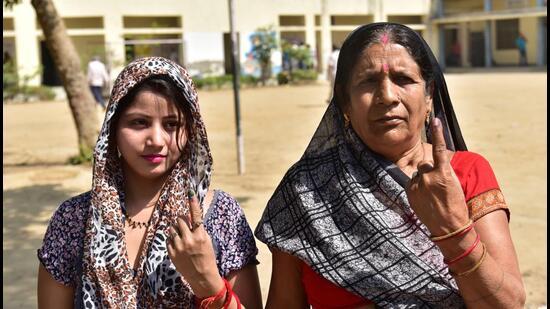
Had women not raised their voice against former Wrestling Federation of India (WFI) president and Bharatiya Janata Party (BJP) member of Parliament (MP) Brij Bhushan Singh, the party high command might have by now repeated his candidature from the Kaiserganj constituency in central Uttar Pradesh; given, especially, because he also wields influence in neighbouring constituencies of Gonda and Bahraich.
Singh, who won from Kaiserganj thrice in 2009, 2014 and 2019, is likely to contest as an independent. The BJP leadership has not yet taken a decision on their party’s nominee from here though barely two days are left for the last date of filing nominations.
Also Read | Who is Prajwal Revanna and what is the sex tape controversy involving him?
The BJP had given a slogan of ‘Bahut Hua Nari Par War, Abki Baar Modi Sarkar’ in 2014 but there has been no reprieve from such crimes. The Congress party’s outreach on women’s security ahead of the 2022 UP assembly elections, in which Priyanka Gandhi had herself led the campaign ‘Mein Ladki Hun Lad Sakti Hun’, did not go beyond creating a buzz. The party’s manifesto mentions ‘justice for different categories’ but the issue of crimes against women is not specifically mentioned.
{{/usCountry}}The BJP had given a slogan of ‘Bahut Hua Nari Par War, Abki Baar Modi Sarkar’ in 2014 but there has been no reprieve from such crimes. The Congress party’s outreach on women’s security ahead of the 2022 UP assembly elections, in which Priyanka Gandhi had herself led the campaign ‘Mein Ladki Hun Lad Sakti Hun’, did not go beyond creating a buzz. The party’s manifesto mentions ‘justice for different categories’ but the issue of crimes against women is not specifically mentioned.
{{/usCountry}}The chief minister of UP Yogi Adityanath has often mentioned the use of bulldozers to demolish the houses of criminals in his rallies. Referring to the Palghar incident in Maharashtra in which vigilante groups had lynched two Sadhus in 2020 and the infamous Sandeshkhali incident, the CM said at rallies in Maharashtra and West Bengal that ‘we would have hanged the culprits, upside down’. The fact remains, according to the data of the National Crime Records Bureau (NCRB) for 2022, the state with the highest number of cases of crime against women in the country followed by Maharashtra is UP. As many as 65,743 cases were reported in the state despite high conviction rate.
Both the Unnao and Hathras incidents had unnerved the women of the state, but they simply ignored the cases when it came to electing their representative in the 2019 Lok Sabha and 2022 Vidhan Sabha elections: Neither crimes became an election issue.
Why? Dr Urvashi Sahni, social entrepreneur and educator, says there are two reasons why women don’t vote for issues like crime against women - one, they are consumed by urgent issues of livelihood; and, second the acceptance of crimes like sexual assaults and domestic violence as they say, ‘ woh to hota hi auroton ke saath’, almost normalising it.
“But I think we must hold our governments responsible and vote en masse on these issues,” Sahni said.
Dr Rakesh Chandra, former director of the Institute of Women Studies in Lucknow University, who has also written gender report for United Nations Development Programme (UNDP), referred to a study conducted by the Institute some years ago, in which they studied quality of life issues in 10 districts, and said many of them took issues like health services , drinking water as more important.
Also Read | Election In Pincodes: As polls near, shadow of Sandeshkhali looms over delta
Ironically, India gave equal voting rights to women from its very first general elections followed by 33% quota in the legislative bodies recently, which, of course, is yet to be operatioanlised. The participation of women in electoral politics has also risen, compelling all political parties to include women’s issues in their manifestos. But, as mentioned earlier, crime against women does not figure emphatically in political agendas.
Some women, on condition of anonymity, wanted their counterparts in the political system to pressure leaderships to launch gender sensitisation programmes for party’s rank and file – from top to bottom, so that they don’t use their might and indulge in crimes against women. The mindset that while in power they can get away with murder must go, they said.
Others were of the view that women should work as pressure groups and ensure that issues like crimes against women along with specific plans to check them figured prominently in the manifestos of all political parties. As of now, they are offering doles in the form of free bus travel--- but what about safety in public transport? They are offering subsidised cooking gas cylinders but what about women being burnt by their husbands and family?
After all, political parties need our votes, we oblige them too, but we continue to lead a life in fear. This must end. We must use our power to vote to ensure Karnataka doesn’t happen again.
(The views expressed are personal)