
 E-Paper



Photos: Mosquito trials in Vietnam raise hopes of defeating dengue
Hundreds dead in the Philippines; a threefold increase of cases in Vietnam; hospitals overrun in Malaysia, Myanmar and Cambodia -- dengue is ravaging Southeast Asia this year due in part to rising temperatures and low immunity to new strains. But one group of scientists is rolling out trials to breed dengue-resistant bugs in a bid to tackle one of the world's leading mosquito-borne illnesses, raising hopes the untreatable disease can finally be beaten.
Updated on: Sep 11, 2019 1:20 PM IST

Share via


Copy link

1/9

 View Photos in a new improved layout
Updated on Sep 11, 2019 1:20 PM
A laboratory assistant examines a mosquito sample at the Pasteur Institute in the southern Vietnamese city of Nha Trang. The World Mosquito Program (WMP) has pioneered a method where male and female Aedes Aegypti mosquitoes are infected with the disease-resistant bacteria called Wolbachia before being released into the wild. (Nhac Nguyen / AFP)
2/9
 View Photos in a new improved layout
Updated on Sep 11, 2019 1:20 PM
Field officer Luu Quoc Hung from the World Mosquito Program collects mosquitoes. Dengue is passed to humans by infected mosquitoes, which thrive in crowded, hot and humid areas. Cases have surged across Southeast Asia this year, with around 670,000 infected and more than 1,800 people dead, according to an AFP tally of national and WHO data. Experts say it’s the worst outbreak in years. (Nhac Nguyen / AFP)
3/9
 View Photos in a new improved layout
Updated on Sep 11, 2019 1:20 PM
Lab official Nguyen Viet Hoang examines mosquito samples at the National Institute of Hygiene and Epidemiology in Hanoi. In a matter of weeks, baby mosquitoes are born carrying Wolbachia, which acts as a disease buffer for the bugs -- making it harder for them to pass on dengue, Zika, chikungunya and yellow fever. First trialled in northern Australia, the method has been trialled in nine countries including in Vietnam. (Nhac Nguyen / AFP)
4/9
 View Photos in a new improved layout
Updated on Sep 11, 2019 1:20 PM
A mosquito sample at the Pasteur Institute. “We have seen a remarkable reduction of dengue cases after the release,” explained Nguyen Binh Nguyen, project coordinator for WMP in Nha Trang. His team set free around half a million Wolbachia-infected mosquitoes last year in Vinh Luong, a crowded dengue-prone Vietnamese district.Since the trials, dengue cases are down 86% compared to nearby Nha Trang town. (Nhac Nguyen / AFP)
5/9
 View Photos in a new improved layout
Updated on Sep 11, 2019 1:20 PM
Today, mosquitoes still buzz about in the shops, cafes and homes of Vinh Luong, but the majority in the test areas now carry Wolbachia compared to none before. Convincing wary residents along with health officials and ethics boards, that the mosquitoes won’t make them sick was not an easy task. Residents have long subscribed to the official motto “no mosquitoes, no larvae, no dengue” to avoid the virus. (Nhac Nguyen / AFP)
6/9
 View Photos in a new improved layout
Updated on Sep 11, 2019 1:20 PM
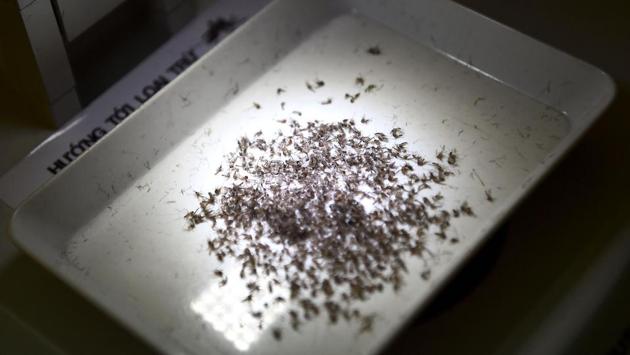
Warmer weather, coupled with the introduction of new dengue strains among populations lacking immunity are behind the outbreak. Long-term trends such as breakneck urbanisation in Asian megacities, massive increase in international travel and trade and the cyclical outbreaks are also at play. Even the widespread use of plastics has contributed -- things like garden pots and takeout containers making perfect breeding pools. (Nhac Nguyen / AFP)
7/9
 View Photos in a new improved layout
Updated on Sep 11, 2019 1:20 PM
Wolbachia was discovered by scientists in the 1920s in mosquitoes living in the drainage system beneath the Harvard University School of Public Health and was mostly ignored until the 1970s when researchers discovered it could be used to prevent the spread of disease by bugs. Over the years, anti-dengue experiments with Wolbachia-laden mosquitoes have had varied success, but now WMP hopes its approach will stick. (Nhac Nguyen / AFP)
8/9
 View Photos in a new improved layout
Updated on Sep 11, 2019 1:20 PM
WMP is one of the only organisations in the world seeking to repopulate colonies with Wolbachia-infected mosquitos to fight dengue, estimated to spread annually to as many as 100 million people globally. Other groups, including in Singapore and Malaysia, are using Wolbachia but only in male mosquitoes who render female eggs infertile. Many countries are also fogging with insecticides -- effective in the short term. (Nhac Nguyen / AFP)
9/9
 View Photos in a new improved layout
Updated on Sep 11, 2019 1:20 PM


