
 E-Paper



Photos: On Mount Paektu, among the believers in North Korea’s ‘holy land’
North Korea is avowedly atheist, with its own Juche ideology proclaiming that "Man is the master of all things", but quasi-religious terminology abounds at Mount Paektu, a dormant volcano straddling the border with China. It has long been considered the spiritual birthplace of the Korean nation and -- according to Pyongyang's orthodoxy -- Kim Jong Il, son of the North's founder Kim Il Sung, came into the world at a secret guerrilla camp on its slopes, where his father was directing the fight against Korea's Japanese colonial overlords. Now it is a place of pilgrimage for tens of thousands of North Koreans every year, who are trained from birth to revere their leaders.
Updated on: Sep 20, 2019 4:22 PM IST

Share via


Copy link

1/12

 View Photos in a new improved layout
Updated on Sep 20, 2019 4:22 PM
Guide Kim Un Sim (23) poses for a portrait before a replica of the cabin said to be used by Kim Il Sung at the ‘Secret Camp’, said to be the birthplace of late North Korean leader Kim Jong Il, near Samjiyon. North Korean leader Kim Jong Un’s father and predecessor is said to have been born in a simple wooden hut on the slopes of a sacred mountain, and guide Kim Un Sim has no doubts: “Welcome to our holy land.” (Ed Jones / AFP)
2/12
 View Photos in a new improved layout
Updated on Sep 20, 2019 4:22 PM
Kim Jong Il “was born amid arduous conditions” guide Kim said, “not in a luxurious house, but in an ordinary, humble log cabin”, with bitter winter temperatures plunging to minus 40 Celsius. His mother Kim Jong Suk -- another member of the North’s revolutionary pantheon -- could only be served soup made from dried mountain herbs and corn, she added. (Ed Jones / AFP)
3/12
 View Photos in a new improved layout
Updated on Sep 20, 2019 4:22 PM
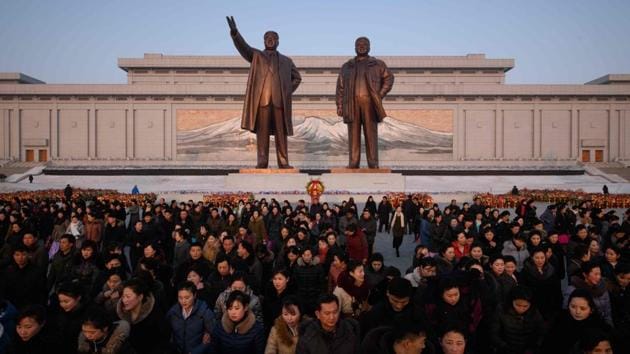
An image of Mount Paektu displayed behind the statues ofKim Il Sung and Kim Jong Il, as people pay their respects in Pyongyang. “The guerrilla fighters shed tears from pity that our general -- only a few months old -- had so little to eat and brought back food and goat milk.” The story has several echoes of the Christian Nativity, from a bright star shining in the sky, a birth in adversity, and well-wishers bringing gifts. (Ed Jones / AFP)
4/12
 View Photos in a new improved layout
Updated on Sep 20, 2019 4:22 PM
Visitors along a path at the 'Secret Camp'. Guide Kim said the camp, never located by the occupying Japanese in nine years, was Kim Il Sung’s headquarters from 1936, from where he travelled across Korea and to China “to finally accomplish the historic liberation of the country”. There was no mention of the US atomic bombings that triggered Japan’s WW II surrender, and the end of Tokyo’s 35-year rule over the peninsula. (Ed Jones / AFP)
5/12
 View Photos in a new improved layout
Updated on Sep 20, 2019 4:22 PM
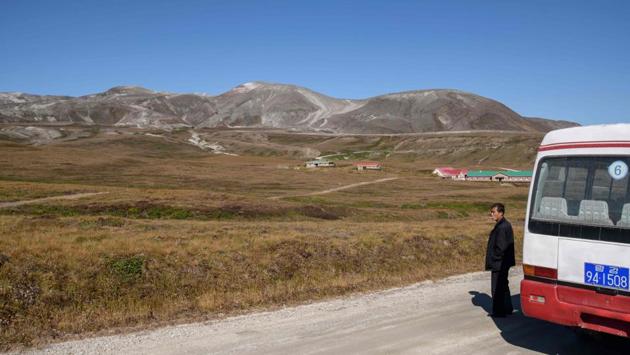
A man stands before the summit of Mount Paektu, near Samjiyon. The ruling Workers’ Party of Korea and the Kim dynasty bases its claim to legitimacy on what it says was Kim Il Sung’s pivotal role in the national struggle for independence. Korea’s foundational myth says its people are descended from King Tangun, born on Mount Paektu to a god who came to earth from heaven and a bear transformed into a woman. (Ed Jones / AFP)
6/12
 View Photos in a new improved layout
Updated on Sep 20, 2019 4:22 PM
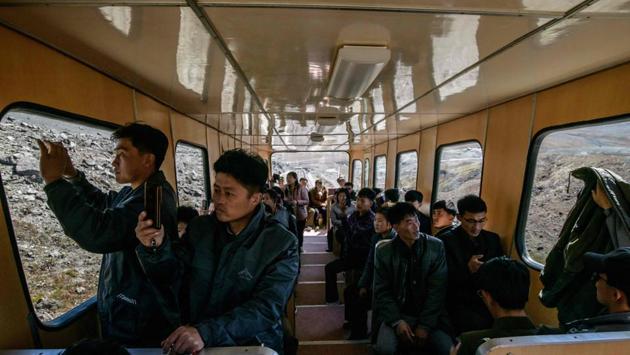
A funicular railway near the summit of Mount Paektu. Kim Jong Il’s birth here puts the ruling family in the same tradition, a concept reinforced by the North’s references to the “Paektu bloodline”. Outside historians, though, say that the founding Kim spent most of the war in exile. Soviet records state his son was born in the Russian Far East village of Vyatskoye on February 16, 1941 --exactly a year earlier than his official birthday. (Ed Jones / AFP)
7/12
 View Photos in a new improved layout
Updated on Sep 20, 2019 4:22 PM
After the war the Mount Paektu camp was lost to the forests, the guide explained, but Kim Il Sung recognised its location on a visit in 1986 and had its three huts rebuilt to ensure younger generations could be taught about “our country that he has defended and won back with his blood”. “It is the ardent wish of all the people to visit the secret camp,” she added. (Ed Jones / AFP)
8/12
 View Photos in a new improved layout
Updated on Sep 20, 2019 4:22 PM
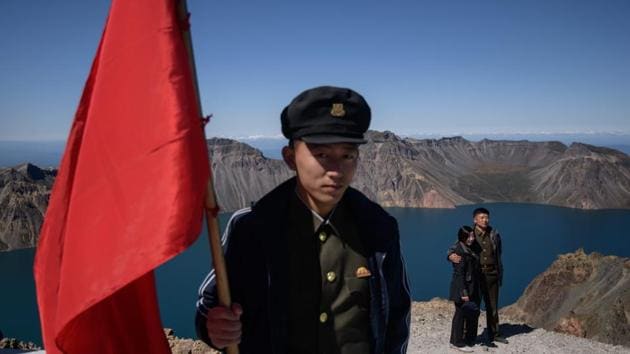
Every year 100,000 North Koreans or more are taken on study tours to the camp, the mountain, and nearby revolutionary sites. Dressing in khaki uniforms said to resemble guerrillas’ outfits and carrying red flags, they march to the summit of the volcano, where an inscription in Kim Jong Il’s handwriting proclaims: “Mount Paektu, holy mountain of the revolution” and a tablet declares Kim Jong Un “another unsurpassed hero received by Paektu”. (Ed Jones / AFP)
9/12
 View Photos in a new improved layout
Updated on Sep 20, 2019 4:22 PM
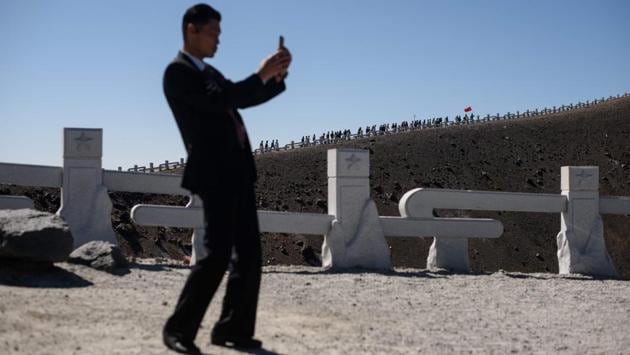
A security guard takes a photo as a group of North Korean students march to the summit of Mount Paektu. For ordinary workers it can be a two- or three-day trip, but for students the standard itinerary is four weeks, officials said, including a period of voluntary work on a construction site or other project. (Ed Jones / AFP)
10/12
 View Photos in a new improved layout
Updated on Sep 20, 2019 4:22 PM
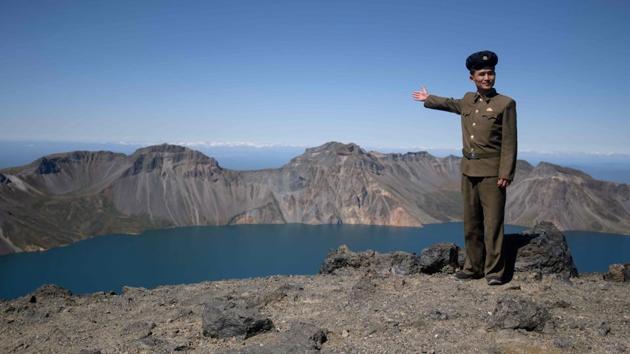
A North Korean student poses for a photo at the summit of Mount Paektu. The visiting troupes sing songs such as “We Will Go to Mount Paektu” and paddle joyously in Lake Chonji, its crater lake. “Everyone needs a spiritual pillar,” said Ri Yong Myong, 30, who is studying Korean literature at the elite Kim Il Sung University in Pyongyang after 10 years of military service. (Ed Jones / AFP)
11/12
 View Photos in a new improved layout
Updated on Sep 20, 2019 4:22 PM
North Korean students stand in Chonji lake, or 'Heaven lake', as they visit the crater of Mount Paektu. “Rather than wealth or honour, the Korean people hold Mount Paektu, which is the holy mountain and the mountain of our great leaders, as our spiritual pillar. My body is full of the spirit and force of Mount Paektu so I can provide loyal service to the leader by even grinding all my bones and flesh,” Ri said. (Ed Jones / AFP)
12/12
 View Photos in a new improved layout
Updated on Sep 20, 2019 4:22 PM


