The long canopied concourse leading up to the main building of the Savitribai Phule Pune University, has much more hidden within the contours of lush expanses than its academic laurels. A home to Pune’s rarest flora, this 411-acre university was the erstwhile monsoon residence of the British Governor of the Bombay (now Mumbai) Presidency. Remnants of the classic 19th century English landscape garden remain well preserved within it’s campus.
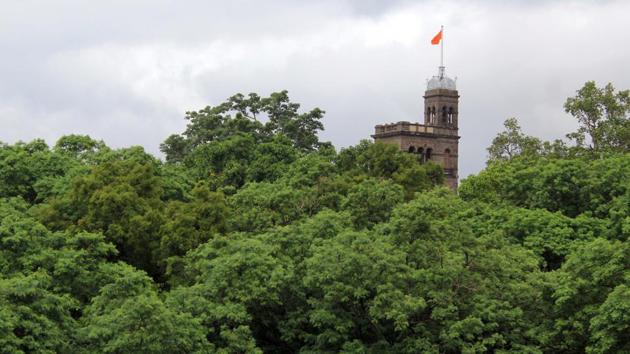
These ‘formal gardens’ have been laid near the main administrative building of the university and have gradually merged with the surrounding ‘landscape park’, all adhering to the principles of the English landscape garden. The heritage of the university garden landscape design has been documented by landscape architect Shankar Brahme, who was also the garden superintendent of the university park from 1954 to 1962.
The gardens of the university, once Governor’s residence and later established on February 10, 1949, as Poona University, had plant species selected in such a way to replicate the English countryside, so much so that the effects of seasonal cycles of the English countryside were to be reflected in the hues of the landscapes. The Patangi trees that now populate the different corners of the premises was one such species which was brought from Africa to serve this purpose. The varsity now houses over 400 of them.
Scientifically known as, Dalbergia melanoxylon, this species of trees are lush green during the monsoons, while from summer to winter, they shed leaves to depict the seasonal transition. Yet again, they bloom with white fragrant flowers to usher the spring season.
{{/usCountry}}Scientifically known as, Dalbergia melanoxylon, this species of trees are lush green during the monsoons, while from summer to winter, they shed leaves to depict the seasonal transition. Yet again, they bloom with white fragrant flowers to usher the spring season.
{{/usCountry}}Later, the British further introduced many species of exotic flora, eventually creating a botanical garden within it’s folds. With a sprawling greenery of 780 species of flora, the campus has an ancient Banyan tree - Ficus benghalensis (Wad) and Adansonia digitata (Baobab) tree, which is said to be some 120 years old.
Among the other rare flora species present in the campus are Bursera penicillata, Cycas zeylanica, Stercuculia guttata, Olea europaea (European Olive).