An annular solar eclipse, wherein the Sun appears like a ring of fire, had been the prime focus of Punekars on Sunday. While the annular eclipse was visible between 10:19 am and 2.02 pm within a narrow corridor in the northern part of the country (parts of Rajasthan, Haryana and Uttarakhand), the city witnessed a partial solar eclipse.
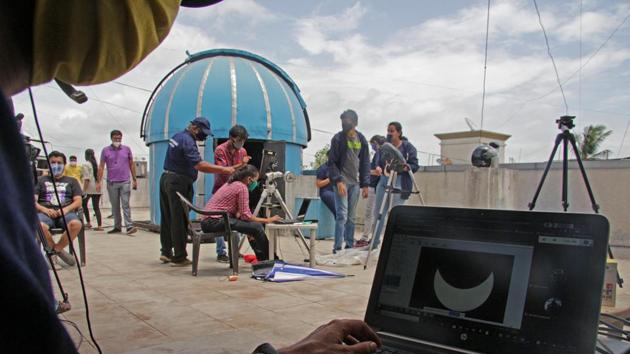
Several online programmes were organised by scientific institutes and astronomy groups in the city for students and public to observe the celestial event as residents went to their terraces to witness it. Residents used solar goggles, x-ray sheets or even mobile phones to watch the eclipse shadow image on the screen. However, cloudy skies played a spoilsport for some residents.
Professor Somak Raychaudhury, director of Inter-University of Astronomy and Astrophysics (Iucaa), said, “Eclipses are very rare events and occur when the sun, moon and the earth play shadows with each other. The sun is the source of the light and if one of the two come in between the shadow, the other is eclipsed. They rare events because not much in the sky changes on an hourly or daily basis and that is why such rare events are wonderful to look forward to and to experience. Anybody who has seen an eclipse of the sun can never forget it in their lives. This year, we had an annular solar eclipse which is also an uncommon event, it was not a total eclipse but we can see the ring of fire and that is because of the relative sizes of the moon and sun on the sky. Residents should dispel fears about eclipses and enjoy watching the event with precautions.”
Solar Eclipse 2020: Watch captivating images of the ‘ring of fire’ from across the country
{{/usCountry}}Solar Eclipse 2020: Watch captivating images of the ‘ring of fire’ from across the country
{{/usCountry}}Iucaa shared live observations and experiences of different eclipses in the form of short videos on their YouTube channel, whereas the Indian Institute of Science Education and Research, Pune’s (IISER) science activity centre organised a live seminar ‘Solar Eclipse – A play of Shadow’ with scientist professor Prasad Subramanian, faculty at IISER, Pune. The seminar was for schoolchildren and teachers across the city and more than 5,000 children, teachers attended it.
Ashok Rupner, programme manager at science activity centre, IISER, Pune, said, “We have conducted a live demonstration to explain the concept behind Sunday’s annular solar eclipse for schoolchildren and teachers from Classes 5 to 10. Various concepts were explained by the scientist to the students like size of the moon, earth and sun, how far are they from each other.”
“There are two kinds of shadows, if you are in the umbra zone, then, you can see the total or annular solar eclipse. However, if you are in the penumbral zone then you witness a partial eclipse and Pune comes in the penumbral zone, so we observed a partial solar eclipse, around 60 per cent of the eclipse. There was great response to the live demonstration of the eclipse and students asked several questions,” he added.
Vedashree Dangat, a student who observed the solar eclipse from Pune, said, “I was waiting for this day and was excited to see Sunday’s eclipse. Astronomy is my favourite subject and I have read a lot about the different types of eclipses and to witness it live is something for which we have to wait for years.”