They ask the most difficult of questions, and hold almost all the answers. They do the craziest of things, but deliver the profoundest of lessons. They get into the worst kinds of trouble, and show the simplest of ways out. Meet the most philosophical six-year-old boy ever, and his best friend, a tiger, who seems to know human nature better than any other soft toy ever could.
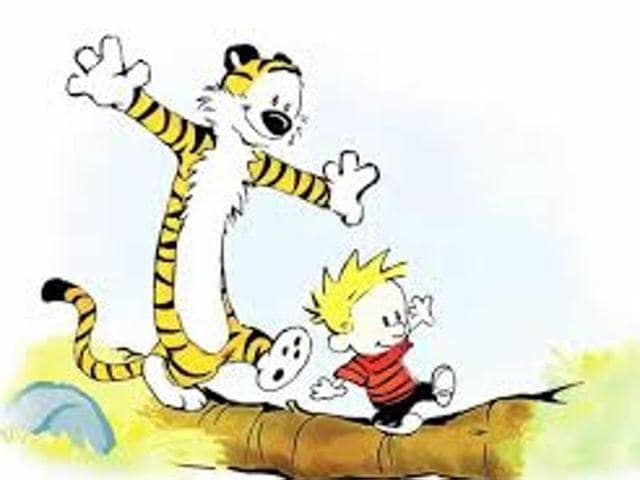
Calvin and Hobbes completed 30 years of existence on November 18. (It was also my mom’s birthday, but that obviously can’t be the subject of this article, especially since I forgot to wish her and she chose not to get sentimental over it. Anyway, sorry about that; let’s move back to Calvin and Hobbes.)
American cartoonist Bill Watterson’s legendary strip ran originals only for a decade, from November 18, 1985, to December 31, 1995. To this day, though, re-runs continue in newspapers across 50-odd countries, including the one in which you’re reading this. But it is on the internet that the strip has found a new life and wider reach.
Even as recently as last week, the hallmark of the strip was underlined when one of the most touching things doing the rounds online after the Paris suicide attack was Hobbes, the tiger, looking as serious as he does sometimes, saying, “You know, there are times when it’s a source of personal pride to not be human.” He was merely talking to Calvin, and that’s all it took for the message to be driven home, as always.
Set in an unnamed suburb in the US, the strip, in simple terms, depicts Calvin’s limitless imagination, including the very existence of his toy Hobbes as a living animal, and some sweet and sardonic observations on things ranging from artists battling deadlines to environmentalism to contemporary politics, to UFOs and aliens and war and peace.
{{/usCountry}}Set in an unnamed suburb in the US, the strip, in simple terms, depicts Calvin’s limitless imagination, including the very existence of his toy Hobbes as a living animal, and some sweet and sardonic observations on things ranging from artists battling deadlines to environmentalism to contemporary politics, to UFOs and aliens and war and peace.
{{/usCountry}}Sample this: “Sometimes I think the surest sign that intelligent life exists elsewhere in the universe is that none of it has tried to contact us,” Calvin tells Hobbes in one of the funniest indictments of the human race here on earth.
In more complex terms, though, it holds meanings as strong as the principles of Watterson, who has refused to allow any official merchandising, animation movie or other such commercial use of his little big boy’s world. It’s a different matter that Calvin and Hobbes posters and T-shirts — all unofficial — remain a rage online.
Calvin’s dreams and fantasies, too, are often windows to the hopeless hopefulness of the human condition. At other times, they also point towards the pitiable pointlessness of mankind’s resistance to the ways of the world, as it were.
Journalist Christopher Caldwell tries to define the phenomenon well in a recent Wall Street Journal article, further quoting the late political scientist James Q Wilson “[who] described ‘Calvin and Hobbes’ as ‘our only popular explication of the moral philosophy of Aristotle’. Wilson meant that the social order is founded on self-control and delayed gratification — and that Calvin is hopeless at these things. Calvin thinks that ‘life should be more like TV’ and that he is ‘destined for greatness’ whether he does his homework or not… Day-in, day-out, Calvin keeps running into evidence that the world isn’t built to his (and our) specifications. All humor is, in one way or another, about our resistance to that evidence.”
But Calvin and Hobbes is no Woody Allen movie. It certainly does not set out to prove that the human condition is a terrible state to be in, or that “life is a lot of sound and fury signifying nothing”.
Watterson seeks to play on the nuance but many of his strips have the boy and his best friend just sharing a tight hug, only because they’ve met after a long time; or be crossing a brook, balancing themselves on a tree-trunk ‘bridge’ as they walk on to find new adventures. It’s as much a celebration of life as it is a critique of the times.
But, certainly, the best of Calvin and Hobbes comes through in its directness, in its lack of filter between the mind and the mouth. “How come we play war and not peace?” Hobbes asks Calvin, brandishing a toy gun. From under his helmet, Calvin replies, “Too few role models.”