December 2016 had been the worst in terms of monthly sales for sewing machine manufacturer Ravi Arora in his 62 years stint in the industry. From Rs 15 lakh in December 2015, Arora’s medium-scale unit at Lakkar Bazaar in Ludhiana saw a substantial drop in sales to Rs 4 lakh in December 2016.
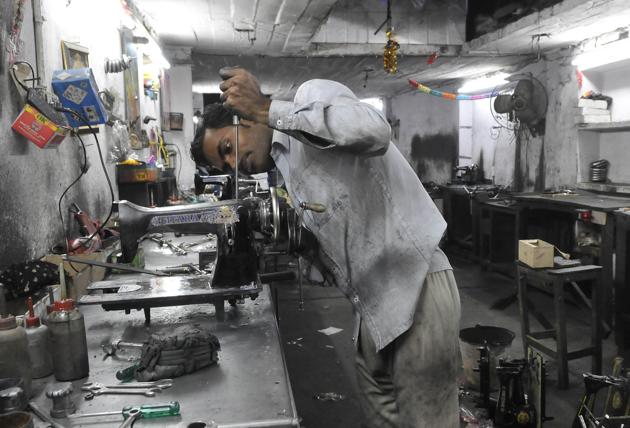
After laying off half a dozen workers temporarily, Arora is now managing with just three workers in his assembling section.
The sales figure for the sewing machine industry in Ludhiana has plummeted by 50% owing to minimal cash flow. It has forced the manufacturers to lay off around 20% of their workforce permanently (besides around 25% migrant workers heading to their native places temporarily) and curtailed the production volume up to 50%.
Exports have also nosedived up to 50% for the Ludhiana industry that supplies machines — both domestic and industrial — to Israel, Egypt, Qatar, Dubai, Kenya and other African and Middle East countries.
The sales of Daichi Internationals, a major exporter of sewing machines located at Focal Point, has dropped up to 30%. Deepak Sachdeva, one of the owners, says: “We had to make 40% cut in our production as there are no fresh orders and exports have been dwindling. We suffered around Rs 1-crore loss in one month. There are many workers who have not been paid for over two months now.”
Virender Rakheja, who owns a unit in Sundarnagar, could sell only 30,000 sewing machines in December 2016 as compared to 80,000 in the corresponding month in 2015.
{{/usCountry}}Virender Rakheja, who owns a unit in Sundarnagar, could sell only 30,000 sewing machines in December 2016 as compared to 80,000 in the corresponding month in 2015.
{{/usCountry}}Rakheja, who has been in this ancestral trade for the past 35 years, says: “Owing to fluctuating metal prices (raw material) and labour shortage, sales used to drop once in a blue moon, but nothing served us such a perilous blow as cash crunch following demonetisation.”
As only a small proportion of the total workforce possesses bank accounts, payment of salaries through cheques was not a viable option. So owners of almost all sewing machine units gave holidays (temporary layoff) to around 50% of their workers while rest received salaries in instalments.
Around three dozen sewing machine manufacturers (26 assemblers and 12 manufacturers) in Jalandhar have also been hit hard.
Inderpal Singh of Mahindra Sales in Jalandhar, says: “Sewing machine is a poor man’s luxury, often gifted to daughters on wedding. An average machine costs around Rs 1,500 to Rs 2,500. With minimal cash flow, the buyer is not turning up at the market, prioritising his other household expenses.”
As compared to the small industry in Jalandhar, Ludhiana has around 2,400 units (400 assembling and 2,000 manufacturing), which employ more than 20,000 workers and manufacture around 3 lakh machines a month.