If you live in a snake-prone area, do heed the counsel of the legendary herpetologist Rom Whitaker. He advises householders and snake-rescue experts not to remove all snakes but allow non-venomous Rat snakes to thrive because they tend to colonise the area and oppose entry of competitors such as venomous cobras. It may be a good idea also to let massive Indian bullfrogs breed around your house if you don’t mind their croaks, and if you enjoy a walk after dinner on dark paths. Here is an encounter from Jankipuram Extension, Lucknow, during which a bullfrog gobbled the highly-venomous Russell’s viper after an epic battle. It was captured for posterity in a series of stunning images clicked by PhD scholar, Durgesh K Singh.
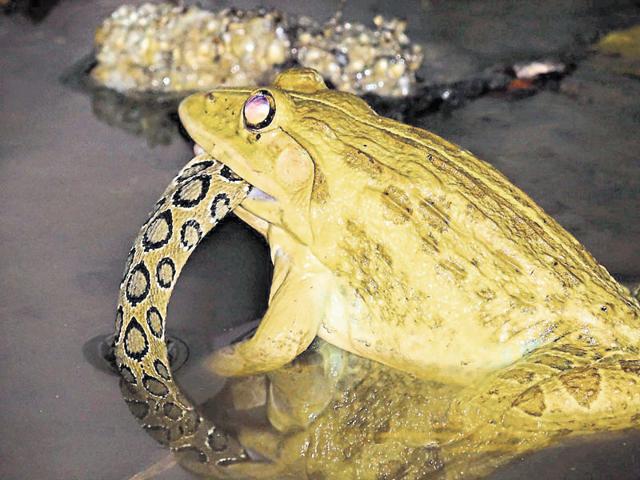
Here is Durgesh’s narrative: ‘’On September 3, at around 9pm, I was on a walk after dinner with my wife along a muddy path when I heard a noise in an otherwise silent location. I used my cell phone’s flash light and was surprised to see a bullfrog fighting a viper. The viper didn’t look an adult but was still nearly two feet. I saw them fighting for about 5-10 minutes and thought it would be a routine encounter, wherein a frog falls prey to an aggressive predator. But to my surprise, the bullfrog attacked with an intensity and swallowed the viper’s head. The turn of events prompted me to run to my house and get my digicam and document what I felt could be a once-in-a-lifetime moment. By the time I got back, the bullfrog was halfway through its meal. After the first 10-15 minutes of swallowing, the bullfrog’s stomach got full and it was having trouble taking the viper in. Then, suddenly, the bullfrog tried to take it in further and the viper started moving its tail. This lasted for another 10-15 minutes after which the bullfrog managed to engulf it completely.’’
I requested Rom to lend perspective to the above encounter so that readers could enjoy an understanding beyond the ‘’obvious attraction’’ of the pictures. Declaring it a ‘’very interesting pix and event’’, Rom told me: ‘’Bullfrogs, like the common Indian toad, grow to large size and are predators of anything they can catch and swallow, including all sorts of insects/arachnids, small snakes, geckos, other frogs/toads, rodents and even birds. I’d say that such predation as observed here is quite common, especially when you consider that new-born snakes like cobras and vipers are the size of big earth worms.’’
{{/usCountry}}I requested Rom to lend perspective to the above encounter so that readers could enjoy an understanding beyond the ‘’obvious attraction’’ of the pictures. Declaring it a ‘’very interesting pix and event’’, Rom told me: ‘’Bullfrogs, like the common Indian toad, grow to large size and are predators of anything they can catch and swallow, including all sorts of insects/arachnids, small snakes, geckos, other frogs/toads, rodents and even birds. I’d say that such predation as observed here is quite common, especially when you consider that new-born snakes like cobras and vipers are the size of big earth worms.’’
{{/usCountry}}Rom discounted theories of abnormality: that the bullfrog’s predation of a viper occurred because there was food scarcity or a bullfrog’s defensive combat or because the viper was moulting and was weakened/immobilised. ‘’No, I’d say this is a case of opportunistic predation, a perfectly normal predation event where the predator is larger and more powerful than the prey. What is interesting is why the viper couldn’t defend itself by giving the frog a good bite of its toxic venom, or if it did, why didn’t the frog react? Of course, the observer (Durgesh) didn’t see if the frog was okay after this meal, but it is probable the little viper didn’t manage a ‘good’ bite,’’ added Rom.
Kill to clean
Under pressure from the UT engineering department to clear weeds from Sukhna lake ‘’within 10 days’’, manual workers from Bijnore under local contractor Shamsheed have also deployed large fishing nets in addition to boats/rakes and removal by wading. The collateral damage is that scores of minnows (small fish) are being netted after they get caught in the weeds that the nets pull out. The minnows die on the banks of the lake amid rotting weeds. The dilemma is that nets are ‘’effective’’ for weed removal but end up damaging minnows, which are a key prey species for certain migratory and resident wetland birds such as darters, egrets, herons, etc.
‘’We are under pressure from the department to clear weeds within 10 days. I admit that minnows get caught in the nets. Our workers pull them out and release them into the lake but some may die. Nets are effective as they make a clean sweep of weeds and even remove weed debris that our workers cannot remove through other methods,’’ Shamsheed told this writer.
The importance of minnows for the lake’s ecological management can be gauged from the fact that the animal husbandry and fisheries department launched a drive in October 2015 to ‘’thin’’ the population of big commercial fish so that surface-feeding minnows could find space to prosper.