
 E-Paper



Does Gurgaon’s flooding have something to do with its missing drains?
The Gurgaon Manesar Master Plan 2031 includes 60 new sectors and almost does away with all the natural outlets including nallahs that are essential to channelise rain water

 Prefer HTon Google


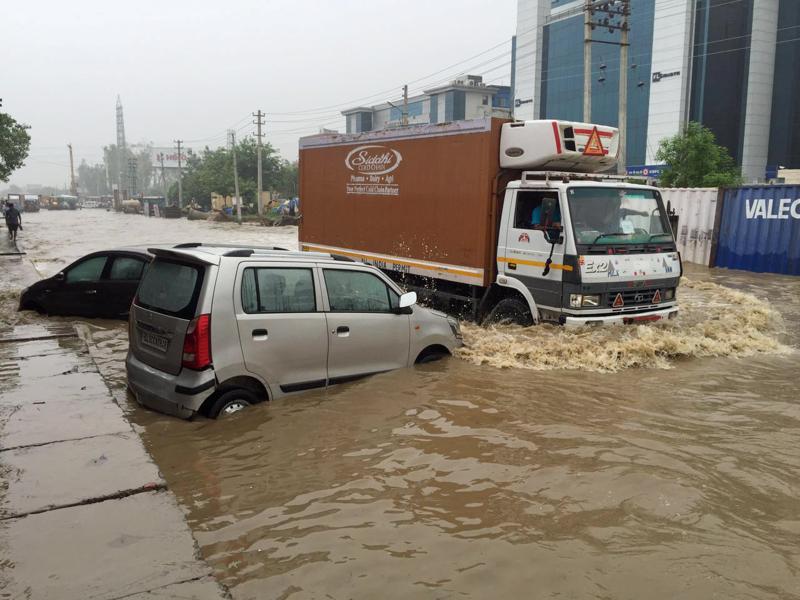
Why is Millennium City, which is home to over 200 Fortune 500 companies and over a million people, at a virtual standstill today because of waterlogging after incessant rains? The reasons could be bad master planning, encroachments on the main Badshahpur drain and concretisation of drains. All these factors have ensured that rain water, with no natural outlets such as ponds, lakes and ravines, has collected on the roads.
Major water channels (nallahs/drains) were demarcated in the early Gurgaon master plans (before 2001), with maps clearly indicating that water channels had to be preserved to conserve rainwater and provide for adequate drainage in the city, say environment experts.
However, subsequent changes in master plans in the real estate boom periods of 2007-12 are indicative of manipulations by vested interests. The major nallahs and ponds were thrown open for construction instead of being preserved.
Important embankments such as Ghata, Jarsa, Chakkarpur, Nathupur bundhs have survived only partially, as they were zoned as protected forests, but their upstream submergence areas have all disappeared, forcing water to take on Gurgaon roads.
The Gurgaon Manesar Master Plan 2031 contains many changes from its predecessors and includes 60 new sectors and almost does away with all the natural outlets including nallahs that are essential to channelise rain water.
The main nallah - called Badshah Kost has been abandoned between Sectors 58 to 62 under the new master plans. Instead, an artificial linear storm water drain has been constructed along the southern peripheral highway.
Ghata, the deepest bandh in the city that had a submergence area (to collect the rain water behind it) as large as 100 hectares to hold rain water, exists, but its submergence area has been zoned as sector 58 for residential construction. In the past, water from the bandh was released for irrigation after the monsoons, and tubewells replenished annually supplied sweet water for major parts of Gurgaon.
Over the last 15 years all these natural channels have been blocked. Over Rs 100 crore has been spent to construct a covered nallah along the southern peripheral highway along the green belt. “In the last three master plans natural nallahs were not protected and low lying areas of the Ghata jheel (the submergence area of the Ghata bandh) was zoned as sector 58. Many sectors along the Dwarka Expressway fall in the high flood level of the Najafgarh and may get submerged during extreme rainfall events in the future,” says Chetan Agarwal, environment analyst.
Bandhs and ponds too act as recharge zones and help sponge flood water. All these natural low lying areas should be left vacant and not filled up, authorities should ensure that their depth is maintained and garbage is not dumped into them, he adds.
In Sector 72 an artificial lake has been planned for some time now to store storm water. Now sector 58 has been created where Ghata lake existed. The “100-year Ghata jheel which was an existing seasonal water body or wetland has been zoned for real estate. Instead now an artificial lake is to be dug out in sector 72. That is a huge drain of public financial resources,” he adds.
Raj Vir Singh, retired chief town planner, government of Haryana, said that preserving the pond, water channels and low lying areas was essential to maintain the rainwater holding and discharge capacity of the city. He said that in the last two development plans of Gurgaon the water channels and ponds etc were not preserved but thrown open for construction. He added that he had even pointed out this in the year 2012 in his comments on the latest development plans of the Gurgaon- Manesar Urban Complex - 2031.


