Corporate occupiers are increasingly looking beyond the office building itself, viewing urban infrastructure through a broader lens of liveability when deciding on commercial space. For nearly 70% office space tenants, employees’ travel time to the workplace is an important consideration when choosing an office location. Nearly 18% are willing to pay a premium for better access to public transport, underscoring how connectivity is becoming central to workplace decisions, according to a CBRE report released on September 15.
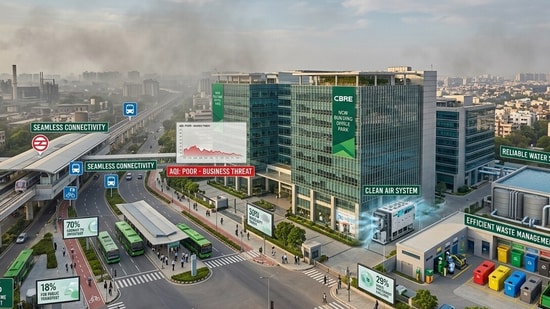
But the concerns extend well beyond the daily commute. Poor air quality and AQI levels were identified by 50% of occupiers as a major infrastructure threat to business operations and employee experience. Water availability and quality were flagged by 31%, while 29% of organisations said waste management and sanitation challenges could disrupt workplace productivity.
The findings are part of CBRE South Asia Pvt. Ltd’s report, Commute Counts, based on its Inside the Occupier Mind series.
The report found that 70% firms consider commute and connectivity the most crucial factors when selecting office space within a city, while about 18% are willing to pay a premium for an asset with access to public transport.
“As India’s cities grow denser and commutes grow longer, occupiers are effectively counting it in their leases,” said Anshuman Magazine, chairman and CEO – India, South-East Asia, Middle East & Africa, CBRE. “Infrastructure access now sits at the centre of where and how corporates choose to locate their businesses. For developers and city administrations alike, this is a clear signal that connectivity investment and commercial real estate value are now inseparable.”
“Commute has moved from being a convenience factor to a non-negotiable one. Occupiers are telling us clearly that access to transit, talent, and reliable last-mile connectivity now shapes real estate decisions as much as rent or location prestige,” said Ram Chandnani, Managing Director, Leasing Services, India, CBRE. “In several transactions we are advising on, transit proximity is being weighed at the shortlisting stage itself, well before commercial terms are discussed.”
Commercial space selection through the infrastructure lens
{{/usCountry}}“Commute has moved from being a convenience factor to a non-negotiable one. Occupiers are telling us clearly that access to transit, talent, and reliable last-mile connectivity now shapes real estate decisions as much as rent or location prestige,” said Ram Chandnani, Managing Director, Leasing Services, India, CBRE. “In several transactions we are advising on, transit proximity is being weighed at the shortlisting stage itself, well before commercial terms are discussed.”
Commercial space selection through the infrastructure lens
{{/usCountry}}The report noted that state governments are responding with infrastructure initiatives to improve the ease of living and connectivity, ranging from metro expansion to road development.
In Mumbai, the planned completion of Metro Lines 2B (DN Nagar–Mandale), 4 (Wadala–Kasarvadavali) and 6 (Lokhandwala–Vikhroli) by 2027 is expected to support leasing activity across the Worli, BKC and Powai corridors.
In Delhi-NCR, the upcoming Golden Line between Aerocity and Tughlakabad, targeted for 2027, along with the proposed Yamuna Pushta elevated expressway bypass to Jewar Airport, is driving interest among occupiers seeking locations with improved connectivity.
In the south, Chennai’s six-lane greenfield Peripheral Ring Road, scheduled for completion by the end of 2026, along with Pune’s runway extension and the development of Purandar Airport, is expected to unlock new, cost-effective submarkets for technology Global Capability Centres (GCCs).