The Ingenuity helicopter, a technology experiment and companion of Nasa’s Perseverance rover, and it’s base station are operating as expected, said the US space agency on Friday. The National Aeronautics and Space Administration announced that the mission controllers at Jet Propulsion Laboratory in Southern California received the first status report from the Ingenuity, a 1.8 kilograms payload that landed at Jezero Crater of Mars attached to the rover’s belly.
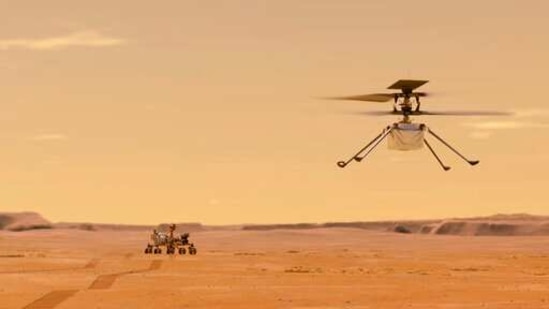
“The downlink, which arrived..via a connection through the Mars Reconnaissance Orbiter, indicates that both the helicopter...and its base station...are operating as expected,” the agency said in a statement.
Here are 5 things you should know about Ingenuity:
It’s an experimental flight test
Ingenuity Mars helicopter seeks to test flight capability for the first time, with limited scope. It does not carry science instruments and is a side-kick of the Mars 2020 Perseverance mission. It’s objective is to demonstrate rotorcraft flight in the extremely thin atmosphere of Mars.
First powered, controlled flight on another planet
The helicopter will attempt the first powered, controlled flight on another planet, a feat with a high degree of difficulty. Martian atmosphere is 99 per cent less dense than that of Earth, which makes it difficult for vehicles to achieve enough lift. But one of the first objectives of the helicopter is just to survive the frigid Martian night for the first time, given the nights at the Red planet are as cold as minus 90 degrees Celsius.
Dependent on Perseverance rover
{{/usCountry}}Dependent on Perseverance rover
{{/usCountry}}After finding a suitable site to deploy Ingenuity, the helicopter delivery system of Perseverance will shed the landing cover, rotate the helicopter to a legs-down configuration, and gently drop it on the surface in the first few months following its landing. The rover will continue to assist in communications related to the helicopter’s commissioning and flight test campaign back and forth from Earth.
Ambitious aerial dimension
While it took centuries and a lot of trial and error to figure out how to fly planes and helicopters on Earth, engineers on the Ingenuity team were able to demonstrate the same in over six years in special space simulation chambers. They demonstrated that it was possible to build a vehicle that could generate enough lift in an extremely thin Martian atmosphere and operate and survive autonomously. Successful flights of Ingenuity could provide an ambitious aerial dimension to future Mars exploration.
A long list of milestones
Now that the helicopter has survived the cruise to Mars and landing on the Red Planet, the next milestone will be the safe deployment to the surface from the belly of the Perseverance rover. The other objectives it needs to fulfil before it can take off and land in the spring of 2021 include autonomously keeping warm through the intensely cold Martian nights and charging itself with its solar panel. Successful communication to and from the helicopter via the base station on the rover is also a prerequisite.