
 E-Paper



SpaceX set to launch NASA's spectacular ‘Dragonfly’ mission to Saturn’s moon Titan | Things to know
Dragonfly will be the first NASA mission to fly a vehicle for scientific purposes on another planetary body.

 Prefer HTon Google


The National Aeronautics and Space Administration (NASA) has chosen billionaire Elon Musk-owned SpaceX to provide launch services for the “Dragonfly mission”, a one-off rotorcraft lander mission under the New Frontiers Program, aimed at exploring Saturn's moon Titan. Dragonfly will be the first NASA mission to fly a vehicle for scientific purposes on another planetary body.
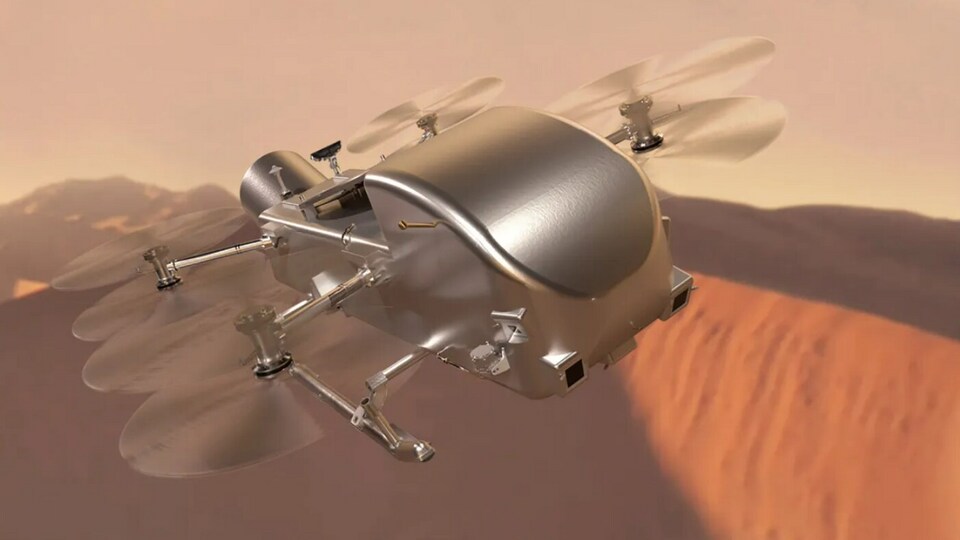
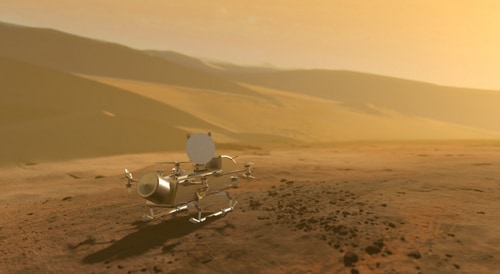
The rotorcraft, resembling a large drone with eight rotors, will conduct flights on Titan’s surface.
The mission will analyse surface materials and composition across various geological sites, furthering the search for the fundamental elements of life.
“Dragonfly is a remarkable scientific mission with wide-reaching interest, and we are thrilled to take the next steps,” the space agency quoted Nicky Fox, associate administrator for NASA’s Science Mission Directorate, as saying. “Exploring Titan will push the limits of rotorcraft technology beyond Earth,” he added.
All you need to know about ‘Dragonfly’
- NASA’s Dragonfly mission will use an innovative rotorcraft-lander to explore various locations on Titan, Saturn's largest moon. The space agency said in a statement issued on November 25 that this approach to planetary exploration offers a novel way to study diverse sites on the moon.
- With international collaboration, Dragonfly's scientific payload aims to examine Titan’s habitability, study the evolution of prebiotic chemistry, and look for signs of either water-based or hydrocarbon-based life. Titan is believed to have hosted carbon-rich material and liquid water for extended periods.
- NASA’s Launch Services Program, based at Kennedy Space Center, is in charge of managing the launch of the Dragonfly mission.
- The fixed-price contract for the launch services is valued at approximately $256.6 million, covering launch and mission-related expenses. Dragonfly's launch window is set between July 5 and July 25, 2028, using a SpaceX Falcon Heavy rocket from Launch Complex 39A at Kennedy Space Center in Florida.
- The rotorcraft, scheduled to reach Titan in 2034, will travel to multiple promising sites on the moon, searching for prebiotic chemical processes that are believed to have occurred on both Titan and early Earth before life emerged.
- The Dragonfly mission, managed by NASA’s Johns Hopkins Applied Physics Laboratory in Maryland, involves a team of experts including scientists, engineers, and technologists with vast experience from missions exploring the solar system, from the Sun to Pluto.
- Dragonfly is the fourth mission in NASA’s New Frontiers Program, which is overseen by the agency's Marshall Space Flight Center in Huntsville, Alabama, and led by NASA's Science Mission Directorate.


