
 E-Paper



8 chances, 4 misses: World Cup's greatest goalscorer Lionel Messi is also its worst penalty taker and why he should stop
The statistics inevitably raise one question: should Messi still be Argentina's first-choice penalty taker?

 Prefer HTon Google


Four scored. Four missed. That's Lionel Messi's record from the penalty spot across six World Cups. And after Tuesday's miss against Egypt in the Round of 16 in Atlanta, that statistic carries a new weight. Messi is now the first player in World Cup history to miss two non-shootout penalties in the same edition of the tournament, and no player before him had ever missed more than one penalty during normal time in a single World Cup.
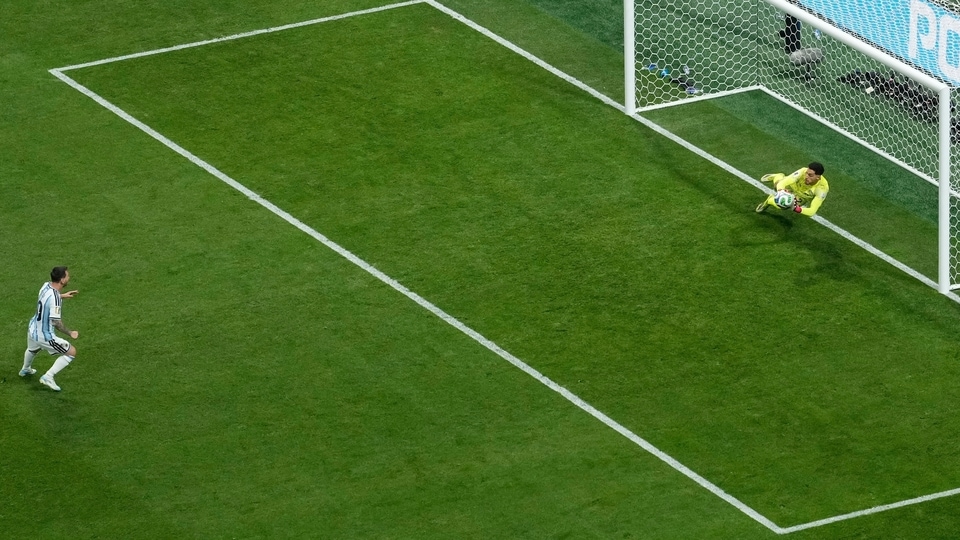
Yet neither miss has ultimately hurt Argentina, yet.
Against Austria in the group stage, Messi failed to convert a 12th-minute penalty that would have broken the deadlock. He responded by scoring twice to overtake Miroslav Klose as the highest goalscorer in World Cup history. Against Egypt, he missed the chance to equalise after Nicolas Tagliafico won a penalty with Argentina trailing 1-0. But once again, he recovered, setting up Cristian Romero's goal before scoring the equaliser himself as Argentina came from 2-0 down to beat Egypt 3-2.
Messi's genius continues to outweigh his flaws. But at some point, a recurring flaw stops being an anomaly and becomes a pattern that opponents can prepare for.
Both misses at this World Cup followed an almost identical script.
Against Austria, Messi had a lengthy wait after a VAR review before taking his penalty. Rather than altering his approach, he stuck to his trademark stop-start routine. He took a short run-up, paused briefly before his final strides and waited for goalkeeper Alexander Schlager to commit first. Schlager refused. Forced into making the decision himself, Messi dragged his effort wide of the right post instead of finding the corner.
Atlanta witnessed a remarkably similar sequence. The slow run-up returned. So did the delayed commitment. This time, Egypt goalkeeper Mostafa Shobeir held his ground, waited for Messi's strike and reacted sharply to push the effort away.
In both cases, the goalkeeper prevailed not because they guessed correctly, but because they refused to play Messi's game. His penalty routine is designed to exploit keepers who commit early. Increasingly, opponents are refusing to do exactly that.
That raises an uncomfortable question. Are Messi's penalty misses simply the cost of being unpredictable, or has his unpredictability itself become predictable?
The placement data suggests the latter. Opta's analysis of Messi's eight World Cup penalties tells a more revealing story than the popular belief that he "mixes it up." Only one of his four successful penalties has been struck low into his preferred corner. Two other goals, all three saved penalties and the one miss against Austria all ended up in a remarkably tight cluster at a similar height and on the same side of the goal.
For a player widely regarded as having no fixed penalty pattern, the data suggests otherwise. Messi varies his run-up, his body shape and even the part of the foot he strikes the ball with, but the final destination of the shot is far less varied than his reputation implies. In an era when every opponent has access to detailed video analysis and placement data, that tendency becomes easier to identify and prepare for.
Compare that with Harry Kane. The England captain has converted more than 87 per cent of his career penalties, largely by relying on a simple formula. His preferred finish is a firm strike across the goalkeeper at mid-height, and his placement data heavily favours one corner. Rather than changing where he aims, Kane varies his tempo, rhythm and pre-kick routine to keep goalkeepers guessing.
Messi, by contrast, often does the opposite. He changes the technique but repeatedly targets a similar area of the goal.
Another notable difference is timing. Unlike penalty takers such as Kane or Jorginho, who often wait and react to the goalkeeper after the whistle, Messi usually commits to his strike almost immediately. That can leave less room for adjustment and, at times, makes his intentions easier to read.
The broader numbers paint a similarly concerning picture. Across club and international football, Messi has converted 116 of his 150 penalties, a success rate of around 77 per cent. While respectable, it falls well short of the conversion rates typically associated with the elite penalty takers. Even more strikingly, in every calendar year in which he has taken more than one penalty, he has missed at least one.
Argentina need a Plan B
The statistics inevitably raise one question: why is Messi still Argentina's first-choice penalty taker?
The obvious answer has always been simple, because he is Lionel Messi. An eight-time Ballon d'Or winner. A World Cup champion. Quite possibly the greatest footballer the game has ever seen.
Perhaps that is precisely why Argentina have never seriously looked beyond him from 12 yards.
But after becoming the first player in World Cup history to miss two non-shootout penalties in a single tournament, and with the margins only getting finer as the knockout rounds progress, Lionel Scaloni may have a decision to make.
Julian Alvarez presents a compelling alternative. The Atlético Madrid forward has missed only two of his 19 career penalties. He is already his club's designated penalty taker, converting 10 of his 11 spot-kicks, a success rate of 91 per cent.
None of this diminishes Messi's greatness. Argentina are in the quarter-finals largely because of him. He rescued them against Egypt after missing from the spot, just as he did against Austria. His influence on this team extends far beyond penalties.
But with a quarter-final, and potentially a semi-final and final still to come, Scaloni must at least consider whether Argentina need a different option from 12 yards if another decisive penalty arrives.


