In the autumn of 2016, hundreds of fans gathered outside Docler Holding’s headquarters at Expo Square in Budapest as Ronaldinho stepped up to a curious-looking curved table and introduced teqball to the world.
The football great, who was brought on as its global ambassador, spoke about wanting to play the game with his former Barcelona teammate and fellow Brazilian Neymar, and of sending them both teqball tables so they could practice.
In India, Quimcy DSouza stumbled upon teqball through Ronaldinho reels on Instagram. The Mumbai-born started out as a middle-distance runner and later played football (U19 level) for Maharashtra before a ligament injury snuffed out her dreams in the game.
Deep Dive
What is teqball and how is it played?
Why is Quimcy DSouza significant to the sport of teqball in India?
How did Quimcy DSouza get introduced to teqball?
Also Read: India at Asian Games 2026, September 20, LIVE Updates
“In 2022, when I was injured, I wanted to play professional football. It had been my dream to play for India since I was a kid. It could be any sport. I watched Ronaldinho on Instagram reels…and when I saw him play (teqball), I loved it,” she told the Olympic Council of Asia.
Four years on, an Asiad medallist
Quimcy, a test engineer with multinational sports goods retailer Decathlon in Bengaluru, came heartbreakingly close to making history for Indian teqball at the Nagoya City Higashi Sports Center on Sunday. She knows a thing or two about recovering from setbacks and that experience will help now. It won't take away the pain, though—the pain of coming so close to the podium but not making it.
{{/usCountry}}Quimcy, a test engineer with multinational sports goods retailer Decathlon in Bengaluru, came heartbreakingly close to making history for Indian teqball at the Nagoya City Higashi Sports Center on Sunday. She knows a thing or two about recovering from setbacks and that experience will help now. It won't take away the pain, though—the pain of coming so close to the podium but not making it.
{{/usCountry}}The 24-year-old moved from Mumbai to Bengaluru and is part of a tiny group of first-generation competitive Indian teqers, who are largely self-taught and have been trying to coach, build a community and answer questions about the sport while holding down day jobs.
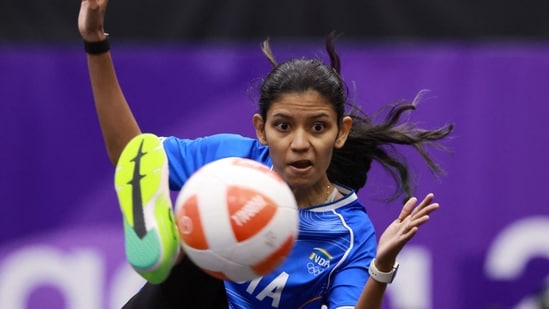
A seven-time national champion, Quimcy founded the Teqball Club of Bangalore, and her football background has helped with the ball control and speed a game that melds football and table tennis demands.
Her road to the medal has been impressive. She defeated top seed Japan’s Yuina Sakamoto, followed by Cambodia’s Koemyean Dy in straight sets, to top her group and earn a direct passage to the semi-finals. She lost to Sumaya of Indonesia on Saturday, and went into a bronze medal playoff, again facing Sakamoto.
On Sunday, Quimcy's hopes were dashed by the home favourite as she was unable to beat her again.
In the mixed doubles match, where she was partnering Mohamed Anas Imran Beg, that followed soon after, she picked up an injury and ended up on the losing side once more.
A fairly new sport
So, what is this sport that looks like it was invented out of boredom with equipment lying around? That presumption isn’t far from the truth.
The idea came to former Hungarian footballer Gabor Borsanyi, who grew up in Ujpest kicking a football on concrete table-tennis tables outside residential buildings when he wasn’t playing regular football. The flat surface didn’t help with the rebound, which led to the idea of an improvised playing table.
About the size of a table-tennis table, a teqball table has a curved surface with a solid acrylic net running across the middle. The ball can bounce back if it isn’t struck properly. Players cannot use their hands, and contact with the table or the opponent isn’t allowed.
Borsanyi, with fellow Hungarians – computer scientist Viktor Huszar and businessman Gyorgy Gattyan, all three of them football fans – developed teqball in 2012. Designing a curved tabletop that met the required geometry while remaining lightweight, smooth and easy to assemble and ship posed its own technical challenges.
“We measured the curve for three years with empirical tests to achieve that, the ball bounces in a way that it has an acceleration and that the tool is operable,” Huszar said in an earlier interview. “If you play teqball, you become a better football player.”
For Quimcy, teqball offered a second shot at something she thought injury had taken away. She believed football would be her route to representing India. It turned out to be the curved table.
The sport she stumbled upon while watching Ronaldinho videos on her phone has now carried her all the way to the Asian Games. Maybe next time, to the podium too.