On the face of it, Chennai and chess seem to have only the first three letters in common. The city’s affinity for the mind game though runs deep. It comes through in one of the city’s oldest bridges being repainted in black and white squares, its metro trains and buses being adorned with posters promoting chess. The Tamil Nadu chief minister has even played a game of chess and ensured preparations are on track. Music maestro AR Rahman, an icon
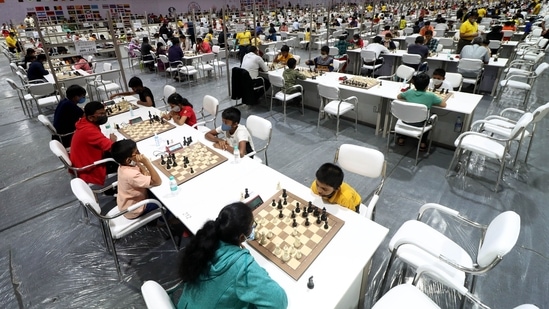
On the face of it, Chennai and chess seem to have only the first three letters in common. The city’s affinity for the mind game though runs deep. It comes through in one of the city’s oldest bridges being repainted in black and white squares, its metro trains and buses being adorned with posters promoting chess. The Tamil Nadu chief minister has even played a game of chess and ensured preparations are on track. Music maestro AR Rahman, an icon of the city, has composed the official tournament anthem.
It is hard to imagine most other places whipping up such fervour for chess, but it is perhaps par for the course in Chennai in the final build-up to the 44th edition of the Chess Olympiad. It will be held in Mahabalipuram, the coastal town 60 km from Chennai that is renowned for its 7th century Pallava Era rock temples. The Olympiad will be held from July 28 to August 10.
The grand build-up by Chennai is to do justice to its reputation as India’s chess capital. Of India’s 74 Grandmasters (GMs), 26 or one-thirds have come from Tamil Nadu, many from Chennai. The city adores its chess talent, and India’s first International Master Manuel Aaron and first GM Viswanathan Anand—he is mentor to the Indian teams—coming from Chennai has only heightened that bond with fans.
“I am very happy with the way Chennai is taking to the Chess Olympiad, how this chess fever is developing. It says something that a whole bridge has been painted in black and white. Every citizen of Chennai will know that a chess event is happening and it is a beautiful way to make a point,” Anand told ChessBase India recently.
“Chennai is a big hub for chess. There is a vibrant chess culture not only in Chennai but in Tamil Nadu. The reason to have it in Mahabalipuram is because all the hotels are on the coast and the players can have a memorable time. In big cities, it is also difficult for us to manage logistics,” tournament director and All India Chess Federation (AICF) secretary Bharat Singh Chauhan said.
The city is steeped in chess culture. Aaron became IM in 1959. Born in Myanmar in December 1935, he moved to Chennai (then Madras) as a six-year-old with his parents in 1941.
“During my early days, there were no chess clubs in the city. People assembled at the homes of friends who played chess. I don’t remember when I started playing, but my parents used to play and I learned by watching them. I don’t remember anyone telling me how the pieces move. There was no formal structure back then,” Aaron, 86, recalled.
Becoming India’s first IM and winning the national championship nine times, Aaron is likely to have inspired many youngsters in the city and beyond then. Like Anand has done in the last three decades.
“Aaron was one of the pioneers. When chess was not considered a sport, he took to the game and achieved many wonderful things,” GM RB Ramesh said. “Every generation lays the foundation for the subsequent generation. India’s first IM and GM came from Chennai. When these titles are won for the first time by an Indian, it has a very positive impact. More people take to the game and want to emulate them.”
Aaron and Ramesh also credit the behind-the-scenes work done by the Tamil Nadu chess body. Even without budget and limited infrastructure, tournaments were held frequently. “The TN chess association has been very proactive. It has organised many tournaments in Chennai and TN. Without the opportunities, players won’t feel motivated to take up chess seriously,” said Ramesh.
“Nobody remembers many people who worked in an honorary capacity. There always used to be some tournament going on. The state championship was held every year from 1950,” Aaron adds.
The opening of the Tal Chess Club in 1972 boosted activity in Chennai. Part of the Russian Cultural Centre in Chennai, it is where Anand honed his game as a teenager in the 1980s.
“It was during the Cold War that Soviet Union took to chess very seriously,” Ramesh explains. “They wanted to build an intelligent population to compete with the US. Since India sided with USSR back then, they opened an academy in Chennai as well as the other metros. In the 1970s and 80s, it was a meeting point for all chess players in Chennai. When the Soviet Union broke up in 1991, the funding stopped. From around 1992, the activities drastically reduced.”
By then, other academies had been established. And given the number of GMs from the city, youngsters could learn from these pros living within the city. In the late 1980s and 1990s, many Chennai institutions made a crucial contribution by gifting promising players laptops to help them access advanced chess programmes for training.
“From around 2000 onwards, we started having more chess academies. Chennai alone will have around 100 academies. More and more GMs are opening academies,” Ramesh, the coach of chess prodigy R Praggnanandhaa, said.
One Subscription.
Get 360° coverage—from daily headlines
to 100 year archives.
Archives
HT App & Website