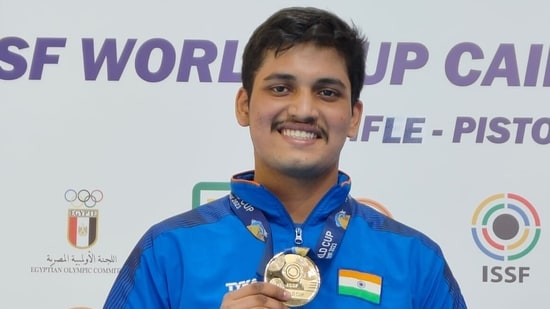
Rudrankksh Balasaheb Patil likes to be in the news. Making the headlines, he says, excites him as much as shooting a perfect 10.9, conscious of the fact that the former is only the by-product of the latter. In about a week's time, the 19-year-old marksman from Thane will have his shot -- both at a perfect 10.9 and consequently, the headlines. Patil will be in action on the first competition day of the 19th edition of the Asian Games that kick off on September 23.
Rudrankksh Patil is a strong gold medal contender for India at the Asian Games 2023. (SAI Media)
"I understand the onus will be on me to deliver the opening punch. A good first-day first show will potentially lift the mood of the entire Indian contingent," he said.
"I always wanted fame and glory, and I don't think there's anything wrong with that. I want people to write about me. Early in my career, I realised that even if I topped the school, I won't get that kind of recognition, so I put all my energy in shooting. I am sure a good performance in my maiden multi-discipline event will make me famous," he added.
Fame, however, can be a double-edged sword. Back in 2018 Asian Games when the Indian shooting contingent returned with nine medals, a certain Saurabh Chaudhary, then 16, made headlines with a gold medal in the 10m air pistol event. Steely, unflappable, and shy, the sheepish teenager held the Indian shooting community in his thrall with his nerveless shooting, racking up gold medals in World Cups and climbing to the top of world rankings. Until, of course, he hit the Olympic-sized roadblock in Tokyo.
Chaudhary's failure and subsequent struggle to make the Indian team -- he is not part of the Hangzhou-bound squad -- is a timely reminder that Indian shooters, despite their unquestionable talent, are yet to crack the code to deliver in big, high-pressure events. At the ongoing World Cup in Rio de Janeiro, Chaudhary couldn't even make the final in his pet event, finishing 30th with a disappointing 572.
Patil, of course, is aware of the fickleness of his sport. The implosion of high-quality shooters such as Chaudhary, Manu Bhaker, and Divyansh Singh Panwar in Tokyo has served as a lesson to the reigning world champion. "I don't judge shooters anymore," he said thoughtfully. "Tokyo has shown us that even the best can fail at the big stage despite trying their best. All these shooters were world No.1 in their disciplines going into the Olympics, and yet they could not perform. That doesn't make them bad shooters overnight."
"In fact, they have earned my respect. I salute Divyansh and Manu to keep trying. It is not easy to keep going after what they went through. We must also remember that we are a young bunch, both in life and in sport. We learn to deal with pressure as we go along," he said.
Still, going into the Asian Games, Patil will have the nation's attention on him as the only reigning world champion in the team. While the title in Cairo arrived in relative obscurity, the Hangzhou event will attract sizeable eyeballs.
"There is pressure, for sure, but I am learning to deal with it. I have cut myself from social media a couple of months back, so I don't know about the medal expectations. At the end of the day, it's my rifle and the target that matters. When I enter the range, I shut myself to the outside world. I guess that's what they call the zone," he said.
Patil admits that he is yet to master the art of entering the 'zone' on command, but is learning to shoot perfectly on an imperfect day. "Look, you can't have a perfect day every day. Sometimes, you don't feel you're in the zone but you still ought to shoot. I find it difficult to enter the zone, but once I take aim, it's just the target that I see."
Another important part of Patil's preparation is visualisation, although he finds it a "hit and miss" method. "I visualise feeling the weight of a gold medal around my neck. Sometimes I visualise climbing the podium to the tune of the national anthem. But frankly, it may not always work for you," he said.
"Entering the competition as a world champion has its own pluses and minuses, but it is important to not get carried away. All success and failure is transient. As a shooting group, all of us believe that neither success nor failure is final. It is such a fickle, technical sport that maintaining consistent results is next to impossible, so it is very important to enjoy the process," he mused.
The Marvel Universe fan is hoping to be India's hero on his debut Asian Games and is also looking forward to some authentic Chinese cuisine. Also on the menu is a meeting with the world and Olympic champion Neeraj Chopra. "I want to get an insight into his mindset. I want to understand how a champion athlete thinks," he said. As things stand, that promises to be some conversation.
Stay updated with the latest sports news, including latest headlines and updates from the Olympics 2024, where Indian athletes will compete for glory in Paris. Catch all the action from tennis Grand Slam tournaments, follow your favourite football teams and players with the latest match results, and get the latest on international hockey tournaments and series.
Home/Sports/Others/'There Is Pressure, But I Am Learning To Deal With It'

 E-Paper