
 E-Paper



Carlos Alcaraz at 22 outpaces the Big 3's early-career math: Sparks debates of ‘Greatest in the making’
Carlo Alcaraz wins the 2026 Australian Open, achieving a career Grand Slam and raising questions about his potential as the greatest player in tennis history.

 Prefer HTon Google


Carlo Alcaraz did not just win the 2026 Australian Open. He rewrote Tennis history.
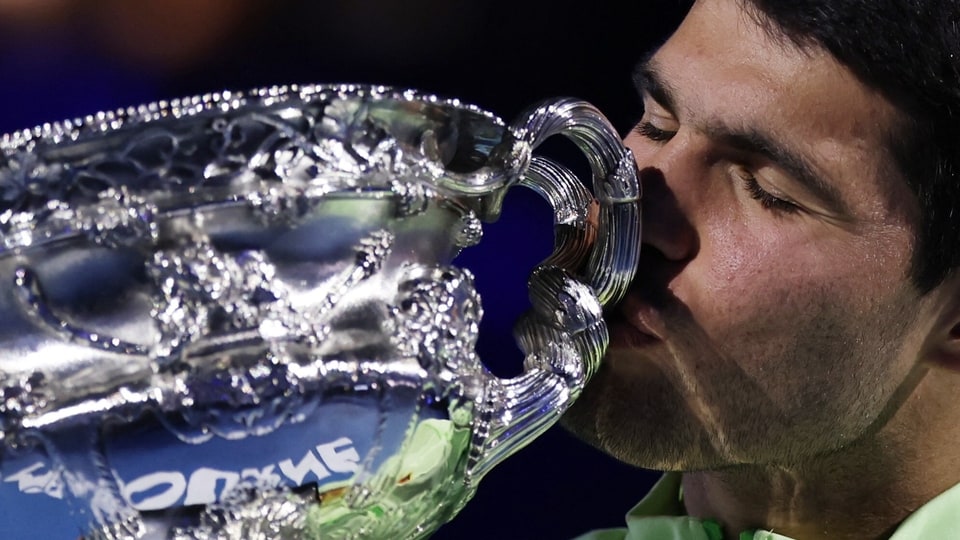
Melbourne gives him the career Grand Slam, pushes him to seven majors, and forces tennis into a rarer debate than “next big thing”: are we watching the greatest player in the making?
Alcaraz is 22 years, 8 months and 27 days old on the day he lifts the trophy. He beat Novak Djokovic 2-6, 6-2, 6-3, 7-5, denying the Serb a 25th major and completing the only Slam Alcaraz didn’t win yet. The result matters not only because it is a title, but because it is a proof of concept: this isn’t dominance that lives on one surface or one season. It travels.
The milestone that changes the conversation
Most GOAT conversations are premature until a player has lived through three stages: breakout, prime, and decline. Carlos Alcaraz has barely closed the breakout phase and already owns the sport’s hardest completeness test. Winning all four majors so early matters because it removes the most common ceiling on great careers: surface dependence.
Seven majors before turning 23 is not a normal pace in men’s tennis. It doesn’t guarantee a record-breaking finish, but it does change the baseline. From here, he does not need to arrive, he needs to endure.
The speed angle: career-days, not just age
To talk about how fast, you need a clean start point. Take Alcaraz's first ATP Tour main-draw win on 18th February 2020. From that date to 1st February 2026 is 2,175 days - roughly six years from first tour win to career Grand Slam and seven majors.
That is why this run feels like it’s happening fast-forward. The Big 3 each built their own version of greatness, but they did it with different timelines: Federer’s early years were a climb into control, Djokovic’s were built into sustained dominance, Nadal’s were an early tsunami that gradually became fully all-surface. Alcaraz has managed the tsunami and the surface spread at once.
Where the Big 3 were at 22
A fair comparison isn’t the Big 3 at the end, it is the Big 3 at the same age band. At 22 years, 8 months and 7 days Alcaraz already has seven Grand Slams and the career slam in the bag. At the same point in their careers, Rafael Nadal had six majors, Roger Federer had two, and Novak Djokovic had one. In plain numbers: Alcaraz is +1 on Nadal, +5 on Federer, and +6 on Djokovic at the same age - and he’s done it with titles spread across all four majors not a single-surface run.
The real boss level: longevity
Here’s the part tennis fans often romanticise away: the greatest careers are not defined by the first even majors. They are defined by the next seven when the tour has mapped your patterns, your body isn’t new, and your motivation has to be manufactured rather than discovered.
This is why the Big 3 are so hard to chase. Their peak level was outrageous; their durability was more outrageous. A simple marker: majors after turning 30. Federer won four after 30, Nadal won eight, and Djokovic has won twelve. That is the difference between historical greatness and historical outlier.
If Alcaraz is going to threaten the outer edge of records, he will need a second act that looks more like Rafael Nadal’s resilience or Djokovic’s reinvention than a normal superstar’s decline.
Also Read: Carlos Alcaraz becomes youngest to achieve career Grand Slam, defeats Novak Djokovic to win maiden Australian Open
What Djokovic’s presence really changes
Novak Djokovic has 24 Grand Slams under his belt and is still functional. If he does step away with the number unchanged, the challenge doesn’t disappear; it changes shape. Instead of solving one or two final-boss match-ups, Alcaraz has to survive a rotating field of elite threats who can spike for two weeks and punish any dip. That kind of era usually spreads majors around. If Alcaraz keeps collecting anyway, it strengthens the greatest argument because it means he is dominating a league, not just a rivalry.
Realistic projections for Alcaraz
Forecasting tennis careers is a tarp unless it is built in with decline and disruption. Alcaraz has seven majors today. From here, there are three realistic arcs:
1. Great, but human
He remains elite through his 20s, adds 8-12 more majors, but his 30s become more deep runs than trophies. That still puts him among the sport’s immortals with around 15-19 Grand Slams.
2. Nadal-like turbulence
Injuries and form valleys arrive, but he keeps winning across surfaces and strings together multiple late-stage title runs. That might see him finish his career with 17-22 Grand Slams.
3. Djokovic-like longevity
A sustained prime plus a second prime. It requires scheduling discipline, tactical evolution, and efficiency as the body changes. This is the route to the record zone of 22-27 Grand Slams.
The ranges are wide because the reality is wide. The point is sharper: starting from seven before 23 keeps the record conversation mathematically alive even after you price in dips.
Why this isn’t just hype
Alcaraz isn’t winning with a single lever. His game has multiple solutions: speed, power, point construction, defense into offence, and most importantly - in-match adjustment. The final itself was a summary: he got hit in the first set, recalibrated, raised his return pressure, tightened his margins without turning passive, and slowly turned the match into a physical and tactical grind that favoured him.
Is he the greatest in the making? Yes, but with one condition
After Melbourne 2026, it is fair to say we are seeing the greatest tennis player in the making - in the strict sense that no one else has combined this age, major volume, and this surface completeness so early.
But the greatest ever isn’t awarded for arriving first. It’s awarded for staying. Alcaraz has proven he can win everything. The next decade will decide whether he can keep winning when it stops being new - and when the sport starts building its entire ecosystem around him.


