
 E-Paper



SpaceX needs to make its bigger rockets work
None of the company’s most ambitious plans are possible without the success of its Starship rockets.


 Prefer HTon Google


SpaceX’s stock has fallen hard since the company’s IPO in June. But Elon Musk still needs a lot to go right to justify the company’s out-of-this-world valuation.
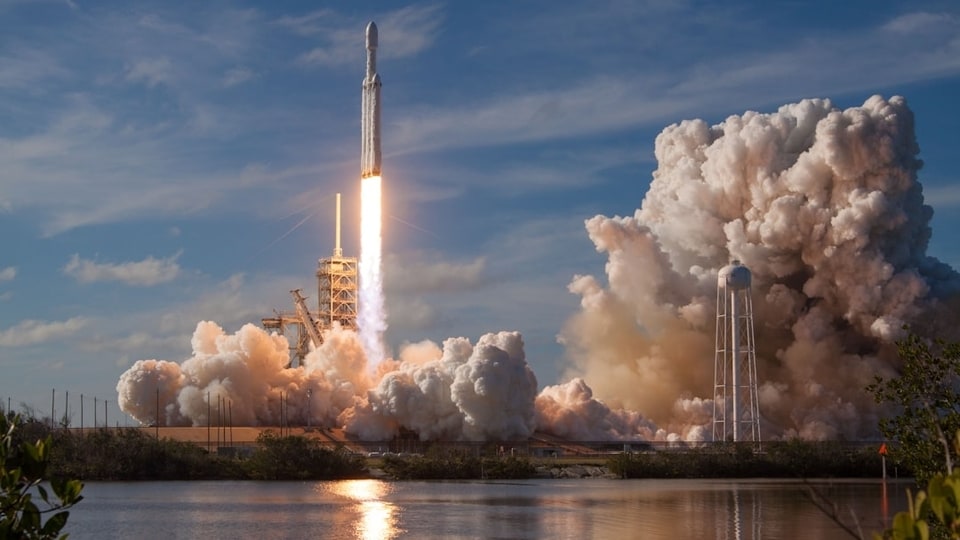
Pretty much all of SpaceX’s most promising ambitions hinge on carrying larger payload capacity at lower cost than today’s rockets. And that means the company can little afford continued hiccups with Starship, the successor to SpaceX’s tried and tested Falcon 9 rockets.
Falcon 9 has been delivering payloads to space for more than 15 years at a rising pace: The company launched 165 of them last year, or nearly one every other day. But as the space economy has developed, upgrading from Falcon 9’s capacity of lifting about 23 metric tons into low-Earth-orbit has become a priority.
One reason is simply that a bigger payload means larger satellites can be launched. And satellite size often correlates with satellite capability.
Of equal importance, bigger capacity and reusability translate into lower launch costs per unit of weight. That makes it economical to do a lot more things in space and widens SpaceX’s already-large competitive moat.
Musk suggested that things were going smoothly on a call with analysts Tuesday. Starship’s next flight was penciled in for later this month, he said. He even seemed to claim that a year from now there could be one Starship launch a day.
Starship’s success, though, is hard to handicap. SpaceX has had few full-on failures and hundreds of successful launches with Falcon 9 over the years, but Starship’s testing has had a somewhat rocky start. Five of the rocket’s 13 launches have failed or had significant flight concerns—surpassing the total number of Falcon 9 launch failures.
Starship has a payload capacity of 100 metric tons. That size—roughly quadruple that of a standard Falcon 9 rocket—is essential for SpaceX to send larger, next-generation Starlink satellites into low-Earth-orbit, increasing the speed and reach of a satellite internet service that accounts for the bulk of the company’s sales. SpaceX reported $4.29 billion of second-quarter revenue for Starlink on Tuesday, up about 66% from a year earlier.
Starship is also crucial if SpaceX is to reach its ambition of putting a million AI-computing satellites into space in the next few years. The company is envisioning a world in which artificial-intelligence models are largely served from space, with lasers and other satellite-communication technologies beaming data around, resulting in near-instant responses to queries.
For that to happen, cost reduction is paramount because of how much computing equipment weighs. MoffettNathanson analysts estimated in a recent note that it would take about 143 launches of the Starship rocket currently under testing to put a gigawatt of computing power into space, roughly matching a single large-scale terrestrial AI data center.
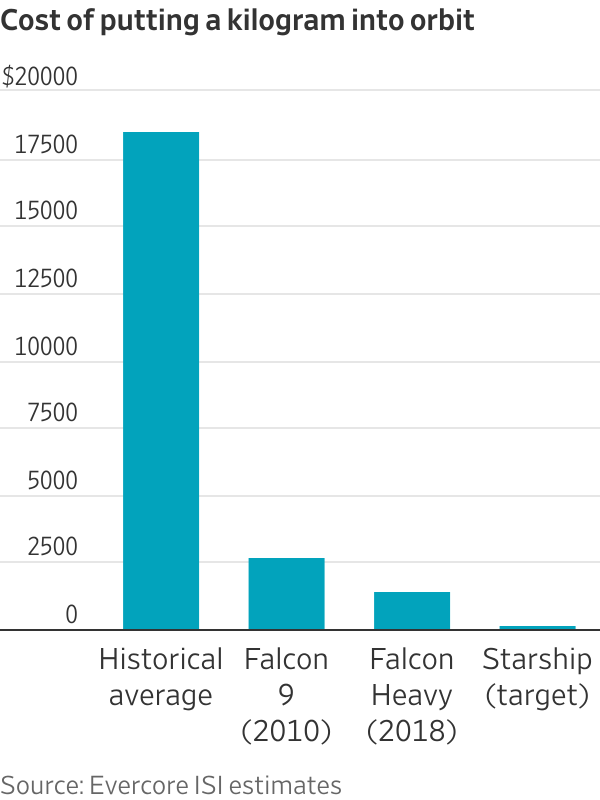
SpaceX is counting on Starship to deliver there, too. To keep costs low, the craft is designed to be fully reusable: Unlike the Falcon 9, with a reusable booster, Starship is envisioned as having a reusable booster and second stage, with both even landing back at their launchpad to ease reuse. Evercore ISI analysts estimated recently that Falcon 9 payloads cost $2,700 a kilogram to send into orbit, while Starship should bring that down to $185 a kilogram.
All of that makes Starship’s success critical to SpaceX’s valuation. Even with its 22% decline since the close of its first day of trading, SpaceX is still valued at around 28 times future sales, far above any of the large tech companies and several times the Nasdaq composite average of around 4.5 times, according to FactSet.
SpaceX does appear to be making progress on Starship. It has had two successful launches into space so far this year, even if it failed to recover and reuse the boosters. Several more launches are scheduled this year.
Musk told analysts Tuesday that Starship would result in a dramatic increase from the 2,500 tons Falcon rockets deliver to orbit a year. “With Starship, our aspirations—and I think we will achieve these aspirations—are to deliver well over a million tons a year and probably ultimately 10 million tons a year,” he said.
If Musk is right and a space boom takes hold, SpaceX might be in the early stages of an unprecedented growth spurt. But for his vision to work out, so must Starship.
Write to Asa Fitch at asa.fitch@wsj.com


