Monsoons often bring a different kind of discomfort. Even when temperatures drop, high humidity can leave rooms feeling warm and sticky. Many households end up running ceiling fans for longer hours, sometimes alongside the air conditioner, to keep air circulating. This naturally raises electricity consumption, making some homeowners wonder if switching to a BLDC ceiling fan could make a noticeable difference to their monthly bill.
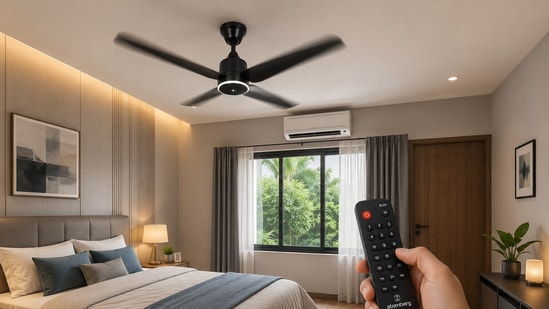
BLDC fans are often marketed as energy-efficient alternatives to conventional ceiling fans. But do they actually save enough electricity to justify their higher price? The answer is yes, though the amount you'll save depends on how often you use your fan, your electricity tariff, and how many fans you have at home.
Why ceiling fans work harder during monsoons
Humidity doesn't increase the temperature inside your room, but it reduces your body's ability to cool itself through sweat evaporation.
According to the India Meteorological Department (IMD) and weather experts, relative humidity during the Indian monsoon often exceeds 70% to 90%, making indoor spaces feel far more uncomfortable than the actual temperature suggests.
That is why many people:
- keep ceiling fans running almost continuously
- use ceiling fans together with air conditioners
- avoid switching fans off even at night
The longer a fan operates every day, the greater the opportunity for energy savings.
So, how much electricity does a BLDC fan actually save?
Here's the part most people care about.
A conventional ceiling fan usually consumes around 70 to 75 watts of power. A comparable BLDC fan typically uses 28 to 35 watts while delivering similar airflow.
That may not sound like a huge difference on paper, but remember how many hours your fan runs every day.
Imagine this:
- You run your ceiling fan for about 12 hours daily during the rainy season.
- A regular 75W fan would consume around 27 units of electricity in a month.
- A 30W BLDC fan would consume roughly 11 units over the same period.
That's a saving of nearly 16 units every month from just one fan.
At an electricity tariff of ₹8 per unit, that works out to roughly ₹130 every month. If your home has four ceiling fans running every day, those savings become much easier to notice.
Does that mean everyone should buy one?
Not necessarily.
A BLDC fan usually costs ₹1,500 to ₹3,500 more than a regular ceiling fan. If the fan is only used in a guest room or switched on for a couple of hours every day, it could take years to recover that extra cost.
On the other hand, the maths starts looking very different if:
- your family spends most of the day at home
- you use multiple ceiling fans
- your electricity bills are already high
- you're replacing an old fan anyway
In those situations, the long-term savings become easier to justify.
Top 5 BLDC fans we recommend our readers
{{#product}}{{/product}}
If your ceiling fan stays on for long hours during the monsoon, the Atomberg Renesa Elite Smart is built to keep electricity use in check without compromising airflow. Its 35W BLDC motor uses far less power than many conventional fans, making it a practical choice for homes aiming to cut running costs.
Smart controls, quiet performance and stable operation during voltage fluctuations add to its everyday appeal.
Why buy this ceiling fan?
Choose it if you want to lower long-term electricity costs during heavy daily use while enjoying smart controls and consistently strong airflow.
{{#product}}{{/product}}
Our Principles
Full Transparency
Every product review clearly lists the Pros and Cons, giving you a balanced view.
Brand Confidence
We focus on products from brands with a proven reputation and long-standing market trust.
If your ceiling fan runs for hours during humid weather, the Colorbot Knoxx Quad aims to keep electricity consumption low without sacrificing airflow. Its 30W BLDC motor draws considerably less power than a conventional fan, making it a sensible pick for everyday use.
The four-blade design, quiet operation and remote-controlled modes also make it well-suited for bedrooms and living spaces where comfort matters.
Why buy this ceiling fan?
Pick this fan if you want lower electricity consumption during extended daily use, paired with strong airflow and practical remote-controlled features.
{{#product}}{{/product}}
The LUKER USA Alpha Galaxy is designed for larger rooms where ceiling fans often run for extended hours during the monsoon. Its BLDC motor is built to consume less electricity than a conventional fan while maintaining consistent airflow.
A wider 1320mm sweep, quiet operation and remote control make it a practical option for those looking to reduce running costs without compromising everyday comfort.
Why buy this ceiling fan?
A good choice for larger rooms if you want an energy-efficient BLDC fan that combines quiet performance with the convenience of remote operation.
{{#product}}{{/product}}
If you're looking to reduce electricity consumption during months when the fan runs almost all day, the TVS Green Eternia is worth considering. Its 36W iDrive BLDC motor is designed to use considerably less power than a standard ceiling fan while maintaining strong airflow.
Silent operation, reverse mode and dependable performance at low voltage make it a practical fit for everyday home use.
Why buy this ceiling fan?
Ideal for homes where the fan runs for long hours, offering lower power consumption, quiet operation and useful remote-controlled convenience every day.
{{#product}}{{/product}}
The KUHL Meridian M3 is aimed at households where ceiling fans remain on for long stretches during humid weather. Its 30W BLDC motor keeps power consumption much lower than a conventional fan, helping trim electricity use over time.
Add to that a point-anywhere RF remote, LED speed indicators and free installation, and it becomes a compelling option for buyers replacing an older fan.
Why buy this ceiling fan?
A strong pick for frequent daily use, offering low power consumption, convenient remote operation and a long motor warranty for added peace of mind.
Top 3 features of the best BLDC ceiling fans
| BLDC Ceiling Fan | Sweep Size | Motor | Power Saving |
|---|---|---|---|
| Atomberg Renesa Elite Smart | 1200 mm | 35W BEE 5-Star BLDC | Up to 65% (claimed) |
| Colorbot Knoxx Quad | 1200 mm | 30W BEE 5-Star BLDC | Up to 67% (claimed) |
| LUKER USA Alpha Galaxy | 1320 mm | BEE 5-Star BLDC | Energy-efficient BLDC motor (power saving not specified) |
| TVS Green Eternia | 1200 mm | 36W iDrive BEE 5-Star BLDC | Up to 60% (claimed) |
| KUHL Meridian M3 | 1200 mm | 30W BEE 5-Star BLDC | Up to 65% (claimed) |
Lower bills aren't the only reason people buy BLDC fans
While electricity savings get the most attention, they aren't the only difference.
Most BLDC fans also offer features that are uncommon on entry-level ceiling fans, such as remote controls, timer modes, quieter operation and lower power consumption on an inverter during power cuts.
These features may not reduce your bill dramatically, but they can make day-to-day use more convenient.
Can a BLDC fan help if you're using an AC?
Indirectly, yes.
Energy experts, including the U.S. Department of Energy, recommend using ceiling fans alongside air conditioners because moving air helps people feel comfortable at slightly higher thermostat settings.
That doesn't mean the fan cools the room faster. Instead, it improves air circulation, which may let you raise the AC temperature by a degree or two without sacrificing comfort. If that happens, your air conditioner, which consumes far more electricity than a fan, could also use less energy.
Similar stories for you
I tested high-speed ceiling fans for my 250 sq ft living room - These 6 stood out
Should you replace your old ceiling fan? How efficient is the BLDC fan transition
The Research
I’ve used and tested hundreds of ceiling fans including the ones with BLDC motors and AC motors. I’ve also been writing about consumer electronic devices and home appliances for over a decade.
To compile this guide, I’ve used hundreds of BLDC ceiling fans across price segments and brands in India and combed through Reddit pages that talk about their motors, airflow capacity and features that make them energy efficient. Like all HT journalists, I review products with complete editorial independence and recommend products based on my learnings.
Disclaimer: At Hindustan Times, we help you stay up-to-date with the latest trends and products. Hindustan Times has an affiliate partnership, so we may get a part of the revenue when you make a purchase. We shall not be liable for any claim under applicable laws, including but not limited to the Consumer Protection Act, 2019, with respect to the products. The products listed in this article are in no particular order of priority.