The National Aeronautics and Space Administration (Nasa) has released a picture of a pair of merging galaxies. Released on Friday, the image shows two galaxies distorted by gravity and coiled into an enormous ring, leaving their cores settled side by side.
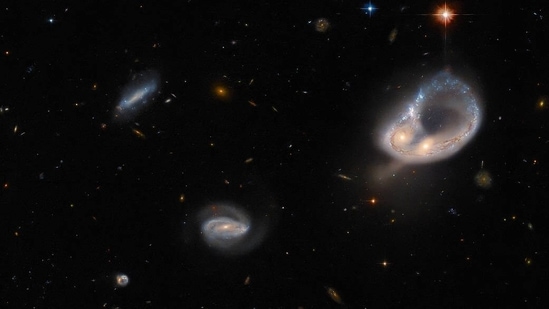
The Hubble Telescope, a project in collaboration with the US space agency and European Space agency (ESA) has captured the spectacular view. The galaxy merger, known as Arp-Madore 417-391, is based 671 million light-years away in the constellation Eridanus in the southern celestial hemisphere.
The Arp-Madore catalog is a batch of unusually distinct galaxies spread throughout the southern sky and consists of a set of elegantly interacting galaxies along with astonishing colliding galaxies, the European Space Agency (ESA) stated.
Hubble used its Advanced Camera for Surveys (ACS) which are built to probe galaxies and galaxy clusters in the ancient universe. ESA said, “Hubble’s ACS has been contributing to scientific discovery for 20 years, and throughout its lifetime it has been involved in everything from mapping the distribution of dark matter to studying the evolution of galaxy clusters.”
Last month, Hubble captured one another similar image where two interacting galaxies forming the pair known as Arp-Madore 608-333 looked like they were floating side by side. The two galaxies were warping one another through a mutual gravitational interaction which brought disruption and distortion in both the galaxies.
THe Hubble Telescope
{{/usCountry}}Last month, Hubble captured one another similar image where two interacting galaxies forming the pair known as Arp-Madore 608-333 looked like they were floating side by side. The two galaxies were warping one another through a mutual gravitational interaction which brought disruption and distortion in both the galaxies.
THe Hubble Telescope
{{/usCountry}}Named after astronomer Edwin P. Hubble, the Hubble space telescope was launched in 1990 to take pictures of planets, stars and galaxies. In 2009, astronauts flew to Hubble on for the fifth time to fix Hubble. However, Nasa says, Hubble will not be repaired again.