The engineers at Massachusetts Institute of Technology (MIT) have developed wearable wireless sensors without the Bluetooth module housed in it. This is a different wearable sensor that transmits wirelessly without involving onboard chips or batteries. Their project opens an avenue towards chip-free wireless sensors, reported MIT news.
Wearable sensors are helpful for our health monitoring as being wireless it constantly measures the person’s glucose concentrations, blood pressure, heart rate, and other activities. The measurement is then passed on seamlessly from sensor to smartphone for further evaluation and interpretation of the observation. They house a Bluetooth module for connectivity and a power source to support it. But this makes their size relatively bulkier against modern technological developments.
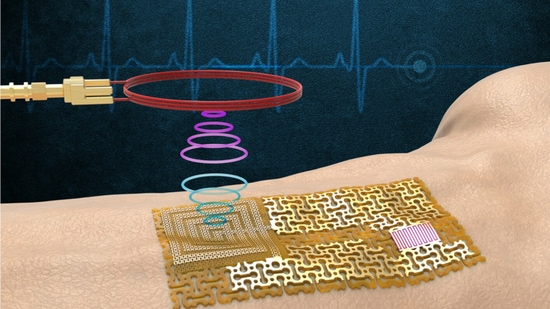
The new sensor – ‘e-skin’, as they call it, is an ultrathin semiconductor film of piezoelectric material which sticks to the skin, sensing the vibration of the body. It does not require any power source, either.
Piezoelectric material is a type of material which can generate an electric signal when mechanical strain is applied and will vibrate when electricity is passed through it. Thus, it can sense as well as transmit signals wirelessly. Researchers have used a high-quality film of gallium nitride as piezoelectric material.
The gallium nitride film was paired with a conducting layer of gold to amplify any incoming or outgoing electrical signal. The device vibrated in response to a person’s heartbeat, as well as the salt in their sweat, and that the material’s vibrations caused an electrical signal that could be read by a nearby receiver. In this way, the device could transmit wirelessly with no chip or battery. It can grasp any variation to the skin’s conditions, such as a change from a sped up heart rate, would influence the sensor’s mechanical vibrations, and the electrical signal that it repeatedly transmits to the receiver.
{{/usCountry}}The gallium nitride film was paired with a conducting layer of gold to amplify any incoming or outgoing electrical signal. The device vibrated in response to a person’s heartbeat, as well as the salt in their sweat, and that the material’s vibrations caused an electrical signal that could be read by a nearby receiver. In this way, the device could transmit wirelessly with no chip or battery. It can grasp any variation to the skin’s conditions, such as a change from a sped up heart rate, would influence the sensor’s mechanical vibrations, and the electrical signal that it repeatedly transmits to the receiver.
{{/usCountry}}“You could put it on your body like a bandage, and paired with a wireless reader on your cell phone, you could wirelessly monitor your pulse, sweat, and other biological signals,” said the study’s corresponding author, Jeehwan Kim.