
 E-Paper



Samsung is turning everyday appliances into an AI home that adapts to your digital life
Samsung’s connected-home strategy now revolves around AI-driven automation, appliance-to-appliance communication, and a deeply localised approach.

 Prefer HTon Google


You may be interested in

36% OFF

Samsung 330 L, 2 Star, Convertible 5-in-1, Digital Inverter, Frost Free Double Door, WiFi Enabled Bespoke AI Refrigerator (RT34DG5A2BSLHL, EZ clean Steel/Real Steel, Silver)
 Samsung 330 L
- 2 Star
- Convertible 5-in-1

₹34,990
₹54,990Check Details
31% OFF

Samsung 633 L, 3 Star, Frost Free, Double Door, Convertible 5-in-1 Digital Inverter, Side By Side Refrigerator with AI, WiFi & Water & Ice Dispenser (RS78CG8543S9HL, Silver, Refined Inox)
- Samsung 633 L
- 3 Star
- Frost Free
₹1,04,990
₹1,52,000Check Details
35% OFF

Samsung 330 L, 3 Star, Convertible 5-in-1, Digital Inverter, Frost Free Double Door, WiFi Enabled Bespoke AI Refrigerator (RT34DG5A4DBXHL, Luxe Black)
- Samsung 330 L
- 3 Star
- Convertible 5-in-1
₹37,490
₹57,990Check Details

Connected homes were once a hobby for early adopters who enjoyed wiring sensors and troubleshooting half-broken hubs. Samsung wants that era forgotten. Its engineers are now building a domestic ecosystem where screens, appliances, and AI routines stop behaving like gadgets and start behaving like partners in daily life. Samsung has a ‘sample’ smart home at its Suwon base in South Korea and it shows how far this idea has travelled and how quickly it is becoming the spine of Samsung’s long-term strategy for Digital Appliances. Yes, it’s no longer just ‘home appliances’ for Samsung.
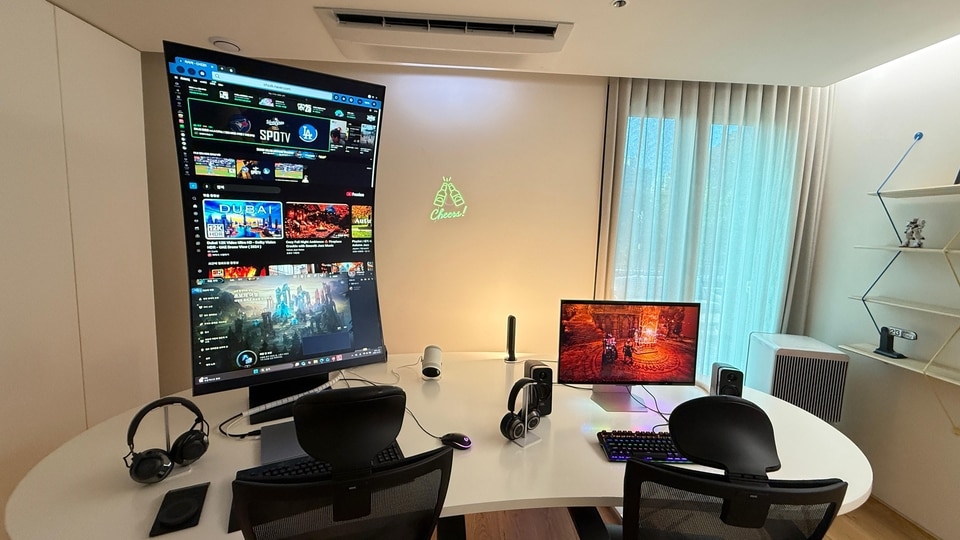

Samsung has spent more than a decade shaping SmartThings into the backbone of its connected-home vision. What began as a straightforward way to manage lights and sensors has evolved into a platform capable of coordinating everything from televisions and refrigerators to vacuum cleaners and security cameras. The shift is deliberate. Samsung no longer wants the smartphone to act as the sole command centre. Instead, it is turning appliances themselves into the brains of the home, reducing friction and eliminating the need for constant phone dependence.
That idea becomes clearer when you walk through Suwon. The campus sits at the intersection of tradition and modern engineering. It is where researchers monitor how people live, what slows them down, and how behaviour changes when technology becomes simpler. Jay Yoon, who oversees the company’s refrigerator R&D group, captures the mindset cleanly. His team is not trying to make appliances smarter for the sake of novelty. They are trying to make them fade into the background while quietly taking over repetitive tasks. Years of trial, failure, and refinement go into a feature that might look simple on the surface.

One example is the refrigerator display. It looks like a gimmick until you watch how the system behaves. A camera positioned inside the fridge monitors items moving in and out and recognises ingredients with surprising accuracy. That data feeds into meal suggestions, expiry alerts, and shopping prompts. The display itself works like a proper tablet. It can run apps, play music, deliver weather updates, and manage the entire kitchen without requiring a phone. It becomes a practical hub rather than a decorative add-on.
Samsung’s strength lies in the scale of its catalogue. Very few companies make televisions, washing machines, air conditioners, ovens, robot vacuums, and smartphones in-house. When these products start sharing information, the connected-home idea becomes far more believable. Walk out of the door and the Jet Bot+ can begin cleaning automatically while every appliance slips into its energy-saving profile. Return home and the system adjusts lighting, temperature, and content recommendations based on your habits. This is not about theatrics. It is about getting rid of small but frequent interruptions.
SmartThings remains the foundation supporting this behaviour. Born out of a burst water pipe incident in 2012, it has scaled to more than three hundred million users. Its purpose has shifted from basic device control to automation that anticipates routines. Appliances can now communicate directly. If the fridge identifies what needs to be cooked, the oven can preheat accordingly. If the washing machine detects the fabric and weight of a load, it can optimise detergent usage and energy consumption. Connect it to SmartThings and AI Energy Mode can reduce power usage without affecting wash quality.
Innovation is also happening inside the hardware. Refrigerators are expected to operate continuously, maintain cooling, and remain efficient. Samsung’s partnership with Johns Hopkins University has brought thin-film Peltier cooling closer to reality. Instead of relying entirely on traditional refrigerants, an electric current can cool one side of a semiconductor. If this reaches commercial maturity, it could lead to refrigerators that are more environmentally friendly and significantly more efficient.
Robot vacuums are seeing similar upgrades. The Bespoke AI Jet Ultra does more than boost suction. It maps surfaces, adjusts power based on flooring, and allocates battery usage intelligently. Washing machines learn from past loads and fine-tune dispensing over time. These improvements make AI feel less like a buzzword and more like a working layer of the home.

Localisation is another part of Samsung’s strategy. In India, customers get Curd Maestro technology because fermentation is part of daily cooking. Korea gets kimchi-specific refrigerators with tight temperature controls. The US market receives beverage solutions with auto-refill pitchers. These differences show that Samsung is designing the connected home for cultural habits, not just universal standards.
The timing matters for India. With 5G adoption expected to skyrocket over the next few years, the connected-home experience will only improve. Faster networks will reduce delays, improve device communication, and make automation feel immediate. Samsung, which builds the screens, sensors, processors, and software, is well placed to shape how these homes function.
The company’s long-term ambition is clear. The connected home is no longer a novelty. It is becoming a tool for cutting energy bills, simplifying chores, improving food management, and boosting household security. Samsung is positioning itself not as a seller of appliances but as the architect of a domestic ecosystem that adapts intelligently to its occupants. The home of the future is not defined by flashy features. It is defined by the quiet removal of everyday friction.


