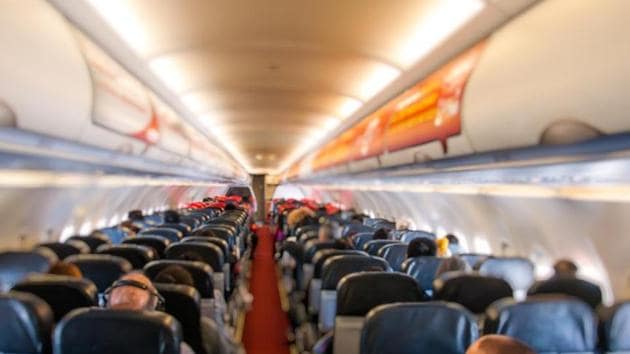
This weekend, a flight travelling from Greece to Philadelphia was hit by severe turbulence just before landing, sending three passengers and seven crew members to hospital. It’s the latest incident of extreme turbulence to make headlines for terrifying passengers. In June, a United Airlines flight traveling from Panama to Houston was also hit by extreme turbulence, slamming one passenger into the ceiling and leaving a dozen other fliers with bumps, bruises, and chest and neck pain. Similar cases have been reported around the world.
According to scientist Paul Williams of the University of Reading, this is just the beginning. In his study published in the journal Advances in Atmospheric Sciences this spring, Williams predicts that incidents of moderate-to-severe turbulence could increase by 127%, while severe turbulence could spike by 149% on transatlantic flights in the near future. Severe turbulence is defined as a force strong enough to catapult unbuckled passengers and crew around the aircraft cabin.
While there are studies aplenty detailing the effects of climate change for life on terra firma, Williams’ study shows that global warming will also have a major impact on air travel, generating stronger wind shears within the jet stream. Wind shears are a major cause of turbulence when they become unstable.
What’s particularly worrying about clear-air turbulence (CAT) — the type of turbulence attributed to climate change — is that it’s undetectable by satellites, on-board radar, or pilots, and therefore difficult to avoid, he adds. “For most passengers, light turbulence is nothing more than an annoying inconvenience that reduces their comfort levels, but for nervous fliers even light turbulence can be distressing,” Williams said in a statement.
{{/usCountry}}What’s particularly worrying about clear-air turbulence (CAT) — the type of turbulence attributed to climate change — is that it’s undetectable by satellites, on-board radar, or pilots, and therefore difficult to avoid, he adds. “For most passengers, light turbulence is nothing more than an annoying inconvenience that reduces their comfort levels, but for nervous fliers even light turbulence can be distressing,” Williams said in a statement.
{{/usCountry}}“However, even the most seasoned frequent fliers may be alarmed at the prospect of a 149% increase in severe turbulence, which frequently hospitalises air travellers and flight attendants around the world.” According to the Federal Aviation Administration, 44 people received serious injuries from turbulent flights in the US in 2016, compared to 21 in 2015 and 31 in 2014.
A serious injury is defined as requiring more than 48 hours of hospitalisation. To stay safe on board, the FAA reminds passengers to wear a seat belt at all times while seated, and use an approved child safety seat or device for children under the age of two.
Follow @htlifeandstyle for more
Catch your daily dose of Fashion, Taylor Swift, Health, Festivals, Travel, Relationship, Recipe and all the other Latest Lifestyle News on Hindustan Times Website and APPs.
Catch your daily dose of Fashion, Taylor Swift, Health, Festivals, Travel, Relationship, Recipe and all the other Latest Lifestyle News on Hindustan Times Website and APPs.