
 E-Paper



5-year-old names 'almost invisible' dwarf galaxy that baffled researchers
The name of the ‘almost invisible’ dwarf galaxy, Nube, was suggested by the 5-year-old daughter of one of the researchers.

 Prefer HTon Google


Astronomers discovered a mysteriously faint object which has left them puzzled. As per reports, this "almost invisible" dwarf galaxy shows characteristics that are contrary to the typical pattern shown by the galaxies.
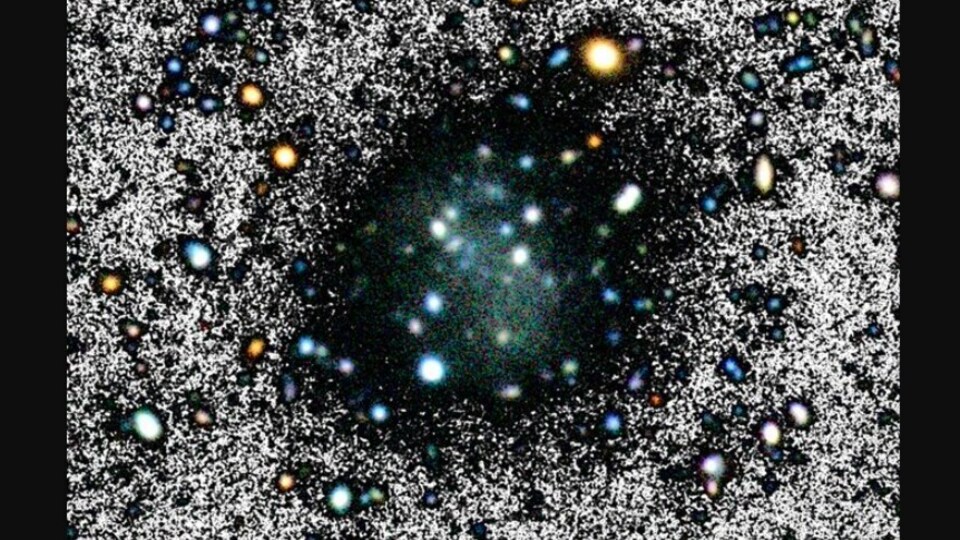
The galaxy is named Nube, mentions a study published in the journal Astronomy & Astrophysics. It was discovered by an international research team from the Instituto de Astrofísica de Canarias (IAC) in collaboration with the University of La Laguna (ULL) and other institutions.
How did the galaxy get its name?
One of the researchers in the study group asked his 5-year-old daughter what the image of the dwarf galaxy reminds her of. To which, she instantly said Nube, a word for clouds in Spanish.
Also Read: NASA's Hubble Space Telescope finds water vapour in exoplanet 97 light years away from Earth
What makes Nube different?
According to the study, “Its surface brightness is so faint that it had passed unnoticed in the various previous surveys of this part of the sky as if it were some kind of ghost. This is because its stars are so spread out in such a large volume that 'Nube' (the Spanish for “Cloud”) was almost undetectable.
Why did the dwarf galaxy baffle astronomers?
The newly discovered galaxy has specific properties which set it apart from the other galactic objects. According to the study, it is “ten times fainter than others of its type, but also ten times more extended than other objects with a comparable number of stars”.
Also Read: ‘Golden egg’ found on Alaskan seafloor baffles researchers
“With our present knowledge we do not understand how a galaxy with such extreme characteristics can exist,” explained astrophysicist Mireia Montes, the lead author of the study.
How far is Nube located?
Due to its faintness, it is hard to determine how far this galaxy is located. Using an observation obtained with the Green Bank Telescope (GBT), the researchers estimated that it is located 300 million light years away. However, only further research will show whether this distance is correct.
Talking about the distance of the galaxy, the study’s second author, Ignacio Trujillo, shared, “If the galaxy turns out to be nearer, it will still be a very strange object, and offer major challenges to astrophysics”.


