Is a degree from an elite institution like IIT Bombay actually worth it, especially in the day and age of AI? This is the question that Shikhar Agrawal, co-founder and CEO of Anahad, faces very frequently. In a LinkedIn post shared yesterday, Agrawal argued that many people misunderstand the true return on investment (ROI) of studying at an institution like IIT.
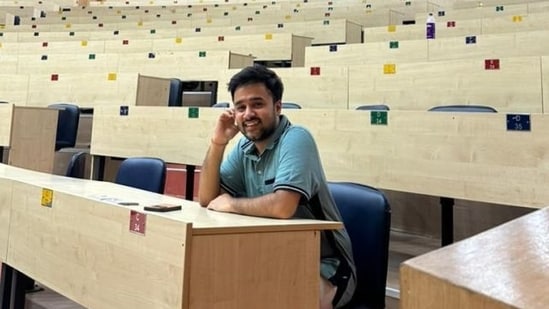
“It's been 5 years now since I left IIT Bombay, built Anahad but people still ask me, ‘IIT actually worth it tha? Or just hype?’” he claimed in his post. Many people, he said, ask whether AI has made a degree redundant to some extent by making information more accessible/
“Especially now, when AI can explain almost anything, information is free & a degree doesn't carry the same weight it once did,” wrote Agrawal, who graduated from IIT Bombay with a BTech in Mechanical Engineering in 2021.
(Also read: 5 IIT graduates who climbed to the top in the United States)
The value of an IIT degree
While the rise of artificial intelligence has made information freely available and reduced the importance of degrees in some industries, Agrawal believes the greatest value of IIT was never the classroom learning or the prestigious tag.
{{/usCountry}}While the rise of artificial intelligence has made information freely available and reduced the importance of degrees in some industries, Agrawal believes the greatest value of IIT was never the classroom learning or the prestigious tag.
{{/usCountry}}To explain what he meant, Agrawal turned to an unusual analogy involving goldfish.
He wrote that a goldfish's size depends largely on the environment it grows up in. "If you put them in a small bowl, it grows 2-3 inches. Put it in a larger aquarium & it grows 3-4 inches. But when you put it in a pond, it grows 5-6 inches."
"IIT was my POND," he added.
The analogy, he explained, was not about infrastructure or academic resources, but about the people around him. According to Agrawal, the biggest return from his four years at IIT Bombay was being immersed in an environment filled with exceptionally ambitious and capable peers.
The biggest return from IIT Bombay
“The biggest return IIT Bombay gave me wasn't the degree hanging on my wall or the tag on my LinkedIn profile. It was spending 4 years surrounded by some of the most ambitious, curious & capable people I'd ever met,” he said.
Agrawal said constantly interacting with students who were building tech products, questioning assumptions, solving difficult problems and thinking on a larger scale inevitably changed the way he approached his own ambitions.
"When everyone around you is building something, questioning assumptions, solving difficult problems, competing at a high level, and thinking bigger than you do, your own standards start changing," he wrote, suggesting that the peer group itself became one of the most valuable aspects of his education.
He went on to argue that this kind of environment has become even more valuable in the age of AI.
"Ironically, AI has made me appreciate that experience even more," he wrote.
A world of information
According to Agrawal, modern AI tools have democratised access to knowledge. Almost anyone can now obtain explanations, learn new concepts or find information within seconds. As a result, he believes knowledge itself is no longer the scarce resource it once was.
"We now live in a world of abundant information. Intelligence is accessible to everyone & AI can answer almost anything you ask it."
What remains difficult to recreate, he argued, is an environment that consistently pushes people to grow by surrounding them with extraordinary peers.
"But a great learning environment, one that challenges you, inspires you & stretches you through extraordinary peers, that is becoming rare. That's what IIT gave me. And no algorithm is going to replicate that anytime soon,” he concluded.
(Also read: ‘Can’t even jog in this life race’: IIT Bombay graduate opens up about pressure, expectations)