Wildlife official Ghulam Mohiuddin Dar and his colleagues break the ice on a frozen wetland, row their boats and spread grain to feed migratory birds in Kashmir.
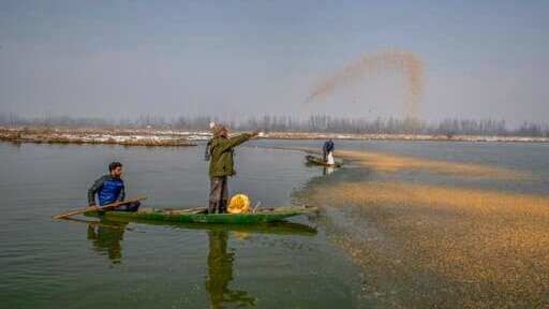
The officials feed the birds to prevent their starvation as weather conditions in the Himalayan region deteriorate, with two heavy snowfalls since December. Temperatures have plummeted to minus 10 degrees Celsius (14 degrees Fahrenheit).
Vast paddy fields and apple orchards are blanketed in snow. Scores of wetlands and lakes, including parts of famed Dal Lake, have frozen.
The cackles and cries of hundreds of thousands of birds that visit Kashmir during their winter migration have long been a welcome noise for the region’s inhabitants. They arrive from as far away as eastern Europe, Japan and Turkey to feed and breed in the wetlands nestled between the region’s mountain peaks and plateaus.
“They are our guests,” Dar said on a frigid day as he dropped grain at bird feeding points on the Hokersar wetland.
{{/usCountry}}“They are our guests,” Dar said on a frigid day as he dropped grain at bird feeding points on the Hokersar wetland.
{{/usCountry}}Officials say at least 700,000 birds have flocked to Kashmir in the past two months and expect more to arrive as temperatures improve in February.
In recent decades the numbers of visiting birds have declined, which experts say is due to a combination of climate change and urban development. They say construction around wetlands, accumulated trash and the changing Himalayan climate are robbing the birds of their traditional watering holes and nesting areas.
According to a recent study by the University of Kashmir, the Hokersar wetland shrank from nearly 19 square kilometers (7 square miles) in 1969 to 12.8 square kilometers (5 square miles) today.
Environmentalists are urging residents to offer food to the birds in the icy conditions.
“It’s not just our official duty to feed them but also a directive from God,” Dar said.