
 E-Paper



Paigah Nama: The Story of the Architectural Maven
Generally attributed to the Nizams, the Falaknuma Palace is even listed as one of their constructions on Wikipedia. But who actually built it?

 Prefer HTon Google


Born on 13th August 1856
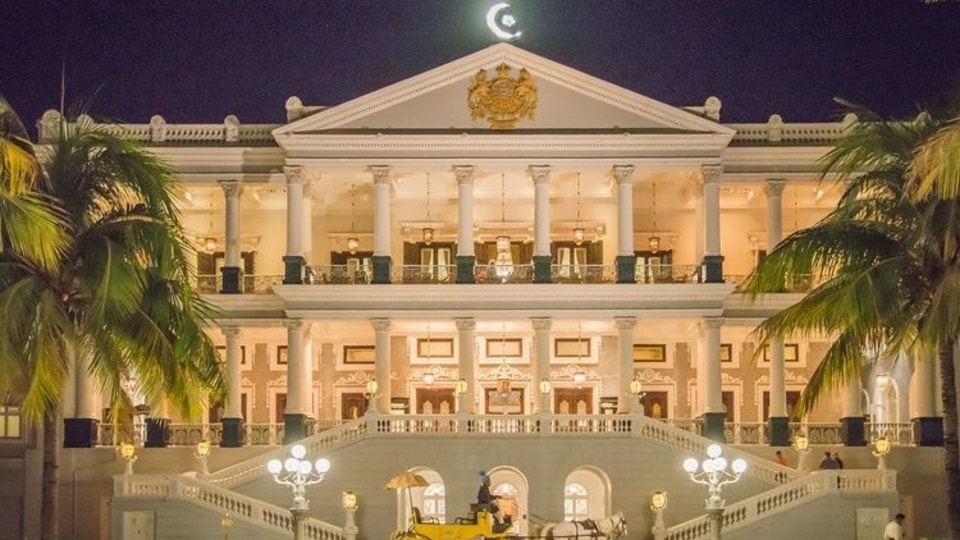
The largest and most prosperous princely state of the 19th and 20th centuries, the Nizams of Hyderabad truly lived a king-sized life with their colossal legends and opulent lifestyles. The regal grandeur of the Nizams accurately matched the possession of the Falaknuma Palace with its magnificent architecture and intricate craftsmanship.
Falaknuma Palace, which translates to ‘Mirror of the Sky’ was used as a private residence of the Nizams since 1897 and served as a jewel in their crown.
But, did you know that this palatial structure was neither built by the Nizams nor for them in the first place?
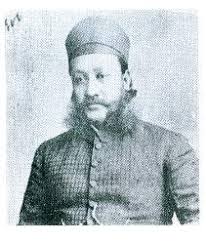
It was in fact the Prime Minister of the Nizams, Viqar-ul-Umra, who commissioned the building of the Falaknuma Palace as his private residence.
Viqar-ul-Umra was a member of the Paigah family, ranking second in the hierarchy next to the Nizams and were related to them through matrimonial alliances.
‘Paigah’, which translates to ‘pomp’ and ‘rank’ in Persian; was a title given by the second Asaf Jahi Nizam of Hyderabad to the estate of Nawab Abul Fateh Khan Taig Jung Bahadur in appreciation of his loyal services.
The Paigahs had accompanied Asaf Jahan’s exit from the Mughal Court to Hyderabad and were therefore their staunch loyalists. They were also traditionally responsible for the security of the Nizams and maintained a standing army.
Legend has it that once Viqar-ul-Umra invited the sixth Nizam Mahbub Ali Khan to his palace for a stay but immensely impressed by its splendour, the Nizam kept increasing his stay first by a week, then a fortnight, and then a month, to which the Nawab humbly offered his palace.
The Nizam gleefully accepted the offer and although it was presented as Nazar (gift), Mahbub Ali paid an obligatory sum of Rs. 2 million to the Paigah.
The 165th birth anniversary of this Paigah noble serves as a golden opportunity for us to learn about the forgotten Umra. His architectural marvels standing so tall in the city of Hyderabad till the present day are a glimpse of the noble’s fine taste in art and culture.
Not only the grand Falaknuma Palace, but Viqar-ul-Umra was also behind the construction of the Spanish Mosque, Paigah Palace, Aiwan-e-Begumpet, and several other deoris, palaces, lakes, and public buildings, each with a history and charm of its own.
The foundations for the Falaknuma Palace were laid in 1884 and took a long period of nine years for the completion of its construction. A majestic blend of Italian Gothic and Tudor architecture, the all-marble palace spread across 32 acres, 60 rooms, a Durbar Hall, a Banquet, and a huge courtyard is all things grand.
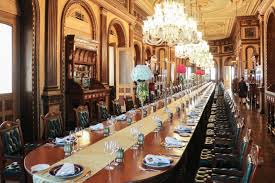
The 101-seater dining hall, believed to house the largest dining table in the world, with its chairs made out of carved rosewood and pure leather upholstery add to its glory. The interiors of the palace are a splendid interplay of Venetian chandeliers and intricate frescos, and have charming outdoor terraces.
A treasure of rare artefacts, including paintings, statues, furniture, manuscripts and 5,900 books housed in the royal library where you can also find the visitor’s book from a century ago and the first edition of books that were curated by the Nizam himself. The library is said to be a replica of the one at Windsor Castle, England.
The sophisticated wooden interiors, ornate crystal chandeliers, breathtaking views, and layers of history embedded in every corner truly make the Falaknuma Palace, now managed by Taj Group of Hotels, one of the most luxurious stays in the world.
A number of distinguished foreign and Indian dignitaries have graced the culturally rich building with their presence including Czar Nicholas II, King George V and Queen Mary, Rajendra Prasad, Donald Trump and Ivanka, among other notable guests.
Viqar-ul-Umra, after gifting the palace to the Nizam shifted his residence to Paigah Palace or Deodi Iqbal-ud- Daula, 20 kilometres away from Falaknuma. It is a large two-storeyed neo-classical building with a portico, semicircular arches, unfluted Corinthian columns, projected and pedimented windows and deep arcaded verandahs on all four sides. With huge rooms, high rise ceilings, and intricate woodwork, the palace is representative of the grandeur of the noble’s rank but lacks lustre in comparison to the Falaknuma Palace.
Who knows if it was intentionally done to avoid another shifting of houses?
Their relations with the Nizams were strongly reinforced through matrimonial relations. Viqar-ul-Umra was married to Jahander un Nisa Begum, the daughter of the Fourth Nizam, Afzal ad-Dawlah and sister of Nizam Mahbub Ali Khan. The Nawab had three wives, Jahander un Nisa, Muneer Un-nisa Begum, and Dr Gul Bai Vicajee.
The Paigahs were thus the first-among-equals amongst the nobles at the Hyderabad Court and were the only ones with the right to hold private palaces, courts, among other privileges.
The fifth Amir of the noble family, Sir Viqar-ul-Umra was conferred with majestic titles and his full name thus went like this. “H.E. Nawab Sir Viqar-ul-Umara, Iqtidar ul-Mulk, Iqbal ud-Daula, Muhammad Fazl-ud-Din Khan Bahadur, KCIE, Kaiser-i-Hind, Secundar Jung.
He served as the Prime Minister of Hyderabad from 1893 to 1901 and as the Amir-e-Paigah from 1881 to 1902.
His contributions were not limited to architectural splendours but also extended to education and it was under his prime ministership that the legislative council and the Asafia Library were opened.
In 1902, Viqar's life came to an end during a hunting expedition in a district of present day Telangana. Whose life had been a personification of grand architectural marvels, it was only fitting that his resting place be remembered as one too. Paigah Tombs, famously known as the 'Taj of South', house the tombs of generations of notable Paigahs, including Sir Viqar-ul-Umra's.
The tombs, a fine example of Indo-Islamic architecture are an eclectic mix of Rajputana and Asaf Jahi style. The centuries old architectural excellence now deteriorated by time and a lackadaisical approach by the authorities, lie forgotten amidst the hustle-bustle of Hyderabad city. While attempts at restoring the cultural heritage of the architecture have been initiated recently by the family and Government, our architectural maven would have certainly scorned at the deplorable state of affairs.
This was story was first published on This Day.app.


