
For New York City activists who support Tibet’s independence, it was unusual that a movement stalwart, Lobga Rangzen, didn’t join a major protest march July 1 between China’s Consulate and the United Nations headquarters.
Instead, Lobga had been preparing a far more dramatic act the next day: sacrificing his own life for the cause.
As the setting sun cast shadows onto the U.N. building on July 2, Lobga placed his black iPhone on a cracked New York sidewalk and began
For New York City activists who support Tibet’s independence, it was unusual that a movement stalwart, Lobga Rangzen, didn’t join a major protest march July 1 between China’s Consulate and the United Nations headquarters.
Instead, Lobga had been preparing a far more dramatic act the next day: sacrificing his own life for the cause.
As the setting sun cast shadows onto the U.N. building on July 2, Lobga placed his black iPhone on a cracked New York sidewalk and began livestreaming. Its camera captures him walking to the traffic’s edge, wearing a robe and holding a Tibetan flag on a long pole.
Then a spark—and a fireball engulfs him. With black smoke belching high into the sky, Lobga staggers some 90 seconds before collapsing in flames and a U.N. security guard rushes over blasting an extinguisher.
The video continues for more than 21 minutes as firefighters and rescue workers arrive to the scene of Lobga’s smoking body. Off-screen, a witness tells police he had smelled gas and “then the guy’s standing there on fire!”
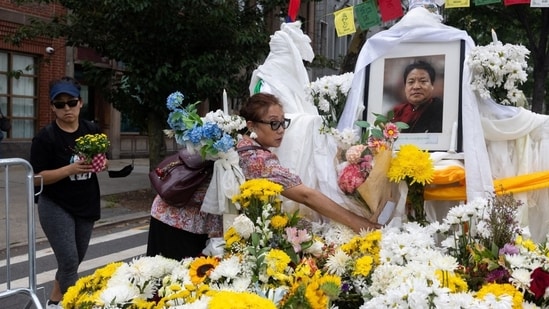
Lobga’s self-immolation has galvanized a global Tibetan diaspora that had become fractured and discouraged. News of the 52-year-old’s death went viral, along with a six-minute video manifesto he left behind, prompting demonstrations in Canada, France, Australia, India and elsewhere, including a floral shrine in front of the U.N.
“It has definitely had a unique impact on the community because this was such a well-known personality,” said Tenzin Dorjee, research director at advocacy group Tibet Action Institute.
Actor and Tibetan activist Richard Gere headlined an hourslong Times Square rally on Saturday honoring Lobga where many wore T-shirts depicting him as a martyr surrounded by flames.
“Frankly, I felt woken up by this,” Gere told the packed crowd.
Tibetans, whose Buddhist beliefs allow for infinite reincarnation, reject notions Lobga simply died by suicide.
“I want you to understand that this was not a deranged person,” said Jamyang Norbu, founder of the Tibetan National Congress, a political party. “This was someone who was making a political statement. A statement for Tibetan independence.”
Tibetan groups blame self-immolations—more than 170 since 1998 but most more recently—on desperation at repressive Chinese policies they say threaten ancient cultures. Until now, the phenomenon had been confined to Asia, primarily in China where virtually no details become public.
Tibet enjoys enormous global goodwill owing to its spiritual leader, the Dalai Lama, winner of the 1989 Nobel Peace Prize. But as the Dalai Lama turned 91 last month, his nonviolent “Middle Way” approach has failed to blunt Beijing’s drive for absolute political and religious control of Tibet, splitting the overseas Tibetan community over how to confront China.
China’s government rejects criticism of its policies, defends its treatment of ethnic minorities and accuses Western countries of double standards for ignoring their own human-rights problems.
A spokesman for Beijing’s Washington embassy said all self-immolations were tragic, yet also “instigated and manipulated by the Dalai [Lama] group in an attempt to advance its separatist agenda.”
The Wall Street Journal interviewed Lobga’s family, friends and fellow activists and reviewed images and writing he posted to social media to better understand what he was thinking in the days before his death.
“What he did was not for himself,” said his cousin, Lobsang Samdup. “His life was all about Tibet.”
Tibetans view swaths of China as their homeland, including the county of Kardze in Sichuan province on the eastern edge of the Tibetan plateau where Lobga was born. Family members say three of Lobga’s uncles perished during a defining Chinese crackdown on Tibet in 1959—when the young Dalai Lama fled to India—and other relatives were imprisoned.
As a teenager in 1992, Lobga joined an outflow of Tibetans migrating to India, which involves a dangerous monthlong trek across the Himalayas. Like many Tibetan men, he served as a monk, spending 12 years at a south India monastery. By 2006, he was in New York, though just how and why he emigrated remained a mystery to relatives and friends. American legal documents list him as Lobsang Palden; his name Rangzen means independence in Tibetan.
A large man comfortable in the spotlight, Lobga was the force behind numerous Tibet promotions, such as a 90-car rally to Philadelphia for the Dalai Lama’s 90th birthday.
He regularly livestreamed his activities, including explaining his advocacy while piloting his black Tesla as a driver for Uber. Each Wednesday near where he lived in the New York City neighborhood of Elmhurst in Queens, Lobga led a religious dance service wearing an outfit of oversize sleeves that accentuated his swinging arms and body twists.
Before going to work less than two years ago for Uber because of its flexible schedule, Lobga was fired from a series of jobs for skipping work to join protests, family said. Some speculated he never married for the same reason: obligations to the Tibetan movement came first. He shared an apartment with other Tibetans.
In his final days, people around him say Lobga began acting differently. He shaved off his black hair like a monk, gathered friends for tea and discreetly picked up the tab. He started smoking cigarettes. He went almost half a month without generating a fare for Uber.
Lobga spent much of his last week with his niece, including driving her and his roommates on July 1 to upstate New York for a daylong hike and picnic.
“What’s unusual, when I think back, he took a lot of pictures of us,” said the niece, Sonam Choedon.
On the way, Lobga lamented that he was missing an important protest. That day, China had implemented a new ethnic-unity law that Tibetans, Uyghurs, Mongolians and minority groups there say forces assimilation by criminalizing cultural activity, including use of their languages.
One of his best friends, Thupten Chonyi, was perplexed Lobga skipped that march between China’s Consulate and the U.N. on opposite sides of Manhattan.
When they finally connected by video call in the late afternoon of July 2, the friend was surprised to see Lobga’s T-shirt drenched in sweat and that he was smoking. He seemed uncharacteristically sad and upset.
All that Lobga let on was, “I’m thinking something. I’m thinking,” Thupten Chonyi recalled.
Thupten Chonyi’s WhatsApp account shows that at 5:38 p.m., he received a message with four photos: a screenshot of the pair speaking, two fliers criticizing Chinese rule of Tibet and a portrait of Lobga posed like a warrior.
In the portrait, Lobga sits a few blocks from the U.N. on the red-carpet steps of a pricey Manhattan restaurant and is seemingly drawing attention to the sizable Tibet independence tattoo on his right arm. He holds a long green pole with the price tag still attached, plus a heavy bag labeled New York and another bag with a Tibetan flag sticking out and decorated with the logo of a Tibetan independence conference he had attended in Toronto.
Minutes later, Lobga was in flames outside the U.N., near a Tibetan flag attached to a green pole. The New York Police Department says officers responded to a 6:32 p.m. emergency call and found a man suffering “severe burns throughout his body,” who was later pronounced dead at a nearby hospital.
Lobga began his video manifesto by criticizing the ethnic-unity law: “What I want to say is that communist China’s policies and activities in Tibet are targeted at completely destroying the Tibetan people,” he said in Tibetan.
“For the struggle of our people, if we don’t do anything,” he said in the video, “we will not achieve anything.”
Write to James T. Areddy at James.Areddy@wsj.com
One Subscription.
Get 360° coverage—from daily headlines
to 100 year archives.
Archives
HT App & Website