After President Donald Trump's order to the Department of War to begin testing the US's nuclear weapons, China on Thursday said that it “hopes” Washington will abide by the nuclear testing ban.
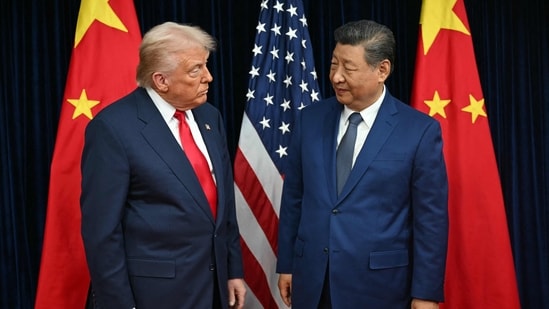
Earlier in the day, just a short while before meeting Chinese President Xi Jinping in South Korea, Trump announced on Truth Social that he has ordered the Pentagon to begin conducting nuclear weapons testing because other countries are testing their programmes.
“The United States has more Nuclear Weapons than any other country. This was accomplished, including a complete update and renovation of existing weapons, during my First Term in office. Because of the tremendous destructive power, I HATED to do it, but had no choice! Russia is second, and China is a distant third, but will be even within 5 years," Trump said.
He added, “Because of other countries testing programs, I have instructed the Department of War to start testing our Nuclear Weapons on an equal basis. That process will begin immediately."
ALSO READ | Tariff cut, rare earth deal: Trump reveals the deals made during meeting with Xi
{{/usCountry}}He added, “Because of other countries testing programs, I have instructed the Department of War to start testing our Nuclear Weapons on an equal basis. That process will begin immediately."
ALSO READ | Tariff cut, rare earth deal: Trump reveals the deals made during meeting with Xi
{{/usCountry}}China's remark on the 'ban' comes in reference to the 1996 Comprehensive Nuclear Test Ban Treaty (CTBT), which bars "any nuclear weapon test explosion or any other nuclear explosion". Many countries, including the US, Russia and China, are signatories to CTBT.
US Nuclear Testing
Trump's order implies that the US will resume nuclear weapons testing after a gap of 33 years.
The US first opened the era of nuclear weapons in July 1945 when it tested a 20-kiloton atomic bomb at Alamogordo, New Mexico. A month later, America dropped atomic bombs on Japan's Hiroshima and Nagasaki to force Tokyo to surrender in World War II.
Four years later, the Soviet Union set off its first nuclear bomb in August 1949.
In the five decades between 1945 and the 1996 CTBT, more than 2,000 nuclear tests were conducted, of which 1,032 were done by the US and 715 by the Soviet Union, Reuters reported, citing the United Nations. Britain carried out 45 nuclear tests, France 210 and China 45.
ALSO READ | Russia tests new nuclear-capable cruise missile: What do we know about Burevestnik?
Since the nuclear testing ban treaty came into place, 10 nuclear tests have been conducted. India carried out two in 1998, Pakistan also two in 1998, and North Korea conducted tests in 2006, 2009, 2013, twice in 2016, and 2017.
The US last tested a nuclear weapon in 1992, while China and France did so in 1996 and the Soviet Union in 1990.
Since Russia inherited most of the nuclear weapons arsenal of the Soviet Union, it has never carried out such tests.
Why was nuclear testing banned
Concerns increased over the impact of the nuclear tests on ground, underground, underwater, and above ground, on human health and the environment.
The West was testing in the Pacific and the Soviet Union in Kazakhstan and the Arctic. Activists reportedly said that millions of people in both the Pacific and Kazakhstan had their lands contaminated by nuclear testing, which led to them facing health issues for decades to come.
Advocates said that by limiting the Cold War bonanza of nuclear testing, tensions between the US and Russia could be reduced.
The CTBT was signed by Russia in 1996 and ratified in 2000. In contrast, the US signed the treaty in 1996 but has not ratified it, Reuters reported.
In 2023, Russian President Vladimir Putin formally revoked Moscow's ratification of the nuclear test ban treaty, bringing his country in line with the US.
According to the Federation of American Scientists, Russia has a total of around 5,459 nuclear warheads, while the US has about 5,177.
But a Washington DC-based Arms Control Association has said that the US has 5,225 nuclear warheads and Russia has 5,580.