At the heart of the escalating tensions over border between Thailand and Cambodia is an ancient Hindu temple with Lord Shiva as its main deity.
At least 12 people have been killed in the latest cross-border hostilities between the Southeast Asian neighbours, with both exchanging rocket fire and airstrikes using F-16 jets.
ALSO READ | Why are Thailand and Cambodia on the brink of war?
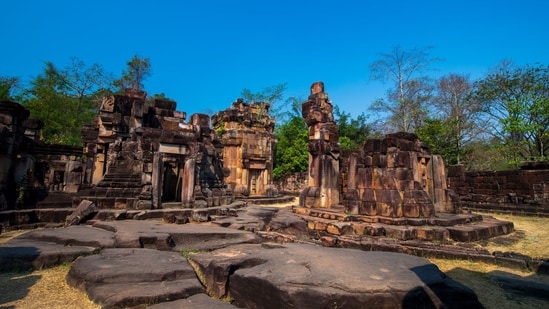
The Prasat Ta Muen Thom temple is part of an archeological site which is home to two other Khmer-style religiously important structures and located in the Dangrek mountains at Ban Nong Khanna. The entire archeological site is on the Thai-Cambodian border.
About three sites, including Hindu temple, at heart of Thailand-Cambodia issue:
PRASAT TA MUEN
Prasat Ta Muen, a Mahayana Buddhist religious site, was constructed as a dharamshala (a place of accommodation for travellers). It is one of the 18 places built by King Jayavarman VII, according to tourismthailand.org.
The structure is made of laterite, a reddish clay-like material, and looks like a single, tall, tower-like spire.
A long room is connected to the front of the Prasat (a royal palace or sacred religious structure according to Thai architecture), and the opaque north wall has a window, not a real one, but an engraved one. The southern part of the structure also has windows lined up throughout.
ALSO READ | Thailand-Cambodia border clash: 11 civilians dead in missile exchange; Thai hospital attacked | Video
Earlier, there were two to three pieces of lintels, a horizontal structural beam across openings like doors or windows, with images of Buddha in meditation posture. These were present in the Ruean Kaeo arch.
PRASAT TA MUEN TOT
{{/usCountry}}Earlier, there were two to three pieces of lintels, a horizontal structural beam across openings like doors or windows, with images of Buddha in meditation posture. These were present in the Ruean Kaeo arch.
PRASAT TA MUEN TOT
{{/usCountry}}Then comes the Prasat Ta Muen Tot, situated 340 metres from the Prasat Ta Muen. This was built in the 13th century and is one of the 102 places built by King Jayavarman VII. Prasat Ta Muen Tot used to be a hospital shrine for the local community.
The structure, which is still in near-perfect condition, has a principal Prasat, in square shape, with a front porch made of sandstone and laterite.
There is also a library to the right of the Prasat, surrounded by laterite walls and an arch (gopura) in the southeast front. Outside the front wall is a pond.
ALSO READ | How do Cambodia and Thailand's militaries compare?
The middle part of the gopura contains a stone inscription, which has Khmer characters inscribed in Sanskrit. King Jayavarman VII ordered the stone inscription to be built for the shrine.
The text pays tribute to Phra Phaisachaya Khuru Waituraya, the Bodhisattva of pharmacology. It mentions the appointment of employees at the hospitals in various departments, such as doctors and caregivers. The main inscription is currently kept at the National Library, Tha Wasukri, in Bangkok.
PRASAT TA MUEN THOM
Last comes the main architecture that lies at the centre of the Thai-Cambodian conflict, Prasat Ta Muen Thom. The temple, built as a Hindu shrine around the 12th century by King Udayadityavarman II, is located around 800 metres to the south of Prasat Ta Muen Tot. The shrine, which regarded Lord Shiva as the supreme deity, is older than the other two Prasat structures and also the largest one among the three.
Prasat Ta Meun Thom has one principal prasat, in the centre, which is the largest, while the other two are located on the right and left. It is built of sandstone facing south.
ALSO READ | Thailand, Cambodia shut borders, expel diplomats as tensions rise | What we know
The interior of the principal prasat houses some crucial evidence, the Shiva Lingam extracted from natural stone. A waterway from the Lingam goes from the principal prasat to the east side of the balcony.
Additionally, there are two libraries made of laterite on the southeast and southwest sides of the principal prasat.
There is also a winding corridor made of sandstone that surrounds the entire building, with a laterite-covered pool right outside the walkway on the north side.
According to tourismthailand.org., tourists have been cautioned to first enquire with the military unit in charge of the area before making a visit to the site, as it is near the Thai-Cambodian border. They have also been advised to carry an ID card or passport with them for the visit.