Prosperity and infrastructure development have not come with improved safety
Published on: Jul 13, 2026, 16:00:45 IST
The Economist
Prefer HTon Google
Share via
Copy link
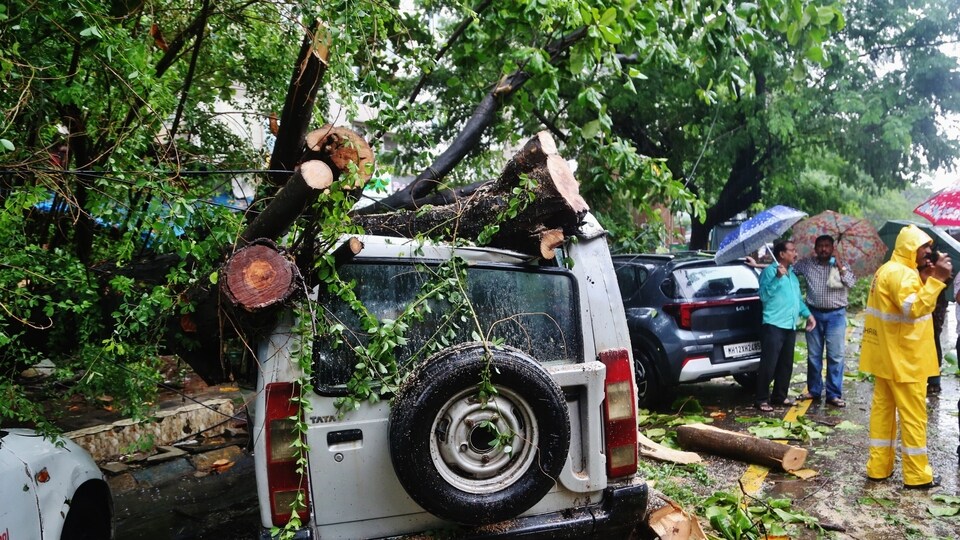
NO METROPOLIS IN India and few big cities anywhere receive as much rain in as little time as Mumbai. Even by the city’s own standards it has been an exceptionally soggy July, the wettest bit of the monsoon. It rained as much in the first week as it normally does over the whole month. Wind speeds of over 75kph wreaked havoc. By July 7th, 830 trees had fallen (compared with 855 in all of 2025) along with 1,238 branches. An 11-year-old was crushed inside his school bus; an 18-year-old on his bike; a 63-year-old outside his shop.
By July 7th, 830 trees had fallen (compared with 855 in all of 2025) along with 1,238 branches. (Praful Gangurde/Hindustan Times)
Citizens blame the authorities for blocking the roots of trees with concrete. Officials counter that no city in the world could weather this weather. They have a point. Strong winds in Beijing last year knocked down 843 trees and 2,572 branches in a single day. But the problem with that explanation is that the phenomenon of objects falling on and killing people is not restricted to the monsoon, to trees or to Mumbai.
Everything that can crush someone has crushed someone in India—including an actual anvil (in 2024). On just one day this month a jamun tree cracked a man’s skull, a tanker overturned and squashed two people in an autorickshaw and a trash mountain tumbled onto a building, which then collapsed, trapping 12. India is the land of death from above.
The good news is that death by tree should become less common. India is cutting them down to make way for flyovers, metro lines and other infrastructure. The bad news is that this brings its own hazards. Among the things that have fallen on people in recent years are slabs of concrete, iron rods, iron pipes, iron plates, a 40,000kg block of iron, a piling rig, a crane’s trolley and various sections of under-construction bridges. Airport-terminal canopies have collapsed in Delhi, Jabalpur and Rajkot. As one newspaper put it recently, “Yet another unsuspecting citizen walks past an infra-project and nearly pays with his life.” That India is at last creating much-needed infrastructure is laudable. If it could do so without killing passers-by that would be even more so.
When it is not the new stuff that is collapsing, it is the ageing and decrepit. The roof of a school in Rajasthan—which gets almost no rain—crushed seven children last year. Two more school roofs in the same state fell the next day. Another two in the past few weeks. In April a student died when a basketball post toppled onto him, the third such incident in six months. Nothing is too absurd or tragic. In 2024 an illegal billboard, three times the maximum permitted size, collapsed and killed 17 people at a petrol pump. Nine workers were killed at a steel plant last month when a bucket dropped molten metal at 1,600°C on them. The response is usually to suspend some officials, arrest a scapegoat or offer “ex gratia” compensation and move on.
For citizens, the answer to this crisis is not to walk around looking up, forever fretting about what might befall them. For there is another hazard: that the ground beneath simply crumbles away. Well before the monsoon started, motorcycles and whole cars were being swallowed up by unmarked open pits in streets across India. In May two dozen candidates outside an exam centre fell into a sewer when the pavement gave way. This month the staircase collapsed in the offices of one northern city’s development authority. Last month a Mumbai municipal official fell into a drain while accompanying the mayor to inspect drainage.
One response would be for the state to do a better job of enforcing health-and-safety regulations and road-traffic rules designed to prevent exactly this sort of needless loss of life. Another is to marvel at the sheer absurdity of it all, as Ameet Satam, a legislator and the Mumbai president of the ruling Bharatiya Janata Party, was no doubt doing when he was captured on video laughing, “Yesterday it was because of a tree, today it is a manhole.”
In 1996 Steve McCurry, a photographer, took a picture that captured the essence of Mumbai at the time: framed against the city’s magnificent Indo-Gothic railway terminus, a taxi driver reclines on the bonnet of his car reading a local tabloid. The front-page headline reads: “BLDG CRASHES IN FORT, 2 DIE”. Much has changed in the decades since, not least India’s income per person, which has quadrupled. But some things remain the same. Earlier this year another newspaper summed up in a front-page headline what many Indians know to be true: “NOWHERE IS SAFE”.
Get the latest World News, breaking headlines and global updates from the US, UK, Pakistan, Bangladesh, Russia and other countries. Follow major international events on Hindustan Times.
Home/World News/An Incomplete List Of Falling Objects In India

 E-Paper





 Prefer HTon Google