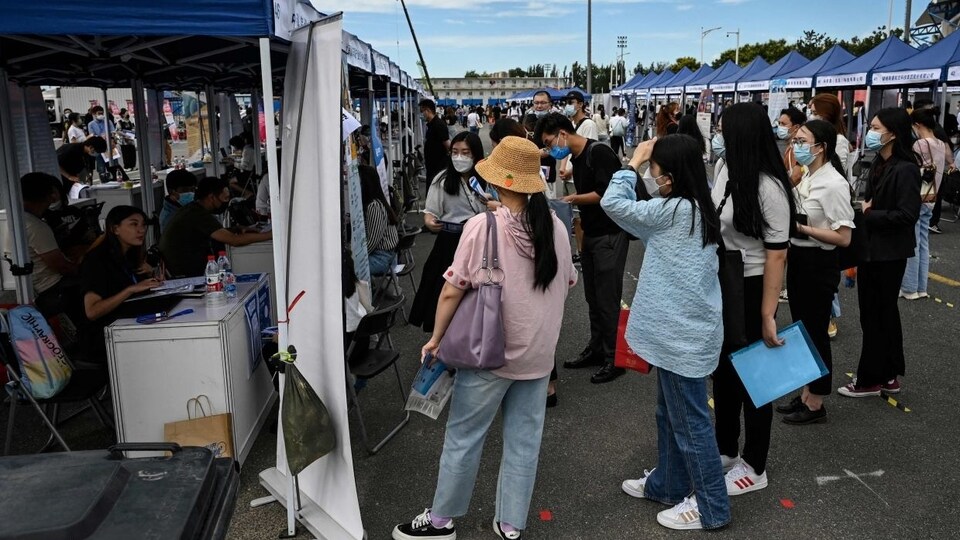
Chinese social media buzzwords can offer insight when official data is unreliable. One hashtag making the rounds shows mounting frustration among jobseekers, signaling that efforts to boost employment are falling short.
China’s private sector can’t accommodate millions of young people entering the labor market each year.
The phrase “beauty in the time of economic upturns” has been trending on Chinese sites for months, a nostalgic reference to the 2000s-2010s when it was common for fresh graduates to field multiple job offers.
China’s youth nowadays aren’t as fortunate.
The private sector can’t accommodate millions of young people entering the labor market each year, forcing many to accept positions that don’t deliver on dreams of fat paychecks and job security.
Many compete to join the ruling communist party to lock down a job in its vast bureaucracy.
This year’s trade war with the U.S. has added to the sense of uncertainty about the future.
Hitting the official 5% economic growth target looks like a stretch, consumer confidence is weak, deflationary pressure is entrenched and there’s no end in sight for the property sector’s slump.
“We see continued signs of deterioration in the labor market,” Barclays economists said in a recent note, pointing to employment subindexes in recent purchasing manager surveys showing that angst surrounding U.S. tariff is slowing hiring.
Economists look at PMIs and other indicators due to the unreliability of official job market figures. China’s statistics bureau paused the release of youth unemployment data for a few months after the rate hit a record high in June 2023, and started posting them again after making changes to how it calculates the number.
Goldman Sachs’s wage tracker suggests the pay growth has been trending down since the first quarter of 2023 when China ended its zero-Covid policy. Despite economic growth in the most recent quarter, sluggish pay increases could weigh on consumption through the rest of this year, GS said in a recent note.
Beijing’s stepped-up efforts to bolster employment don’t seem to be bearing fruit yet, even though its introduced tax incentives for companies and more vocational training for job seekers.
Barclays’s gauge of private-sector indicators, plus anecdotal evidence across industries and regions, point to scant improvement in the labor market. Instead, there have been more reports of pay cuts and layoffs, the economists said.
A poll by Beijing-based Cheung Kong Graduate School of Business shows that hiring has been much weaker than average for the past two years, said Ernan Cui at Gavekal Dragonomics.
Those who do get hired are making less and less, indicators suggest.
Chinese wages fell sharply across multiple sectors last year, eclipsing the rout seen during the pandemic in 2020, to mark the worst outcome on record, she said. The tech sector has been the worst-hit in the private sphere, but public-sector employers have also cut wages, reflecting local governments’ fiscal stress, Cui said.
That’s feeding into low consumer confidence, Cui said. “Many people sense that their job and income prospects are precarious, and are thus unwilling to spend.”
Policymakers will need to strengthen the social safety net and encourage private sector growth to boost the availability of high-quality jobs, economists say.
Until things improve, “beauty in the time of economic upturns” could continue to trend on Chinese social media.
As one blogger on lifestyle app RedNote put it: What people are reminiscing about is when income growth and appreciating housing prices were a certainty, “and there was a sense that entrepreneurial spirit will be rewarded, things that were never questioned during better economic times.”
Get the latest World News, breaking headlines and global updates from the US, UK, Pakistan, Bangladesh, Russia and other countries. Follow major international events on Hindustan Times.
Home/World News/Chinese Social Media Hashtag Signals Growing Frustration With Job Market

 E-Paper