
 E-Paper



Donald Trump repeats ‘51st state’ call after imposing tariffs on Canada, escalates tension
Donald Trump officially approved the previously threatened 25% tariffs on Mexico and Canada, despite the three nations being part of a free trade agreement.

 Prefer HTon Google


US President Donald Trump on Sunday once again called for Canada to become a US state, escalating tensions with one of the country's closest allies after imposing heavy tariffs.
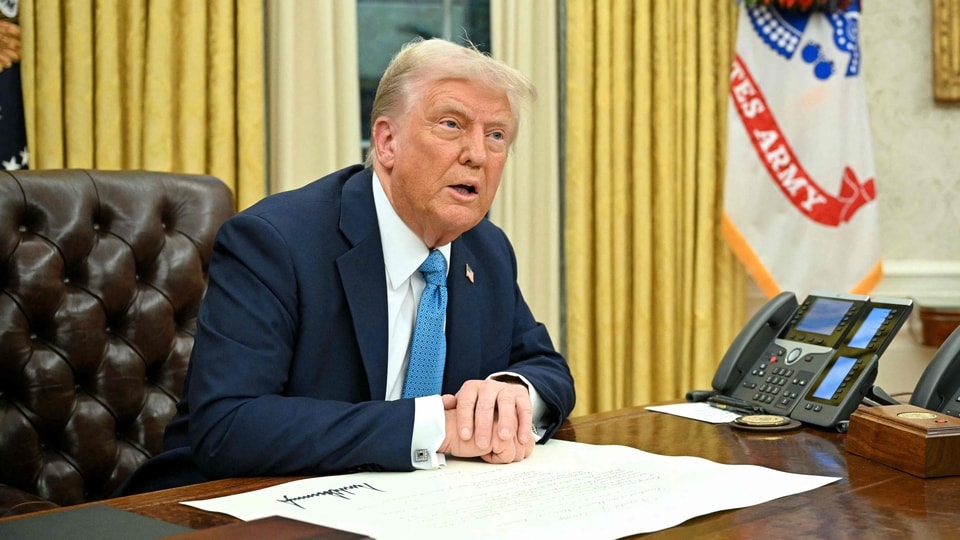
In a social media post, Donald Trump reiterated his call for Canada to join the United States, further straining relations following the recent trade measures. Claiming that the US pays “hundreds of billions of dollars to SUBSIDIZE Canada,” seemingly referring to the trade deficit, Trump said, “without this massive subsidy, Canada ceases to exist as a viable Country.”
Also Read | Tariffs imposed by Donald Trump on Mexico, Canada and China: What are they?
“Therefore, Canada should become our Cherished 51st State,” he wrote on his Truth Social platform, asserting that the move would lead to “much lower taxes, and far better military protection for the people of Canada - AND NO TARIFFS!”
Meanwhile, Canadian Prime Minister Justin Trudeau vowed on Saturday that Canada would retaliate with 25 percent tariffs on select American goods worth Can$155 billion (US$106.6 billion). The first round of tariffs is set to take effect on Tuesday, with a second phase following in three weeks.
Several Canadian provincial leaders have also announced countermeasures, including the immediate suspension of U.S. liquor purchases.
Also Read | Why did Donald Trump impose tariffs on Canada, Mexico and China?
Tariffs on Canada, China and Mexico
On Saturday, President Donald Trump officially approved the previously threatened 25 per cent tariffs on Mexico and Canada, despite the three nations being part of a free trade agreement. He also imposed a 10 per cent tariff on China, adding to existing trade levies.
Trump justified the tariffs, set to take effect on Tuesday, by invoking the International Emergency Economic Powers Act.
The decision triggered immediate pledges of retaliation from all three affected countries, while analysts warned that the resulting trade war could slow US economic growth and lead to higher consumer prices in the short term.
Speaking on Sunday, Trump acknowledged that Americans might experience economic "pain" due to the tariffs on key trading partners but insisted it would be "worth the price" to protect US interests.
Canadian Prime Minister Justin Trudeau and Mexican President Claudia Sheinbaum discussed the US tariffs in a call, according to Trudeau’s office. The two leaders agreed to collaborate on shared concerns and strengthen Canada-Mexico relations.
According to the US Census Bureau, the 2024 trade deficit in goods with Canada stands at $55 billion.
Trump’s tariffs are a response to what he claims is a failure by Canada, Mexico, and China to curb the flow of undocumented migrants and illegal drugs, including fentanyl, into the U.S.
Canada’s exports to the US largely consist of oil, automobiles, vehicle parts, bauxite, and aluminum. White House officials stated that energy imports, such as oil and electricity, will be exempt from the full 25 per cent tariff and will instead face a 10 per cent levy. This measure is intended to limit price increases on gasoline and home-heating oil.
(With inputs from agencies)


