India and Canada formally launched their inaugural Economic and Financial Dialogue in Toronto on Thursday as Finance Minister Nirmala Sitharaman said that in a time of global uncertainties, the two countries could work together to bring predictability to global growth.
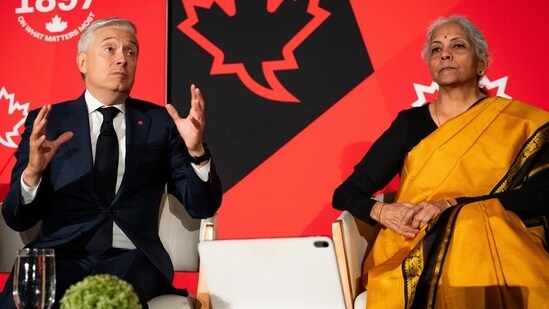
The Dialogue took place between Sitharaman and her Canadian counterpart Francois-Philippe Champagne.
India, Canada seek deeper economic partnership amid global uncertainty
Canada is going through tariff turmoil amid a trade war with its southern neighbour, the United States. And Prime Minister Mark Carney has focused on diversifying Canada’s trade basket to mitigate the reliance on America. In his opening remarks as the Dialogue commenced, Champagne said, “Canada has been saying we’re going to be strong at home and diversified abroad. So this is very much our diversification agenda in action.”
He said the two countries have “unique” complementarity. “That is really the key message today. We can be a very strategic partner to India when it comes to energy security, to food security. We had the privilege of hosting the minister yesterday for dinner,” the Canadian Finance Minister stressed. In return, he said later, India can provide to Canada “scale, talent, and technology”.
Also read: India expresses readiness to initiate negotiations on investment treaty with Canada
{{/usCountry}}Also read: India expresses readiness to initiate negotiations on investment treaty with Canada
{{/usCountry}}After the meeting, he said it was “very fruitful” and the two countries were “aligned”. “Canada is a very stable and predictable partner. And I think in today’s world, what people are looking the most is trust. And I think trust is what Canada can offer to our Indian colleagues and Indian friends. And I hope so today that this is just the beginning,” Champagne noted, touting his country as the partner of choice for energy and food security for Indian, particularly given the current crisis in the Strait of Hormuz.
Sitharaman agreed. She said this was possibly the “best time to start this dialogue” between Canada and India “because global uncertainties being what they are and they seem to continue with severity. Economies like Canada and India can bring so much more predictability and certainty to the global growth”.
Sitharaman calls for resilient, inclusive economic ties
She elaborated after concluding the discussion, stating, “The world is going through a profound transformation, there’s just a lot of uncertainty everywhere and the geopolitical and economic realities are constantly evolving. So in this background, closer economic cooperation has become increasingly important to build resilient, sustainable and inclusive economies both in Canada and in India.”
She added the Dialogue reflected the “broad ambition” to move beyond traditional trade and goods and services. and “build a deeper economic partnership encompassing investment, finance, capital markets, and regulatory cooperation”.
She also said that on food security, energy security, and also on critical minerals, a relationship can be built between the two countries “that will go into the strengthening of our people’s purchasing power, ability to face supply chain disruptions, and it will be a conscious effort to address the concentration risks in global sourcing of commodities or intermediary products”.
Also read: India, Canada could sign investment protection pact by end of year: Sitharaman
Canadian pension funds have nearly $79 bn invested in India
She alluded to her multiple meetings with Canadian pension funds’ leaders on Wednesday, along with sovereign wealth funds, private entrepreneurs, and the private equity leadership. Canadian pension funds have nearly CA$ 110 billion (USD$79.2 billion) invested in India.
Both countries are also expected to pursue a foreign investment protection agreement, with the objective of completing the negotiations at the same time as the ongoing comprehensive economic partnership agreement talks end. Both Prime Ministers have set a deadline of the end of this year for that purpose.
Also read: India is against weaponising economy: Sitharaman
Economic dialogue follows reset in bilateral ties
Sitharaman also referred to the reset in the relationship, describing it as a “wonderful time” for bilateral ties. That renewal started after Carney assumed charge as Prime Minister in March 2025 and invited Prime Minister Narendra Modi to the G7 Leaders’ Summit in Kananaskis two months later. They have met twice more since, with Carney visiting India in February/March this year. Modi is expected to travel to Canada this December.
The reset came after ties cratered following previous Canadian PM Justin Trudeau’s statement in the House of Commons on September 18, 2023, that there were “credible allegations” of a potential link between Indian agents and the killing of pro-Khalistan figure Hardeep Singh Nijjar in Surrey, British Columbia, three months earlier. India had dismissed those accusations as “absurd” and “motivated”.