New Delhi: With PML (N) veteran leader Nawaz Sharif taking the pole position in Pakistan general elections today, India should expect stability on its western borders at least for next three years as Mian Sahib has not only the blessings of Rawalpindi GHQ but also is a mature experienced leader unlike his predecessor and now incarcerated Imran Khan, and childish PPP leader Bilawal Zardari.
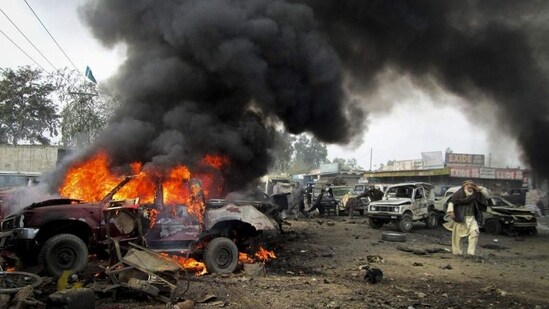
However, whosoever the Pakistan public elects as the new leader, the country is no bed of roses and the next Prime Minister will have to deal with problems ranging from a pathetic economy, rampant insurgency in Balochistan and KPK, a state within state terrorist groups in Punjab province and a highly radicalized Islamic society within the exalted sense of geographical identity. Simply put, Pakistan is a failed state thriving on doles from China, which uses Islamabad in its effort to contain its arch-rival India.
Also Read | Pakistan election 2024 in numbers: Facts that you must know
While there is no doubt that Pakistan Army is the biggest stakeholder in India’s neighbouring country and runs the Islamic Republic from the shadows, Nawaz Sharif is the best bet for Rawalpindi as its experiment with the unscrupulous Imran Khan failed miserably. Sharif has been removed by Pakistan President, Pakistan Army and Pakistan Supreme Court in the past, yet has the gumption to trudge his own path. His last tenure as PM was numbered after the word Kashmir, smelling salts for all Punjabi Pakistanis, was found amiss in the India-Pakistan joint statement at Ufa on July 10, 2015, after Nawaz Sharif met Prime Minister Narendra Modi. But then the same word was found missing when Nawaz Sharif came for PM Modi’s swearing-in ceremony on May 26, 2014, even during the one-to-one the two leaders had after the ceremony.
While the leftist-liberal media of the Indian sub-continent and the west tries to draw an equivalence between India and Pakistan by calling them nuclear powered rivals, the fact is that the Modi government has only cross-border terrorism on its agenda with Pakistan having moved on from Islamabad in the past decade of Narendra Modi. Since PM Modi respects Nawaz Sharif, India will give another chance of normalization of ties with Pakistan if the PML (N) leader takes the chair but its objectives insofar as Pakistan are concerned will remain unchanged. Bluntly put, India will not take cross-border terrorism lying down and will retaliate in kind.
{{/usCountry}}While the leftist-liberal media of the Indian sub-continent and the west tries to draw an equivalence between India and Pakistan by calling them nuclear powered rivals, the fact is that the Modi government has only cross-border terrorism on its agenda with Pakistan having moved on from Islamabad in the past decade of Narendra Modi. Since PM Modi respects Nawaz Sharif, India will give another chance of normalization of ties with Pakistan if the PML (N) leader takes the chair but its objectives insofar as Pakistan are concerned will remain unchanged. Bluntly put, India will not take cross-border terrorism lying down and will retaliate in kind.
{{/usCountry}}Also Read | Pakistan election today: Voting amid rising violence, economic crises
In case Nawaz Sharif becomes the PM of Pakistan, then trade and traditional ties may resume with Islamabad provided the new PM takes action against rabidly anti-India Punjabi terrorist groups in Pakistan. Fact is that Pakistan can ill-afford to heat up its eastern border with terrorism as its western front is burning with both Iran and Afghanistan upset at the machinations of Pakistani deep state and Baluch and Tehreek-e-Taliban Pakistan (TTP) insurgency at its peak.
Unlike his predecessors, Prime Minister Narendra Modi is not looking for any legacy with Pakistan and is crystal clear on what to expect from the rabidly radicalized state. With Nawaz Sharif as PM, there should be a semblance of stability on India’s western front though it will take Pakistan decades to come out of the economic and political abyss that it is currently finding itself in. And for that Pakistan Army and its unscrupulous politicians are to be blamed.