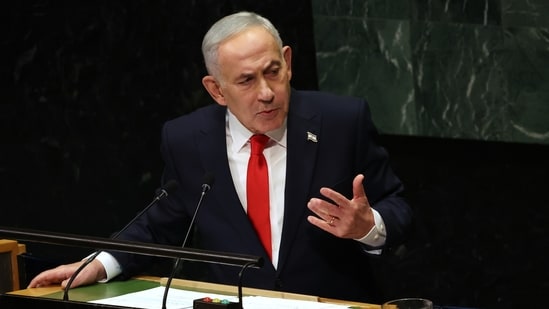
Israeli Prime Minister Benjamin Netanyahu, during his speech at the United Nations General Assembly, acknowledged a gesture from Uganda that carries a personal significance for him.
Israeli Prime Minister Benjamin Netanyahu speaks during the 81st session of the United Nations General Assembly at United Nations headquarters. (AP Photo/Heather Khalifa)
{{^htLoading}} {{/htLoading}}
During his address, Netanyahu paused to thank Uganda for erecting a statue honouring his older brother, Yonatan Netanyahu, at the site where he was killed during the 1976 Entebbe hostage-rescue operation.
What is the significance of the statue of Yonatan Netanyahu in Uganda?
The statue honors Yonatan Netanyahu's legacy, marking the location where he was killed during the 1976 Entebbe hostage-rescue operation, which holds personal significance for his brother, Israeli Prime Minister Benjamin Netanyahu.
Why did Benjamin Netanyahu thank Uganda during his UNGA speech?
Netanyahu paused his speech to express gratitude to Uganda for erecting a statue of his brother, Yonatan Netanyahu, acknowledging the gesture as a tribute to his brother's sacrifice during the Entebbe operation.
How did the Entebbe operation influence Israeli military history?
The Entebbe operation was a pivotal Israeli commando mission to rescue hostages from a hijacked plane in 1976, showcasing Israel's military capability and determination, and it remains a significant historical event linked to the country's identity.
Powered ByAsk HT
Netanyahu’s remarks turned briefly from the wider issues addressed in his speech to the memory of his brother, whose death remains closely connected with the Entebbe operation.
{{^htLoading}} {{/htLoading}}
{{^usCountry}}
He expressed his gratitude to Uganda for placing a statue of Yonatan Netanyahu at the location where he lost his life nearly five decades ago.
{{/usCountry}}
{{#usCountry}}
He expressed his gratitude to Uganda for placing a statue of Yonatan Netanyahu at the location where he lost his life nearly five decades ago.
{{/usCountry}}
“I want to thank Uganda again for recently erecting a statue of Yoni in the place where he fell,” Netanyahu said.
The Entebbe operation was an Israeli commando mission carried out in Uganda in 1976 to rescue passengers held hostage after their flight was hijacked by terrorists. According to details of the operation on idf.il, the hijackers demanded the release of Palestinian prisoners held in Israel as part of their conditions. Israeli commandos launched the rescue mission at Entebbe Airport, where the hostages were being held.
{{^htLoading}} {{/htLoading}}
Benjamin Netanyahu’s older brother, Yonatan Netanyahu, served as the commanding officer of the mission. During the operation, Yonatan was killed while Israeli forces rescued 103 Israeli passengers who had been held hostage. His death became closely associated with the Entebbe rescue mission, and his name has since remained linked to the operation.
The statue of ‘Yoni’ was unveiled in August 2026 to mark the 50th anniversary of the Entebbe operation.
Nearly 50 years after the Entebbe hostage-rescue operation, Yonatan Netanyahu’s memory has been formally marked at the location of his death, with his brother publicly thanking Uganda for the gesture.
{{^htLoading}} {{/htLoading}}
Netanyahu remembered his words "We are going to win he said, we don't have other choice."
Roshan Tony is an early career journalist at Hindustan Times whose. He joined the organisation as an intern before becoming part of the newsroom team. Roshan holds a Master's degree in Mass Communication and Journalism from the Central University of Karnataka and a Postgraduate Diploma in English Journalism from the Indian Institute of Mass Communication (IIMC). His academic interests include critical theories and film studies, and he is particularly interested in developing research that connects media, philosophy and politics. Before joining Hindustan Times, Roshan interned with Mathrubhumi, where he primarily worked on regional news, gaining hands-on experience in newsroom operations, reporting and news production. Beyond journalism, Roshan is a writer and filmmaker with a passion for storytelling across mediums. He has written and directed short fiction films and directed a documentary on the Lavender Revolution in Doda for the Ministry of Information and Broadcasting, exploring the region's socio-economic transformation. His creative interests extend to philosophy, literature and reading, which continue to shape his perspective on journalism and storytelling. He is also interested in developing academic papers that bridge media studies, philosophy and politics. Through his work, Roshan aims to combine accuracy, depth and compelling narratives to produce journalism that informs, resonates and develops readers.
Get the latest World News, breaking headlines and global updates from the US, UK, Pakistan, Bangladesh, Russia and other countries. Follow major international events on Hindustan Times.
Get the latest World News, breaking headlines and global updates from the US, UK, Pakistan, Bangladesh, Russia and other countries. Follow major international events on Hindustan Times.
Home/World News/Netanyahu pauses UNGA speech to thank Uganda for statue honouring his brother Yonatan Netanyahu
{{^htLoading}}
Advertisement
{{/htLoading}}
SHARE THIS ARTICLE ON
{{#usCountry}}{{/usCountry}}
Notifications
Get breaking alerts directly from the newsroom
Notifications are on!You'll be notified when news breaks