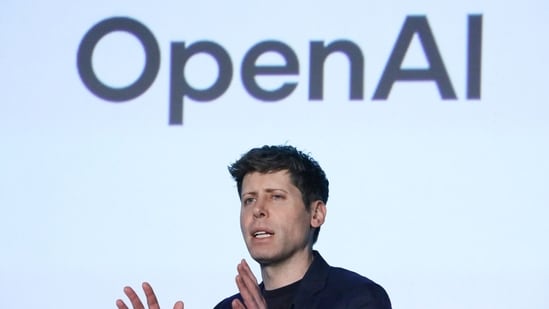
Amid the chaos in US stock markets over Chinese startup DeepSeek, OpenAI chief Sam Altman said on Monday that he has "no plans" to sue the latter, which shook Silicon Valley with its powerful and affordably developed chatbot.
Last week, OpenAI had warned that Chinese companies were pro-actively trying to replicate the US firm's advanced models of artificial intelligence (AI), news agency AFP reported.
ALSO READ | OpenAI's Sam Altman breaks silence on DeepSeek
‘No plans to sue DeepSeek’
"No, we have no plans to sue DeepSeek right now. We are going to just continue to build great products and lead the world with model capability, and I think that will work out fine," Altman told reporters in Tokyo.
Altman described the Chinese startup as an "impressive model". But, he said, "we believe we will continue to push the frontier and deliver great products, so we're happy to have another competitor".
The OpenAI CEO said that there have been many competitors of his firm before as well, adding that "I think it is in everyone's interest for us to push ahead and continue to lead."
ALSO READ | ChatGPT's new tool can do work at level of a ‘research analyst’
{{/usCountry}}The OpenAI CEO said that there have been many competitors of his firm before as well, adding that "I think it is in everyone's interest for us to push ahead and continue to lead."
ALSO READ | ChatGPT's new tool can do work at level of a ‘research analyst’
{{/usCountry}}DeepSeek's performance and abilities sparked a row of accusations which said that the Chinese startup had reverse-engineered the capabilities of top American technology, such as AI-powered ChatGPT.
Notably, OpenAI has said that its rivals are using 'distillation' process, wherein developers creat smaller models to learn from the larger ones by mirroring their behavior and decision-making patterns, similar to how students learn from teachers.
On the other hand, Altman's company in itself is facing several accusations of intellectual property violations, primarily those related to the use of copyrighted materials in training its generative AI models, the AFP report said.
ALSO READ | US Congress warns employees not to install Chinese AI app DeepSeek: Report
Earlier as well, Altman had said that OpenAI will continue to deliver better models. He hinted that his firm would reshuffle its planned releases to keep up with market demands, but ultimately keep its focus on its research roadmap to AGI or artificial general intelligence, a type of AI that matches or surpasses the cognitive capabilities of human beings.
Like Altman said, OpenAI on Monday revealed that a new ChatGPT tool called "deep research", which promises "find, analyse and synthesize hundreds of online sources to create a comprehensive report in tens of minutes vs what would take a human many hours” with just a prompt.
The artificial intelligence (AI) giant claimed that the new tool “accomplishes in tens of minutes what would take a human many hours.”
(with AFP inputs)