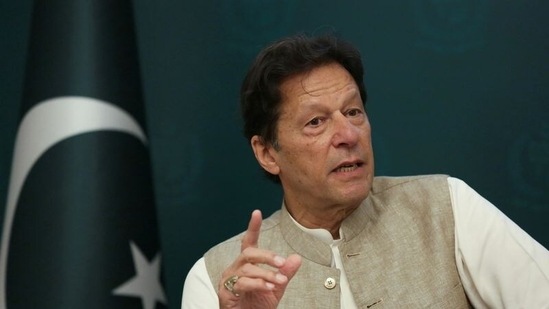
Imran Khan, whose claim to political power was based on the promise of a new Pakistan, seems to be falling behind on one of his vows to make the country's economy stronger, as a recent media report claimed that Pakistan is now facing its biggest economic crisis in history. According to The News International, one of the largest English language newspapers in Pakistan, the country is in the throes of a deep financial crisis – with the Imran Khan-led regime ideally requiring gross external financing of $51.6 billion within a two-year period (2021-2023) in order to fulfill its needs.
Also Read | End in sight for Imran Khan's 'Naya Pakistan' amid rising inflation in Pakistan
As per the report, Pakistan's gross external financing requirement stands at $23.6 billion in 2021-22 and $28 billion in 2022-23. The development comes despite the very conservative estimates assessed by the International Monetary Fund (IMF). Pakistani authorities are now reportedly trying to make a last-ditch effort to strike a staff-level agreement with the IMF to bridge the gap of external financing requirements.
In a recent report, the World Bank noted that Pakistan has joined the list of top ten nations with the largest foreign debts. Citing the International Debt Statistics 2022, The News International reported earlier that there lies a “wide divergence” in the rate at which external debt is accumulated in individual DSSI-eligible countries – including the group's largest borrowers which include Pakistan. The World Bank report also pointed out that Pakistan's foreign debt increased by 8 per cent; in June this year, another report revealed that the Imran government had borrowed $442 million from the World Bank.
However, with the suspension of program loans from the World Bank and Asian Development Bank (ADB) now, Pakistan is further at risk of a monumental economic crisis – with the headache of the gross external financing requirement upon it – to deal with which it needs to anyhow strike a deal with the IMF under the existing $6 billion extended fund facility (EFF) during the ongoing parleys in Washington.
{{/usCountry}}However, with the suspension of program loans from the World Bank and Asian Development Bank (ADB) now, Pakistan is further at risk of a monumental economic crisis – with the headache of the gross external financing requirement upon it – to deal with which it needs to anyhow strike a deal with the IMF under the existing $6 billion extended fund facility (EFF) during the ongoing parleys in Washington.
{{/usCountry}}Also Read | No more assistance to Pakistan, hold Imran Khan accountable now: Ex-US advisor
Meanwhile, the WB and ADB will continue lending project loans but keeping in view the capacity to implement projects, the disbursement becomes dismally low. The credit rating agencies may further downgrade the country's ratings, so generating funds through the issuance of international bonds will become expensive, reported The News International.
The IMF had been asking for the removal of distortions into the taxation system and also pointed out that different GST exemptions and rates should be aligned with the standard rate of 17 per cent, according to officials cited by the ANI news agency The standard GST rate of 17 per cent should be imposed on Petroleum Oil Lubricants (POL) products. The GST rate on fertilizer, tractors and other items should be brought at the standard rate of 17 per cent, as per the report. However, Pakistani authorities are opposing such proposals arguing that it would further marginalise the neglected agricultural sector.