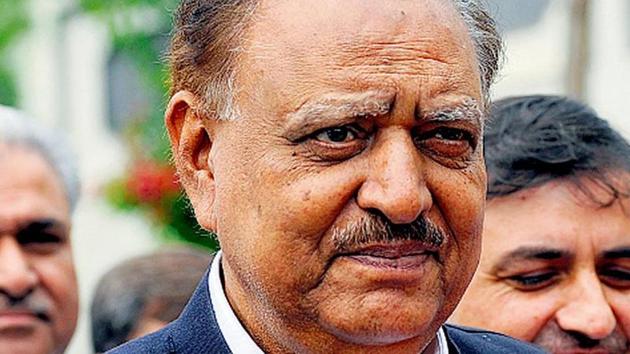
Pakistan President Mamnoon Hussain has promulgated an ordinance to amend the country’s Anti-Terrorism Act to list groups sanctioned by the UN Security Council — including the Jamaat-ud-Dawah (JuD) and the Falah-e-Insaniat Foundation (FIF) — as terror organisations.
The ordinance, promulgated by Pakistan President Mamnoon Hussain late last week, was made public on Monday. (File Photo)
{{^htLoading}} {{/htLoading}}
The ordinance promulgated late last week was made public on Monday. Under the existing provisions of the Anti-Terrorism Act, groups sanctioned by the UN Security Council were not automatically listed as terror organisations in Pakistan. The ordinance amends Sections 11B and 11EE to include groups that have been sanctioned by the UN Security Council.
The move came a week ahead of a crucial meeting of the Financial Action Task Force (FATF) on terror financing in Paris, that will assess Pakistan’s efforts to choke funding to the Lashkar-e-Taiba, JuD, and LeT founder Hafiz Saeed.
The JuD and FiF had not been banned by Pakistan, even though the US and the UN had sanctioned them after the 2008 Mumbai attacks. Both groups were on a “watch list” maintained by Pakistan’s National Counter Terrorism Authority (NACTA).
{{^htLoading}} {{/htLoading}}
{{^usCountry}}
JuD was put on the watch list soon after the Mumbai attacks and FiF was included in the list in 2012.
{{/usCountry}}
{{#usCountry}}
JuD was put on the watch list soon after the Mumbai attacks and FiF was included in the list in 2012.
{{/usCountry}}
The ordinance will also have an impact on the al-Qaeda linked al-Akhtar Trust and al-Rasheed Trust which had already been sanctioned by the UN.
Rezaul Hasan Laskar is Foreign Editor with the Hindustan Times, which he joined in 2015. He began as a journalist in his hometown of Shillong in northeast India and has worked in newspapers and wire services over the years. He moved to New Delhi in 1997 and initially focused on defence, national security, Jammu and Kashmir and the northeast, while also working of foreign policy and international relations. He has been part of the media delegation accompanying PMs on foreign visits and has reported from destinations ranging from Tibet to Ukraine. Between 2007 and 2013, he was the Press Trust of India correspondent in Pakistan, one of only two Indian journalists allowed to report from the country. He extensively covered Pakistan’s domestic politics and the life of the common people, as well as the fallout of the 2008 Mumbai attacks on India-Pakistan relations and the subsequent trial in Pakistan of the suspects involved in the attack. As part of his reportage in Pakistan, he travelled the breadth of the country, from the Swat Valley to Balochistan. Reza’s first gig in journalism was writing a weekly music column, and music – especially classic rock – remains a keen interest. He is also a movie buff and a keen photographer.
Get the latest World News, breaking headlines and global updates from the US, UK, Pakistan, Bangladesh, Russia and other countries. Follow major international events on Hindustan Times.
Get the latest World News, breaking headlines and global updates from the US, UK, Pakistan, Bangladesh, Russia and other countries. Follow major international events on Hindustan Times.