The military chiefs of Pakistan, Saudi Arabia and Turkey, the three signatories of the Mecca defence pact, on Friday reaffirmed their commitment to defend the Kingdom amid repeated attacks from Yemen’s Houthi rebels.
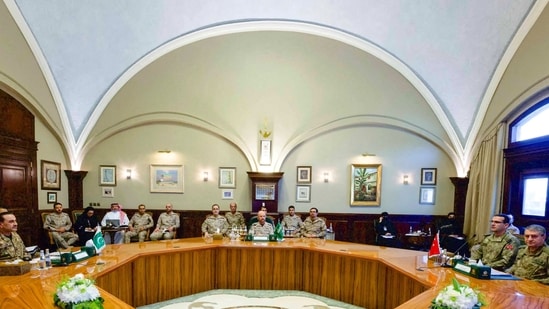
According to statements from Saudi Arabia's Defence Ministry and Pakistan's military, the three military chiefs discussed enhancing intelligence sharing, military coordination and capability integration at a meeting in Riyadh.
The statements said the chiefs of defence forces and chiefs of general staff reviewed the security situation and threats facing Saudi Arabia and condemned attacks by Yemen's Iran-backed Houthis targeting the holy city of Mecca, as well as the kingdom's civilian and economic infrastructure.
The attacks have targeted Saudi cities, energy infrastructure and shipping, adding to pressures on global oil supplies caused by the US-Israeli war on Iran and putting at risk the main alternative Red Sea route for Gulf exports as traffic through the Strait of Hormuz remains largely blocked.
"The chiefs also discussed ways to further advance cooperation among the armed forces of the three countries," the Pakistan military added.
The Mecca Pact
{{/usCountry}}"The chiefs also discussed ways to further advance cooperation among the armed forces of the three countries," the Pakistan military added.
The Mecca Pact
{{/usCountry}}Saudi Arabia, Pakistan and Turkey signed the Makkah Joint Defence Agreement last month, saying an armed attack on any one of the three countries would be regarded as an attack on all. The signatories said the pact was aimed at strengthening collective deterrence and military cooperation.
The pact follows nearly a year of negotiations, and comes as the Iran war exposes Gulf states' security vulnerabilities and disrupts the shipping of oil and other key goods through the Strait of Hormuz.
Pakistan PM flags ‘attacks on Mecca’ as ‘red line’
Pakistan's Prime Minister Shehbaz Sharif said at the UN on Friday that further attacks on the Islamic holy city of Mecca would be a "red line" for Islamabad.
Pakistan maintains ties with Iran, which backs the Houthis responsible for firing missiles at Saudi Arabia, where Mecca is situated. But Islamabad is also strategically close to Saudi.
"We once again condemn, in the strongest possible terms, the recent deplorable attacks by the Houthis against the Kingdom of Saudi Arabia," Sharif said at the UN's gathering of world leaders in New York.
“The attempted drone attack on the holy city of Mecca al-Mukarramah has outraged Muslims across the globe. Any threat to safety and sanctity... is a red line that must never be crossed. No Muslim can even dare to think of committing such a heinous (act),” Sharif said.
Last week, Riyadh accused the Houthis of targeting Mecca for the first time since 2017 with a drone that was downed -- an accusation the Houthis denied. On Saturday, the Saudi-led coalition battling the Houthis said it had intercepted drones and ballistic missiles, as the Iran-backed group launched fresh attacks, including on Riyadh, despite international condemnation.
The United Nations Security Council earlier condemned escalating attacks on Saudi Arabia by Houthi fighters, noting that the strikes have wounded "civilians, including women and children".
A spokesman for the Saudi-led coalition said on Saturday its air defences "intercepted and destroyed two drones launched by the terrorist Houthi militia towards the Riyadh area".
Saudi air defences also intercepted and destroyed two Houthi-launched ballistic missiles targeting Khamis Mushait, a city in the country's southwest that is home to an air base, the spokesman said.
Hezam Al-Assad, a member of the Houthi Political Bureau, said on Saturday that "Despite the operation's strength, scope, and impact, our armed forces view it as merely a small-scale rehearsal for a full-scale escalation."