Changes in India’s neighbourhood, technology and threat perceptions should trigger a review of the country’s nuclear doctrine once a decade, according to former diplomat Rakesh Sood, who served as the prime minister’s envoy on disarmament and non-proliferation.
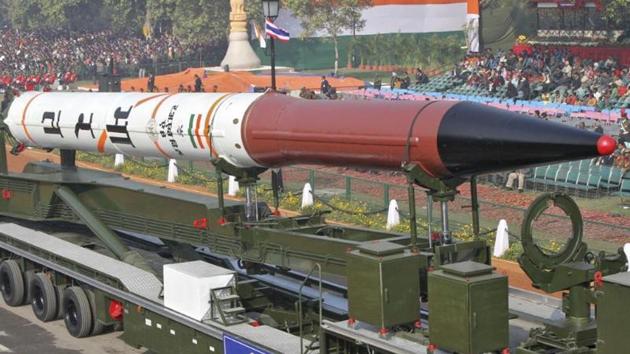
Addressing an event on “India's Nuclear Doctrine and Nuclear Diplomacy” at the International Institute for Strategic Studies (IISS) here on Thursday, Sood, who held several ambassadorial and other senior roles, said that India, as a responsible nuclear weapons state, needs to update its doctrine once a decade.
Insisting that he would not pre-judge such a review, he said: “The credible minimum deterrent, no first use policy and sole purpose would remain intact and ought to remain intact.” This would be a result of India being on its way to “achieving the (nuclear) triad, which is going to constitute the mainstay” of its nuclear deterrent.
The nuclear triad is the nomenclature used to refer to a country’s ability to launch a nuclear-capable missile from land, air or sea.
Sood said once India is in “a position where the triad gets operationalised, then I think that would be an appropriate time to take a look at elements of the doctrine”. He added, “This doesn’t mean you necessarily have to change.
{{/usCountry}}Sood said once India is in “a position where the triad gets operationalised, then I think that would be an appropriate time to take a look at elements of the doctrine”. He added, “This doesn’t mean you necessarily have to change.
{{/usCountry}}“The change depends on a whole host of other technological developments. What happens to missile defence? What happens to the world around us? I think there is a huge element of unpredictability in today’s age. So I would not pre-judge that.”
Sood further said there is a “worrisome doctrinal asymmetry between India and Pakistan”. He added this “is not surprising“ as Pakistan has “developed tactical nuclear weapons geared towards full spectrum deterrence”.
“As Pakistan has a different doctrinal approach, it has a different arsenal. It is important to revive the Lahore MoU talks from 1999, revive certain risk reduction measures to bring stability in the region. It is not enough for Prime Minister (Narendra) Modi just to drop in on surprise visits to wish (Pakistan Prime Minister) Nawaz Sharif on his birthday,” he said, referring to Modi’s visit to Lahore in 2015.
“I do think we need to develop some kind of communication (between India and Pakistan), that to me is critical. A more sustained, substantial dialogue on limited, modest objectives, we are not talking of resolving long-standing differences on Kashmir, but limited, modest objectives that contribute to nuclear stability,” he added.
Noting that the sole purpose of India’s nuclear weapons is to prevent nuclear blackmail and aggression against India, he said New Delhi’s 2003 nuclear doctrine (which states atomic weapons will be used in the event of an attack on Indian territory or on Indian forces anywhere) “did not imply that India would be engaging in nuclear warfighting”.
Rahul Roy-Chaudhury, IISS senior fellow for South Asia, recalled that former defence minister Manohar Parrikar had publicly questioned India’s “no first use” policy but later clarified this was only his “thinking” and India’s nuclear doctrine had not changed.