Former Bangladesh Prime Minister Sheikh Hasina said on Wednesday that although she was forced away from her country in 2024, she was “never separated” from her people.
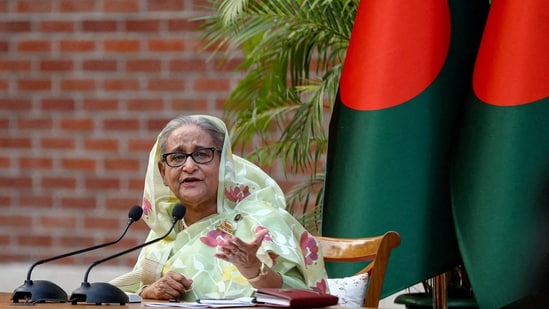
Holding her first press conference in Delhi at a Foreign Correspondents Club of South Asia event, which she joined remotely, Hasina's voice choked repeatedly while remembering her father, family and countrymen who were killed in Bangladesh's war of Liberation and since then.
“For the last two years, I watched my beloved Bangladesh suffer...This is not the Bangladesh we built; this is not the Bangladesh for which 3 million people sacrificed their lives in 1971,” she told the gathering.
She alleged that “organised groups" turned genuine student demands into a “violent political instrument", claiming the movement evolved into a one-point demand seeking her resignation.
"Let me begin with the truth about July and August 2024. It was not a peaceful student movement. From the beginning, my government tried to resolve the issue peacefully through dialogue, legal process, and patience. But behind the language of reform, organised groups were working to turn students' demands into a violent political instrument," she added.
Asked the exact date of her return to Bangladesh, Hasina said that she would reveal the details “when the time comes”.
Bangladesh condemns Hasina's media interaction in New Delhi
{{/usCountry}}Asked the exact date of her return to Bangladesh, Hasina said that she would reveal the details “when the time comes”.
Bangladesh condemns Hasina's media interaction in New Delhi
{{/usCountry}}Reacting sharply to Sheikh Hasina's media interaction in New Delhi, Bangladesh's ministry of foreign affairs said Dhaka was "outraged" that the former prime minister was allowed to address the media from Indian soil.
In a statement posted on X, the ministry said, "Bangladesh is outraged that the absconding convicted genocider Sheikh Hasina was allowed this evening to engage in live interaction with the media in New Delhi where she and her henchmen launched venomous vitriol against the State of Bangladesh and her people."
The ministry said Dhaka had conveyed its concerns to the Government of India in advance about the possible impact of the event on bilateral ties, but the interaction was still allowed to take place.
Government of India's stance
Ahead of the address, the Indian government sought to distance itself from the press event, clarifying that New Delhi does not endorse any statements made during the session.
Ministry of External Affairs (MEA) spokesperson Randhir Jaiswal stated, "The government has no involvement whatsoever in it. Neither does it endorse any views that may be expressed at the forum."
The ministry recently informed a Parliamentary committee that while granting asylum to Hasina, India has strictly maintained its policy, ensuring no political activity targeting another sovereign nation is conducted from Indian territory.
However, Dhaka remains unconvinced after raising the matter with the Indian High Commissioner, Dinesh Trivedi, on Monday. News agency ANI reported, quoting diplomatic sources, that allowing Sheikh Hasina to deliver a political speech could further strain fragile bilateral ties.
What has happened so far since Sheikh Hasina's ouster?
Hasina, 78, has lived in exile in India since fleeing Bangladesh on August 5, 2024, after a student-led uprising ended her 15-year rule. A special tribunal last year sentenced the former prime minister to death in absentia after convicting her of crimes against humanity over the deadly crackdown on the protests.
The United Nations estimates that the violence killed about 1,400 people. Authorities have also banned Hasina’s Awami League party, and she faces multiple additional criminal cases.
“A death sentence, false cases and staged trials cannot frighten me,” Hasina said. She also called the death penalty “part of an illegal, unconstitutional and politically motivated process.”
The Bangladesh Nationalist Party, led by Tarique Rahman, took office earlier this year after winning an election from which Hasina’s party was barred. The new government has taken a legalistic stance on her planned return, insisting she will face justice.
Bangladesh’s Law Minister M. Asaduzzaman said in late July that Hasina would likely be arrested immediately if she returned from India, before she had the opportunity to surrender before a court.
In her written response, Hasina said she did not leave Bangladesh by choice, saying she had “only 30 to 40 minutes” to evacuate her official residence as protesters approached and that she “did not even know I was leaving the country.” She said she had instead prepared to travel to Tungipara, her ancestral hometown.