It was the worst of policies, it was the best of policies; it may not even have been intended as a policy at all. In late summer 2015 as a tide of Syrians, Afghans and others marched towards Europe in search of refuge, Angela Merkel announced that Germany would, in effect, take them all in. The move startled the chancellor’s critics and allies alike. By upending migration policy, had the methodical-to-the-point-of-obstructive leader revealed a rash streak on perhaps the most
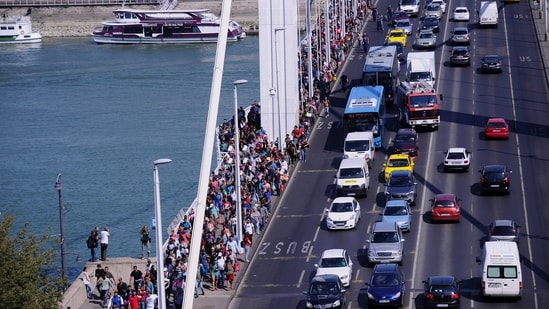
It was the worst of policies, it was the best of policies; it may not even have been intended as a policy at all. In late summer 2015 as a tide of Syrians, Afghans and others marched towards Europe in search of refuge, Angela Merkel announced that Germany would, in effect, take them all in. The move startled the chancellor’s critics and allies alike. By upending migration policy, had the methodical-to-the-point-of-obstructive leader revealed a rash streak on perhaps the most fraught topic in European politics? Mrs Merkel’s answer to both fans and naysayers came in the form of a phrase that came to mark her 16 years as chancellor: Wir schaffen das, We can handle this. Over 1m migrants soon made Germany their home. A decade later Mrs Merkel has been proved right, but in a pyrrhic sort of way. Germany did manage, and better than anyone might have expected. But the costs of doing so have mightily strengthened her political opponents.
The run-up to the anniversary of Mrs Merkel’s proclamation on August 31st was marked by a civic jolt. The Alternative for Germany (AfD), a party marked by such deep-seated xenophobia that the country’s security services have designated it as “extremist”, topped some national polls. (In 2015 it had been a marginal political force too small to get into parliament.) To critics of Wir schaffen das that is the upshot of what they see as Mrs Merkel’s naive kindness to outsiders. Yes, of course Germany could muddle through, as could any rich country of over 80m people taking in a large wave of migrants. But many of the Germans made to do the muddling were not the well-off liberal types on hand to welcome Syrians at train stations with teddy bears and flowers. Rather, the costs fell on those living far from the fashionable bits of Berlin and Munich, whose kids’ classmates now spoke no German. They had expected the state to look out for them, but instead felt patronised by their own chancellor. Today seven in ten Germans feel the state is overwhelmed. The visceral feeling that the authorities were losing control—the stuff of populist politicians’ rhetoric, as Britons well know—took root in 2015.
Those who cheered Mrs Merkel’s approach at the time can feel some vindication too. For them the Willkommenskultur of that summer was an act of national redemption, a moral feather in the German cap. Forget grubby politicking, this had been a case of a leader following her compass, and taking the country along with her. The costs were high—all things worth doing have a cost—but not unmanageable, just as she had said. Doomsday predictions of migrants being on benefits for decades, hobbling the welfare state at the expense of the native-born, proved wide of the mark. Recent data show that around two-thirds of the migrant intake of 2015 now work, not far from the employment rates of native-born Germans (although migrant women have not fared as well). Though costly in terms of benefits, newcomers helped alleviate firms’ concerns of a labour shortage in the German economy.
It wasn’t just Germans, old and new, whom Mrs Merkel had swept up in her bid to welcome the world’s downtrodden. Europe had helped Germany recover from the moral abyss of the second world war, then permitted its unification in 1990. Whether or not she intended it that way, Mrs Merkel was seen as repaying the favour. For the throwing open of borders was a boon not just to migrants, but to Germany’s neighbours, who had no appetite for dealing with the incoming huddled masses. Now they could send them to Germany instead; Hungary’s Viktor Orban helpfully put on buses to help ferry the migrants northward.
Here, Mrs Merkel miscalculated. She had described dealing with migrants as “the next great European project”, the kind of language used for the creation of the euro or the Schengen passport-free travel zone. But demands from Germany that other European Union countries help out by taking their “fair share” of migrants fell on deaf ears. The upshot was that Germany partly reinstated the very border controls that Schengen had abolished. Others followed in time; these days passport checks are rife within the zone. And there was a grubby underside to Mrs Merkel’s principled stand, when she concluded that Germany could not take in thousands of refugees a day indefinitely. The only way to stem the flow of migrants was, in effect, to bribe Europe’s neighbours, notably Turkey, to keep Syrians and others on their territory rather than let them wander to the EU. That has resulted in the bloc toadying to strongmen such as Recep Tayyip Erdogan, when their authoritarian ways should have been called out.
Was it worth it?
Given the shrill tone around migration, it can be hard to draw a nuanced conclusion. It is all too easy to draw wrong ones, however. Pinning the rise of the AfD purely on the events of 2015 is one such case. Even Mrs Merkel has admitted that her “polarising” stand a decade ago had helped the party’s rise. But it was not the only factor. The party’s ideological allies are leading in polls across Europe, including in France and Italy. Germany has a unique history, but it was never likely to be entirely spared the wave of hard-right populism that has enveloped much of the continent.
However one feels about Wir schaffen das, it has aged rather better than Mrs Merkel’s policies that allowed the German economy to become dependent on gas from Russia and exports to China, not to mention her rash shutting-down of its nuclear power plants. Yet a decade on, not much remains of her can-do spirit of 2015. Mrs Merkel’s own party, back in power, has disowned her approach and tightened Germany’s asylum rules. Europe is implementing a “migration pact” that treats asylum-seekers far less kindly. It now looks as though Mrs Merkel spent her political capital on a gamble whose payout turned out to be fleeting. Does that make it a blunder? Perhaps; but a generous and humane one.
Subscribers to The Economist can sign up to our Opinion newsletter, which brings together the best of our leaders, columns, guest essays and reader correspondence.
One Subscription.
Get 360° coverage—from daily headlines
to 100 year archives.
Archives
HT App & Website