
 E-Paper



Trump’s warning of fast reprisal sparks fresh war of words
Late on Sunday, Iran’s state television reported that the country will no longer abide by any of the limits of its 2015 nuclear deal.


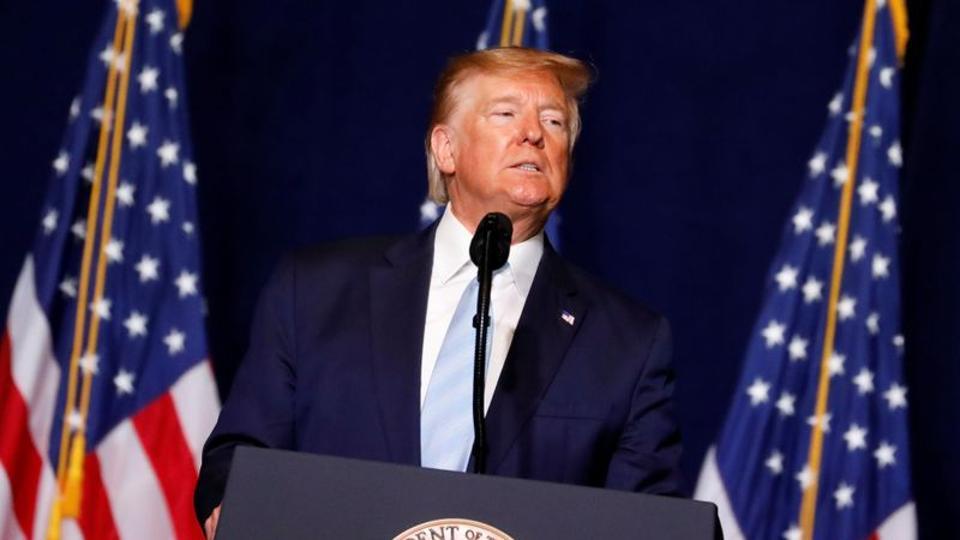
Iran on Sunday warned of military action and called US President Donald Trump a “terrorist in a suit” after he threatened “very fast and very hard” reprisals against any attack on American people or assets in the aftermath of the killing of top military commander Qassem Soleimani, who headed the Islamic Revolutionary Guard Corps.
Late on Sunday, Iran’s state television reported that the country will no longer abide by any of the limits of its 2015 nuclear deal. State TV cited a statement by Iranian President Hassan Rouhani’s administration saying the country will not observe limitations on its enrichment, the amount of stockpiled enriched uranium as well as research and development in its nuclear activities.
Trump, who is holidaying in his private resort in Mara-a-Lago, Florida, earlier said the US military has 52 Iranian targets in its crosshairs, responding reportedly to intelligence that Iranian ballistic missile units were in a heightened state of alert.
“Let this serve as a WARNING that if Iran strikes any Americans, or American assets, we have targeted 52 Iranian sites (representing the 52 American hostages taken by Iran many years ago), some at a very high level & important to Iran & the Iranian culture, and those targets, and Iran itself, WILL BE HIT VERY FAST AND VERY HARD. The USA wants no more threats!,” Trump wrote in a string of tweets on Saturday, referring to the 52 American diplomats and citizens who had been held hostage for 444 days at the US mission in Tehran from November 1979 to January 1981 by Iranian students in support of the Islamic revolution led by Ayatollah Khomeini.
Secretary of state Mike Pompeo said Sunday the US will strike lawful targets, pushing back against criticism that the United States will be targeting Iranian cultural assets, which are protected by an international agreement. The targets are “designed with a singular mission — defending and protecting America”, he added.
Iran’s response was sharp. “Like ISIS [Islamic State], Like [Adolf] Hitler, Like Genghis [Khan]! They all hate cultures. Trump is a terrorist in a suit. He will learn history very soon that NOBODY can defeat ‘the Great Iranian Nation & Culture’,” information and telecommunications minister Mohammad Javad Azari-Jahromi tweeted on Sunday.
The United States killed Soleimani, a leader of an Iran-backed Iraqi militia and five other men in a drone strike outside the international airport in Baghdad on Friday. Soleimani is considered the architect of Tehran’s clandestine and military operations abroad. The attack took long-running hostilities between Washington and Tehran into uncharted territory, and raised the spectre of wider conflict in West Asia. Soleimani was planning “imminent and sinister” attacks on Americans and their military facilities, the US has said. Iranians, their allies and their proxies have responded with expected outrage and have vowed to avenge Soleimani’s assassination. Iranian supreme leader Ayatollah Ali Khamenei promised on Friday that his country would seek harsh revenge. And President Hassan Rouhani assured the general’s relatives “everyone” will step up to it.
The military adviser to Khamenei said on Sunday Iran’s response to the US strike will be military. “The response for sure will be military and against military sites,” Brigadier General Hossein Dehghan told CNN in Farsi, according to a translation by the US news network.
On Sunday, hundreds of thousands of mourners, many chanting, beating their chests and wailing in grief, turned out across Iran to show their respects after Soleimani’s body was returned home to a hero’s welcome.
Iran’s army chief, Major General Abdolrahim Mousavi, was quoted by state television as saying the US lacked the courage for military confrontation with Iran.
Sayyed Hassan Nasrallah, leader of Lebanon’s powerful, Iran-allied Hezbollah movement, said Soleimani’s killing marked “the start of a new phase and new history not just for Iran or Iraq but the whole region”. Hezbollah has had numerous conflicts with US ally Israel, including a month-long war in 2006.
US secretary of state Pompeo said if there were further Iranian attacks on US targets, Washington would respond with lawful strikes against decision-makers orchestrating such attacks.
“The intelligence assessment made clear that no action - allowing Soleimani to continue his plotting and his planning, his terror campaign - created more risk than taking the action that we took last week,” Pompeo said on ABC’s “This Week” show.
He also admitted to the possibility that Iran could try to attack American troops. “We think there is a real likelihood Iran will make a mistake and make a decision to go after some of our forces, military forces in Iraq or soldiers in north-east Syria,” he told Fox News in remarks aired on Sunday. His remarks and Trump’s tweets came against the backdrop of a New York Times report that US intelligence had detected Iranian ballistic missile units in heightened state of alert. The report also said some officials believed it was unclear if the Iranians were dispersing them in anticipation of an American attack or they were being mobilised for a strike against the US.
Also, an Iranian military commander, Brigadier General Gholamali Abuhamzeh, reportedly said on Saturday , “Thirty-five vital American positions in the region are within the reach of the Islamic Republic, and Tel Aviv. The Strait of Hormuz is a vital thoroughfare for the West, and a large number of American destroyers and warships cross the Strait of Hormuz, the Sea of Oman and the Persian Gulf.”
As the two countries assailed each other in a war of words, the European Union, Britain and Oman urged both to make efforts to defuse the crisis even as Iran summoned the Swiss envoy representing US interests in Tehran on Sunday to protest at “Trump’s hostile remarks”.
The United States has deployed 3,500 additional troops to the region and carried out airstrikes on five targets associated with Hezbollah, three targets in Western Iraq and two targets in Eastern Syria. Officials described these facilities as command and control facilities or weapons caches of the militia.
In Iraq, many people, including opponents of Soleimani, have expressed anger at Washington for killing him and Iraqi militia leader Abu Mahdi al-Muhandis on Iraqi soil and potentially dragging their country into another war. Iraq’s Parliament passed on Sunday a resolution telling the government to end the presence of foreign troops in Iraq and ensure they not use its land, air, and waters for any reason. Its foreign ministry also said it had submitted two letters to the United Nations and asked the Security Council to condemn the “assassination” of Soleiman.


