WASHINGTON: It was a stormy meeting. It was hastily-convened. Fault lines were already drawn. But one country stood out with its intervention.
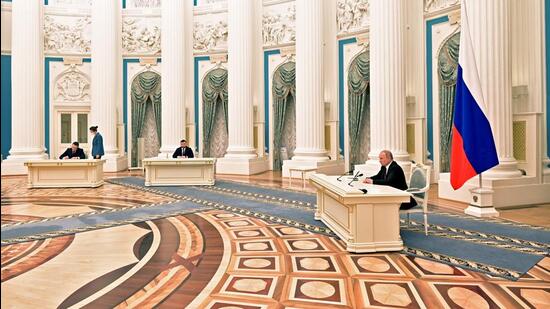
At the United Nations Security Council (UNSC) meeting on Monday night in New York, convened on the request of Ukraine, the United States and its allies forcefully condemned Russia’s decision to recognise two breakaway Ukrainian provinces as republics; Russia slammed the West and put forth the case that President Vladimir Putin had already articulated in a television address; China gave a crisp response which was sympathetic to Russia; and India stuck to its position of ambiguity.
But it was Kenya’s response that drew the most attention, for Nairobi abstained from a procedural vote just three weeks ago on whether Ukraine should even be discussed at the UNSC as a threat to peace and security, as demanded by the West and its allies.
This time, the Kenyan permanent representative to the UN, Martin Kimani, began by acknowledging that diplomacy was failing and they were meeting on the brink of a major conflict in Ukraine. But he took a firm position against the breach of Ukraine’s territorial integrity. “The charter of the United Nations continues to wilt under the relentless assault of the powerful.”
Kenya spoke about the hypocrisy of powers that invoked the charter with reverence and then turned their back on it and said it was “gravely concerned” at Russia’s decision to recognise Donetsk and Luhansk regions of Ukraine as independent states.
And that is when Kenya offered a lesson on borders to the world, and the need to live with those borders – as colonies had, even when those borders were arbitrarily carved out without their consent, even when political borders did not overlap with cultural borders. Russia has often invoked the presence of Russian speakers in eastern Ukraine as a key driver of its actions.
{{/usCountry}}And that is when Kenya offered a lesson on borders to the world, and the need to live with those borders – as colonies had, even when those borders were arbitrarily carved out without their consent, even when political borders did not overlap with cultural borders. Russia has often invoked the presence of Russian speakers in eastern Ukraine as a key driver of its actions.
{{/usCountry}}“Kenya, and almost every African country, was birthed by the ending of the empire. Our borders were not of our own drawing. They were drawn in the distant colonial metropoles of London, Paris and Lisbon with no regard for the ancient nations they cleaved apart,” said Kimani. “Today, across the border of every African country live our countrymen with whom we share deep historical, cultural and linguistic bonds.” But had they chosen to pursue borders on the basis of “ethnic, racial or religious homogeneity”, he reminded the audience, bloody wars would have continued till now.
Kenya said that, instead, it agreed to the borders it inherited and decided to pursue continental political, economic and legal integration.
‘Rather than form nations that looked over backward into history with a dangerous nostalgia, we choose to look over greatness than none of our nations and peoples had ever known.” The reference, in the wake of Russian President Vladimir Putin’s history lessons in his speech on Monday on why Ukraine was never a state and how the West undermined Russia consistently, was hard to miss.
Kenya said that it understood that states formed as a result of the collapse and retreat of empires had people who yearned for integration with people in neighbouring states. “However, Kenya rejects such a yearning from being pursued by force. We must complete our recovery from the embers of dead empires in a way that does not plunge us back into new forms of domination and expression.” Kenya said it rejected “irredentism and expansionism”; it condemned powerful states breaching international law; it declared that multilateralism lay on its deathbed; and it ended by supporting Ukraine once again.
Richard Gowan, the UN director of International Crisis Group, said that African UNSC members agreed with western members that an attack on Ukraine was an attack on UN norms, but singled out Kenya. “Kenya in particular framed this brilliantly in terms of imperialism and colonialism. That was one of the best #UNSC speeches I have heard,” he tweeted.