
 E-Paper



Uphold peace, not the opposite, China tells Quad members ahead of summit
India, the US, Japan and Australia will hold the first meeting of their leaders under the Quad framework on Friday where the discussions are likely to revolve around China


Ahead of the much anticipated Quad leaders’ virtual summit on Friday, China has said that countries involved should uphold the principles of regional peace and stability rather than the opposite in their talks.
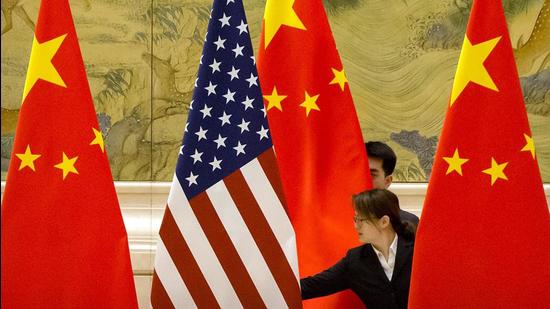
India, the US, Japan and Australia will hold the first meeting of their leaders under the Quad framework on Friday where the discussions are likely to revolve around China.
The US has taken the initiative to set up the meeting, people familiar with developments told HT in New Delhi earlier and Indian Prime Minister Narendra Modi, US President Joe Biden, Japanese PM Yoshihide Suga and Australia’s PM Scott Morrison will take part in the conversation.
Asked to comment on the summit, Chinese foreign ministry spokesperson Zhao Lijian said the countries should keep in mind the common interests of regional nations.
“We believe that any regional cooperation architecture should follow the principle of peaceful development and win-win cooperation, which is the prevailing trend of the times,” Zhao told reporters on Wednesday.
“We hope the relevant countries will keep in mind the common interests of the regional countries uphold the principles of openness, inclusiveness and win-win cooperation and do things that are conducive to regional peace stability and prosperity rather than the opposite,” Zhao added.
Beijing will be closely monitoring the summit, which will attempt to draw up a coordinated strategy for China, a Chinese state media opinion piece said.
“Washington’s aim is to maintain its dominance in the region, while the other three want to prevent China’s rise from affecting their interests,” Yuan Zheng, deputy director of the Institute of American Studies, Chinese Academy of Social Sciences, wrote in the tabloid Global Times.
“India seems to have deviated from its traditional non-alignment policy. As its border disputes with China have not been settled, anti-China voices in India still remain a force. The Modi administration intends to divert attention from its domestic contradictions by underlining China’s threat,” Yuan claimed in the opinion piece.
Media reports from New Delhi on US defence secretary Lloyd Austin’s likely visit to India in mid-March also has been closely followed in China.
Yang Xiyu from the China Institute of International Studies told state media that Washington and New Delhi always have their own interests in their minds.
“The US wants to seize India as weight to retake its hegemony in the Indo-Pacific region and counter China; and India plans to showcase its cooperation with the US to bluff China regarding its influence,” Yang added.
State councillor and foreign minister Wang Yi had called it the “so-called Indo-Pacific new Nato”.
Wang was quoted in a statement by the Chinese foreign ministry as saying that the “Indo-Pacific strategy” proposed by the US is in essence aimed at building a so-called Indo-Pacific “new Nato” underpinned by the quadrilateral mechanism involving the United States, Japan, India and Australia.
“The strategy is to trumpet the old-fashioned Cold War mentality to stir up confrontation among different groups and blocs and to stoke geopolitical competition, in a bid to maintain the dominance and hegemonic system of the United States,” Wang was quoted as saying during a visit to Malaysia last October.


