Could a new era of big infrastructure developments accelerate growth?
Published on: Jul 24, 2026, 19:30:04 IST
The Economist
Prefer HTon Google
Share via
Copy link
For years Lamu, on the coast of northern Kenya, was a tantalising symbol of unrealised promise. The Lamu Port-South Sudan-Ethiopia-Transport (LAPSSET) Corridor, a colossal scheme estimated to cost $25bn, is supposed to connect a deep-water Kenyan port with markets in Ethiopia and oilfields in South Sudan via a pipeline, railway and motorway. Launched in 2012, it was touted as Africa’s most ambitious infrastructure undertaking. Yet 14 years later only the port near Lamu is operational—and for most of the time since the first ships docked there in 2021, just barely. “When it began it was very quiet,” concedes Abdulaziz Mzee, the port’s manager.
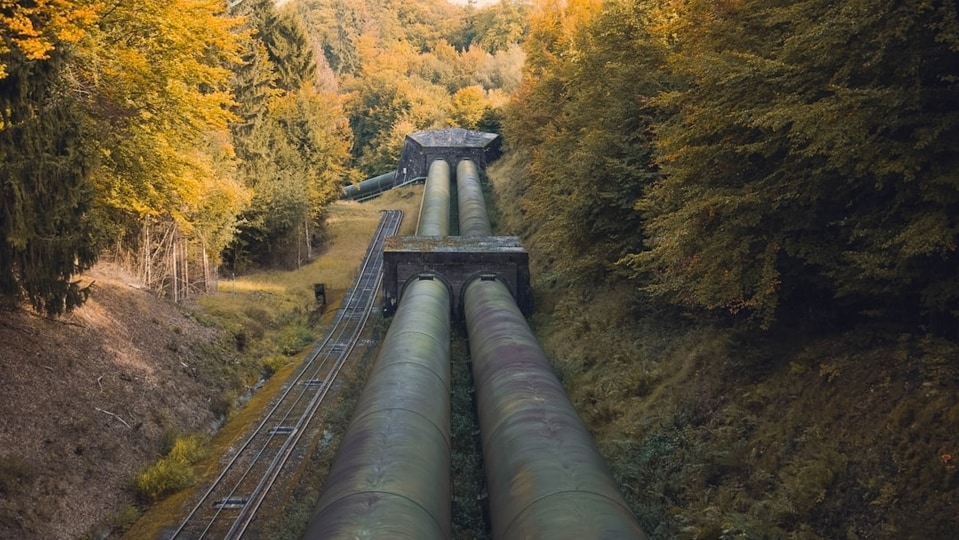
The immediate reason is the war in Iran. Scores of vessels bound for the Persian Gulf have been rerouted to Lamu’s relative sanctuary since February. (Unsplash)
Now, though, Lamu’s port is stirring from its slumber and plans for the corridor are being dusted off. The immediate reason is the war in Iran. Scores of vessels bound for the Persian Gulf have been rerouted to Lamu’s relative sanctuary since February. Yet the renewed discussion of LAPSSET is also a sign of a wider shift in thinking among African policymakers and some investors. Africa is entering a new era of “megaprojects”, schemes costing billions of dollars and affecting millions of people. The question is whether it will accelerate growth or saddle the continent with more white elephants.
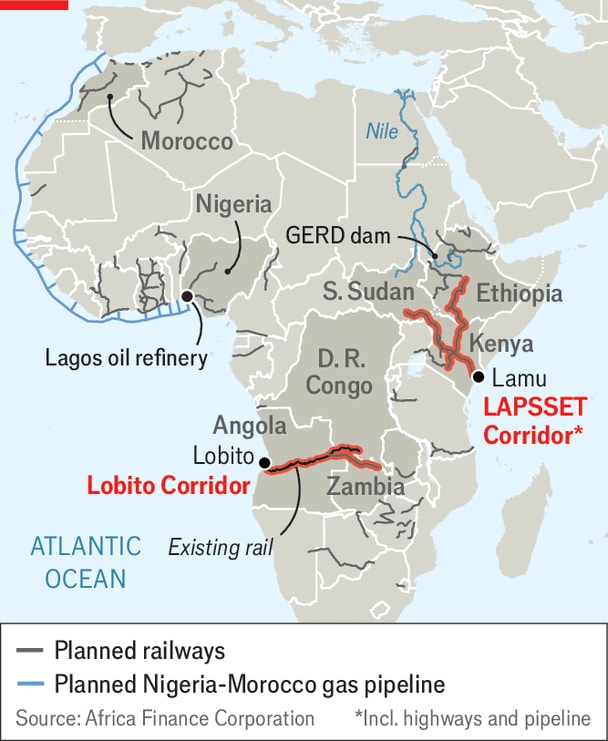
Map
Three ventures in particular explain the buzz. In 2025 Ethiopia completed the Grand Ethiopian Renaissance Dam (GERD), Africa’s largest hydropower plant. A year earlier Aliko Dangote, a Nigerian industrialist and the continent’s richest man, started production at a $20bn oil refinery near Lagos, Nigeria’s commercial capital. Then there is the Lobito Corridor, a multi-billion-dollar rail, port and road system which is set to link Angola’s Atlantic coast to Congo’s copper belt and, eventually, Zambia (see map). The scheme is backed by both America and the EU.
Bright Simons of Imani, a think-tank in Ghana, reckons the ambition of African policymakers “has gone up dramatically”. In January Ethiopia broke ground on a new airport estimated to cost at least $12.5bn. Nigeria is stepping up long-dormant plans for a $15bn west African transport corridor. On July 19th west African leaders said construction could begin in 2028 on a $25bn gas pipeline along the coast from Nigeria to Morocco, where it may connect to Europe’s gas supply. Railway development in Africa is speeding up, according to the Africa Finance Corporation (AFC), a pan-African lender, with some 7,000km under construction and development, more than twice as much as between 2020 and 2024.
Much of this is needed. The OECD, a club of mostly rich countries, reckons that to double Africa’s total GDP by 2040 the continent would need to spend $155bn (around 5.6% of GDP) per year on infrastructure—nearly twice the annual average from 2016 to 2020 and slightly below the share China was spending at home in the early 2010s (6.7% of GDP). Yet aid cuts and debts are squeezing government finances. In 2025 African countries were projected to pay $89bn servicing their debts. That was before the Iran war pushed up interest rates (higher oil prices cushioned the effect in oil-exporting countries, but squeezed finances even more in others).
Private capital is thus required to fill the gap. Between 2021 and 2024 the total amount of private finance raised across all industries in Africa each year rose steadily from $13.2bn to $20.4bn. Overall, Africa attracted about $70bn in foreign direct investment in 2025, the third-highest level since 1990. Philippe Valahu of the Private Infrastructure Development Group says last year was the best for his donor-backed fund, which focuses on Africa and Asia, since it was launched nearly 25 years ago. Despite global crises, this year “the amount of business we are seeing just continues to increase,” he adds.
There are several reasons to expect the push to continue. One is what Sameh Shenouda of the AFC calls the “demonstration effect” of successful schemes like the Dangote refinery. Another is global volatility, particularly in energy markets. Infrastructure that could reduce vulnerability to external shocks appears more urgent.
Take Lamu. James Mwangi, the boss of Equity Bank, a Kenyan lender, argues that LAPSSET has “been given a tailwind by the crisis in the Middle East”. On July 7th Mr Dangote said he would build east Africa’s largest oil refinery in Kenya, a decision fast-tracked by the need to curb the region’s dependence on fuel imported from the Gulf. The area around Lamu’s port is reported to be his favoured site.
Competition between China and America has also given large infrastructure investments a boost. America’s International Development Finance Corporation (DFC) is backing the Lobito Corridor with $550m in the hope of prising the region’s exports of critical minerals away from China. American diplomats are also keen for the DFC to invest in Ethiopia’s new airport, partly to help American construction firms get ahead of Chinese rivals.
Multilateral lenders have had a change of heart, too. In the post-independence era institutions like the World Bank backed lots of grand modernising projects in Africa, before backing away for decades after many failed to take off or became mired in corruption scandals. These days, notes Ndiame Diop, the World Bank’s vice-president for eastern and southern Africa, “the risk appetite for big projects” is higher.
Yet big projects are still controversial. Battles over land use and the environment tend to be especially fierce. On July 7th Ugandan farmers lodged a court case in London to stop a $5.6bn oil pipeline to the Tanzanian coast, arguing it threatens water and ecosystems (the pipeline’s operating company is registered in Britain).
Such projects also tend to be delayed and more costly than advertised; by one estimate, some 90% go over budget. In Africa that risk may be higher because of what Mr Simons calls the “corridor premium”: the additional cost incurred by the uniquely severe shortage of infrastructure. For a single project to succeed, he argues, an integrated corridor of power, roads and the like must be in place first. If one piece is missing, the whole scheme can fall apart.
That does not mean the new projects are doomed. Jean-Luc Konan of Neemba, a pan-African industrial group that worked on Guinea’s Simandou mining complex, notes that delivering infrastructure “forces you to build long-term domestic capacity”. A country’s ability to execute and sustain big projects can thus grow over time. Ambition alone, however, will never be enough.
Sign up to the Analysing Africa, a weekly newsletter that keeps you in the loop about the world’s youngest—and least understood—continent.
Get the latest World News, breaking headlines and global updates from the US, UK, Pakistan, Bangladesh, Russia and other countries. Follow major international events on Hindustan Times.

 E-Paper





 Prefer HTon Google