E-Paper


Artemis II update: Astronauts break Apollo 13's record; name lunar crater after Reid Wiseman’s late wife Carroll
Artemis II astronauts made history by traveling farther from Earth than ever before.


Four astronauts aboard NASA's Artemis II mission have made history, travelling farther from Earth than any humans before them while getting a breathtaking look at parts of the moon that even the Apollo astronauts never clearly saw.
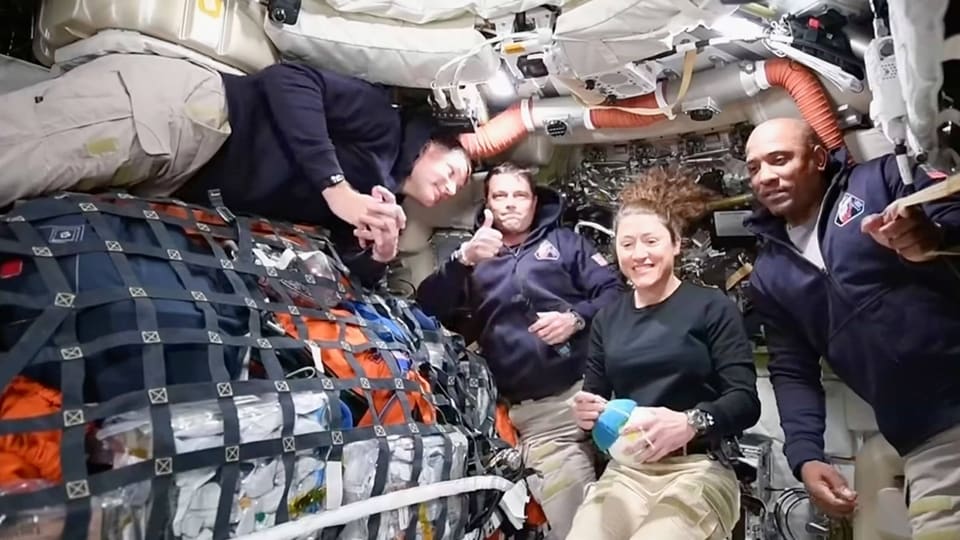
On Monday, the Artemis II crew surpassed the previous distance record of 248,655 miles (400,171 kilometers) set by Apollo 13 back in April 1970 and kept going. By the time the flyby was complete, Mission Control expected the crew to have beaten that old record by more than 4,100 miles (6,600 kilometers), with NASA estimating the maximum distance from Earth would exceed 406,000 kilometers.
"It is blowing my mind what you can see with the naked eye from the moon right now. It is just unbelievable," Canadian astronaut Jeremy Hansen radioed back to Earth ahead of the flyby. He went on to challenge "this generation and the next to make sure this record is not long-lived."
Also Read: Artemis II astronauts ready for Moon flyby on fifth day of historic mission
Emotional moments during the mission
Soon after breaking the record, the crew asked permission to name two newly seen lunar craters. They suggested “Integrity,” after their capsule, and “Carroll,” in memory of commander Reid Wiseman’s late wife.
The moment was emotional, with Wiseman in tears as Hansen made the request, and the crew embracing.
“Such a majestic view out here,” Wiseman said.
The astronauts also received a wake-up message recorded by Apollo 13 commander Jim Lovell before his death last year. “Welcome to my old neighborhood,” he said. “It’s a historic day and I know how busy you’ll be, but don’t forget to enjoy the view.”
How close did they get?
Commander Reid Wiseman, Jeremy Hansen, pilot Victor Glover, and Christina Koch came as close as about 6,550 kilometers to the Moon. Their Orion spacecraft flew past it, made a U-turn and then started heading back to Earth. At the closest point, they were moving at around 3,139 mph (5,052 kph).
Hansen explained the view in a simple way, saying the Moon looked about the size of a basketball held at arm’s length.
As the spacecraft went behind the Moon, it lost contact with Earth for about 40 minutes because the Moon blocked radio signals. For a little over five hours, the astronauts took turns looking at and taking pictures of the Moon’s surface, including craters, old lava flows, and other features that have never been seen this clearly before.
Also Read: Artemis II update: Toilet trouble in space? What 4 NASA astronauts are doing amid mission
What comes next?
Artemis 2 is following the same path used by Apollo 13 after its oxygen tank explosion. This path is called a free-return lunar trajectory which uses the gravity of Earth and the Moon to guide the spacecraft back home without needing much fuel. It creates a figure-eight path in space that naturally brings the crew back toward Earth.
The four astronauts are expected to land in the Pacific Ocean near San Diego on Friday, nine days after launching from Florida last Wednesday.
This is NASA’s first crewed mission to the Moon since Apollo 17 in 1972. The mission is meant to prepare for future Moon landings. Artemis III, planned for next year will involve another crew practicing docking with lunar landers in space. The main goal is Artemis IV in 2028, when two astronauts are expected to land near the Moon’s south pole for the first time in more than 50 years.
Pilot Victor Glover spoke about the meaning of the mission during Christianity’s Holy Week. He described Earth as a small, special place in space and said, “This is an opportunity for us to remember where we are, who we are, and that we are the same thing and that we've got to get through this together.”
A mission worth billions
Artemis II is part of NASA’s larger Artemis program which has already cost more than $90 billion and could go over $100 billion.
Each launch, including Artemis II is expected to cost over $4 billion because of the advanced technology needed for deep space travel.
The mission is mainly funded by the US government with help from international partners and private companies. This makes it one of the most expensive space programs since the Apollo missions.