
 E-Paper


Scientists create humanoid robot with ‘living’ skin that can smile. Watch
“By mimicking human skin-ligament structures, we found a way to bind skin to complex structures,” Professor Shoji Takeuchi said

 Prefer HTon Google


Japanese researchers have created an alien-like robot with “living” skin. What looks like a pink blob with beady eyes is actually a humanoid robot bound with engineered skin tissue that allows it to smile. The University of Tokyo announced the successful experiment by Professor Shoji Takeuchi-led group of researchers on Wednesday, June 26.
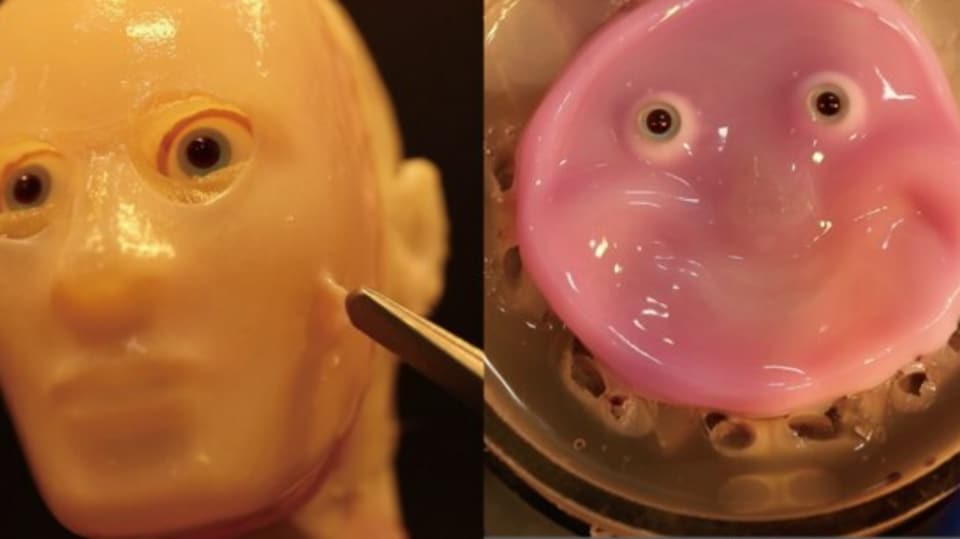
Scientists create humanoid robot with ‘living’ skin
Takeuchi explained how he and his team succeeded in creating a humanoid robot with “living” skin by drawing inspiration from his previous experiments. “During previous research on a finger-shaped robot covered in engineered skin tissue we grew in our lab, I felt the need for better adhesion between the robotic features and the subcutaneous structure of the skin,” he said.
ALSO READ: World champion diver goes on ‘no female’ extreme slide, waterpark responds after sexism accusations
“By mimicking human skin-ligament structures and by using specially made V-shaped perforations in solid materials, we found a way to bind skin to complex structures. The natural flexibility of the skin and the strong method of adhesion mean the skin can move with the mechanical components of the robot without tearing or peeling away,” Takeuchi continued.
“In this study, we managed to replicate human appearance to some extent by creating a face with the same surface material and structure as humans,” said Takeuchi, who holds expertise in the field of biohybrid robotics, where biology and mechanical engineering meet.
ALSO READ: Israeli hostage Noa Argamani speaks out for first time since her rescue: ‘I'm home now, but…’
“Additionally, through this research, we identified new challenges, such as the necessity for surface wrinkles and a thicker epidermis to achieve a more humanlike appearance.” “We believe that creating a thicker and more realistic skin can be achieved by incorporating sweat glands, sebaceous glands, pores, blood vessels, fat and nerves.”
“Of course, movement is also a crucial factor, not just the material, so another important challenge is creating humanlike expressions by integrating sophisticated actuators, or muscles, inside the robot,” he explained. “Creating robots that can heal themselves, sense their environment more accurately and perform tasks with humanlike dexterity is incredibly motivating.”


