
 E-Paper


Solar eclipse 2024: City-wise guide to best times in the path of totality in US
Your city-wise guide to witness the solar eclipse in United States on April 8, 2024.

 Prefer HTon Google


The eagerly anticipated solar eclipse is approaching, and astronomy enthusiasts are preparing to witness this spectacular celestial event. The "path of totality," where the sun is completely obscured by the moon, offers the most dramatic views of the eclipse. Below are the start times, peak times, and end times for totality in several U.S. cities located in the path of totality:
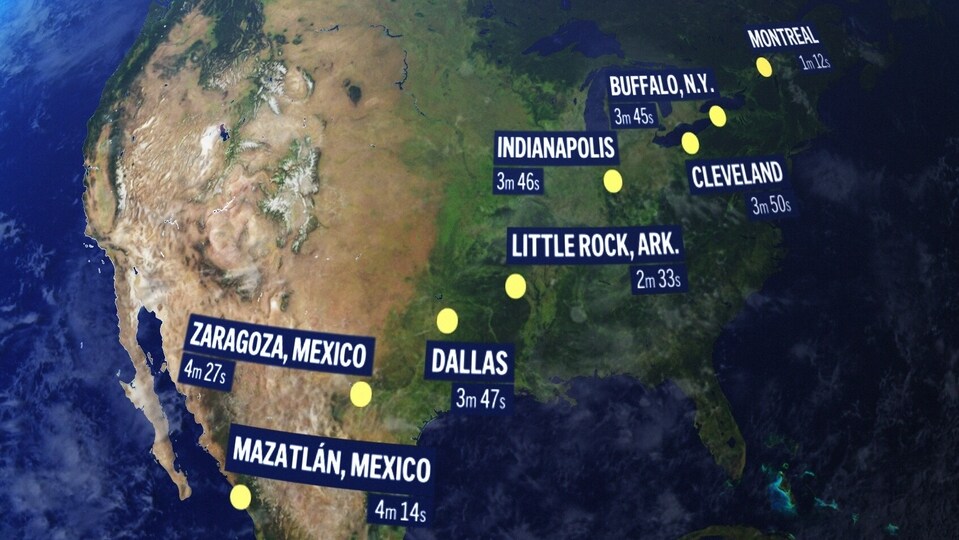
Understanding Totality: Why It's Important and When to Watch
Totality, the phase when the sun is completely covered by the moon, will begin approximately at 11:07 a.m. PDT/1:07 p.m. EDT in Mexico and end in Maine around 1:30 p.m. PDT/3:30 p.m. EDT, according to NASA.
For specific timings of the partial eclipse and totality in your region, refer to the table below or enter your zip code [here](#link).
While a partial solar eclipse will be visible throughout the contiguous United States, those outside the direct path can still witness this extraordinary event, weather permitting.
Also Read: When is Eid? How will solar eclipse impact moon sighting?
Solar Eclipse: Central Daylight Time (CDT) Zone
Dallas, Texas: The partial eclipse begins at 12:23 p.m., with totality starting at 1:40 p.m., reaching its maximum at 1:42 p.m., ending at 1:44 p.m., and the partial eclipse concluding at 3:02 p.m.
Idabel, Oklahoma: The partial eclipse starts at 12:28 p.m., with totality beginning at 1:45 p.m., reaching its peak at 1:47 p.m., concluding at 1:49 p.m., and the partial eclipse ending at 3:06 p.m.
Little Rock, Arkansas: The partial eclipse commences at 12:33 p.m., with totality beginning at 1:51 p.m., reaching its climax at 1:52 p.m., concluding at 1:54 p.m., and the partial eclipse finishing at 3:11 p.m.
Poplar Bluff, Missouri: The partial eclipse starts at 12:39 p.m., with totality beginning at 1:56 p.m., reaching its peak at 1:56 p.m., concluding at 2:00 p.m., and the partial eclipse ending at 3:15 p.m.
Paducah, Kentucky: The partial eclipse begins at 12:42 p.m., with totality starting at 2:00 p.m., reaching its maximum at 2:01 p.m., concluding at 2:02 p.m., and the partial eclipse finishing at 3:18 p.m.
Carbondale, Illinois: The partial eclipse starts at 12:42 p.m., with totality beginning at 1:59 p.m., reaching its peak at 2:01 p.m., concluding at 2:03 p.m., and the partial eclipse ending at 3:18 p.m.
Evansville, Indiana: The partial eclipse commences at 12:45 p.m., with totality starting at 2:02 p.m., reaching its climax at 2:04 p.m., concluding at 2:05 p.m., and the partial eclipse finishing at 3:20 p.m.
Also Read: A Guide to Solar Eclipse 2024
Solar Eclipse: Eastern Daylight Time (EDT) Zone
Cleveland, Ohio: The partial eclipse begins at 1:59 p.m., with totality starting at 3:13 p.m., reaching its maximum at 3:15 p.m., concluding at 3:17 p.m., and the partial eclipse ending at 4:29 p.m.
Erie, Pennsylvania: The partial eclipse starts at 2:02 p.m., with totality beginning at 3:16 p.m., reaching its peak at 3:18 p.m., concluding at 3:20 p.m., and the partial eclipse finishing at 4:30 p.m.
Buffalo, New York: The partial eclipse commences at 2:04 p.m., with totality starting at 3:18 p.m., reaching its climax at 3:20 p.m., concluding at 3:22 p.m., and the partial eclipse ending at 4:32 p.m.
Burlington, Vermont: The partial eclipse begins at 2:14 p.m., with totality starting at 3:26 p.m., reaching its maximum at 3:27 p.m., concluding at 3:29 p.m., and the partial eclipse finishing at 4:37 p.m.
Lancaster, New Hampshire: The partial eclipse starts at 2:16 p.m., with totality beginning at 3:27 p.m., reaching its peak at 3:29 p.m., concluding at 3:30 p.m., and the partial eclipse ending at 4:38 p.m.
Caribou, Maine: The partial eclipse commences at 2:22 p.m., with totality starting at 3:32 p.m., reaching its climax at 3:33 p.m., concluding at 3:34 p.m., and the partial eclipse finishing at 4:40 p.m.
Also Read: Solar Eclipse: How will the celestial event impact psychology
For those planning to witness this rare event, the best time and location within the path of totality would depend on individual preferences and accessibility. Whether you're in the heart of Texas or the northeast corner of Maine, don't miss out on this awe-inspiring natural phenomenon. Remember to use proper eye protection when viewing the eclipse to prevent any damage to your eyes.


